• HOME
  • NEWS
  • EXPLORE
    • CAREER
      • Companies
      • Jobs
    • EVENTS
    • iGEM
      • News
      • Team
    • PHOTOS
    • VIDEO
    • WIKI
  • BLOG
  • COMMUNITY
    • FACEBOOK
    • INSTAGRAM
    • TWITTER
Thursday, July 16, 2026
BIOENGINEER.ORG
No Result
View All Result
  • Login
  • HOME
  • NEWS
  • EXPLORE
    • CAREER
      • Companies
      • Jobs
        • Lecturer
        • PhD Studentship
        • Postdoc
        • Research Assistant
    • EVENTS
    • iGEM
      • News
      • Team
    • PHOTOS
    • VIDEO
    • WIKI
  • BLOG
  • COMMUNITY
    • FACEBOOK
    • INSTAGRAM
    • TWITTER
  • HOME
  • NEWS
  • EXPLORE
    • CAREER
      • Companies
      • Jobs
        • Lecturer
        • PhD Studentship
        • Postdoc
        • Research Assistant
    • EVENTS
    • iGEM
      • News
      • Team
    • PHOTOS
    • VIDEO
    • WIKI
  • BLOG
  • COMMUNITY
    • FACEBOOK
    • INSTAGRAM
    • TWITTER
No Result
View All Result
Bioengineer.org
No Result
View All Result
Home NEWS Science News Chemistry

A survey on optical memory and optical RAM technologies

Bioengineer by Bioengineer
July 21, 2020
in Chemistry
Reading Time: 2 mins read
0
IMAGE
Share on FacebookShare on TwitterShare on LinkedinShare on RedditShare on Telegram

IMAGE

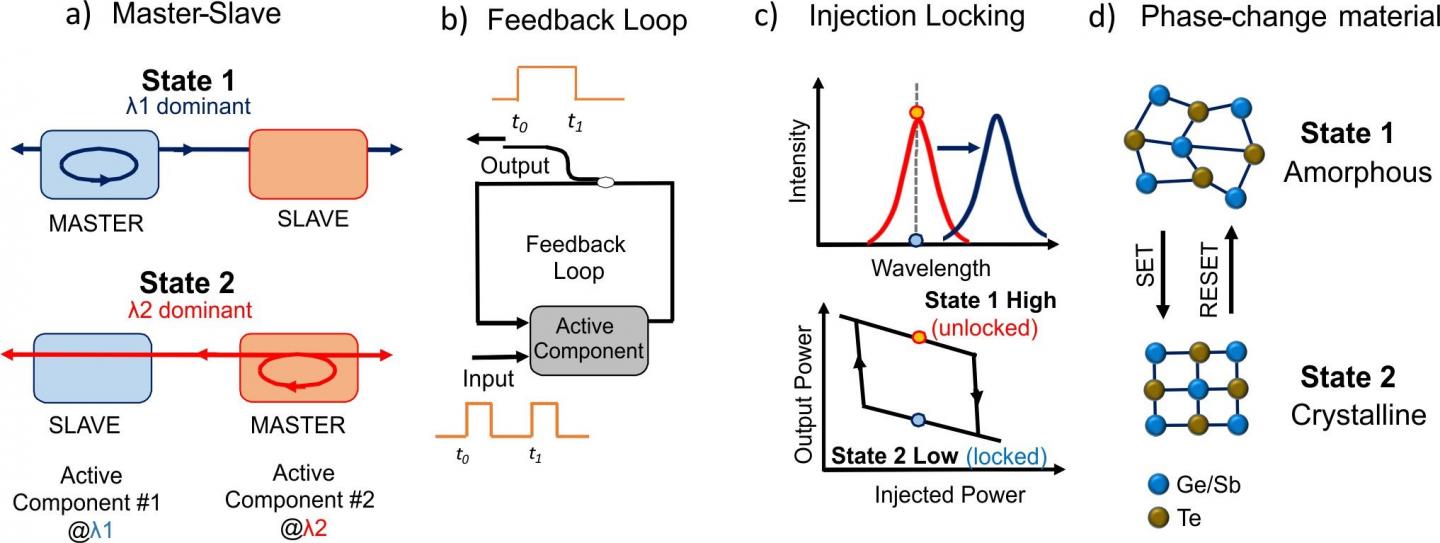
Credit: by Alexoudi, T., Kanellos, G.T. & Pleros, N.

Over the past decades, “storing light” has appeared as a rather controversial statement, given that a photon’s inherent nature hinders its spatial confinement. The first research efforts in demonstrating optical memory functionality started as a fascinating experimental exercise and two decades later the remarkable achievements of integrated optical memories and optical random access memories (RAMs) introduced a new roadmap for light-based information storage that can offer fast access times, high bandwidth and seamless cooperation with optical interconnect lines.

In a new paper published in Light Science & Application, a team of three Greek researchers, Dr. Theoni Alexoudi and Prof. Nikos Pleros from Department of Informatics of Aristotle University of Thessaloniki in Greece together with their co-worker Prof. George T. Kanellos from Bristol University in UK have evaluated the progress witnessed in the optical memory domain over the past 25 years. Their article provides a thorough analysis on the state-of-the-art integrated optical memory technologies and optical RAMs, shedding light on the physical mechanisms behind demonstrated optical memory devices. In the same analysis, optical memory implementations are also being classified and evaluated via their performance metrics highlighting the benefits of different optical technologies. The authors provide a comprehensive guide for the transition from elementary optical memory units towards advanced memory functionalities such as optical RAM operation and report recent achievements towards this direction. Finally, an analysis is presented for the next steps that optical memory technologies must undertake to release a viable and practical alternative memory roadmap.

These scientists summarize some of the key-findings of their review study:

“Optical memories have gradually penetrated into multiple application sectors that include processing, routing, and computing however, modern memory applications call for advanced memory schemes with random access functionality on top of the simple storage mechanism.”

“Optical memories have witnessed an impressive progress in terms of footprint. Their footprint reduced by 12-orders-of-magnitude going from m2 to μm2 during the last 20 years while at the same time electronic counterparts were reduced only by 3 orders-of-magnitude.” they added.

“Optical memory integration roadmap has to be shaped around a high-yield and low-cost fabrication technology allowing for dense optical memory architectures to arrive at scales, complexities and cost-efficiencies similar to those of their electronic counterparts.” the scientist forecast.

###

Media Contact
Theoni Alexoudi
[email protected]

Related Journal Article

http://dx.doi.org/10.1038/s41377-020-0325-9

Tags: Chemistry/Physics/Materials SciencesOptics
Share13Tweet8Share2ShareShareShare2

Related Posts

AI and Quantum Chemistry Reveal Dual-Modulated Catalysts for Next-Gen Fuel Cells

AI and Quantum Chemistry Reveal Dual-Modulated Catalysts for Next-Gen Fuel Cells

July 16, 2026
Bioinspired Hierarchical Hydrogel Electrolyte Enables Ultralong-Life Flexible Zinc Batteries

Bioinspired Hierarchical Hydrogel Electrolyte Enables Ultralong-Life Flexible Zinc Batteries

July 16, 2026

Terminal Groups Enable Tunable, Versatile MXene Materials

July 16, 2026

Ions Move Through Solid Crystals Like Liquid Flow

July 16, 2026
Please login to join discussion

POPULAR NEWS

  • New Drug Candidate Developed at McMaster Shows Potential for Treating Brain Cancer

    58 shares
    Share 23 Tweet 15
  • Scientists Overcome Antimicrobial Resistance in Bacteria Linked to Cystic Fibrosis

    42 shares
    Share 17 Tweet 11
  • Porcine Heart Transplant

    50 shares
    Share 20 Tweet 13
  • A varied menu

    51 shares
    Share 22 Tweet 12

About

We bring you the latest biotechnology news from best research centers and universities around the world. Check our website.

Follow us

Recent News

Mean Reversion Explains Why Geomagnetic Storms Become Saturated

Researchers expand twistronics limits by pushing twist angles further than ever

AI and Quantum Chemistry Reveal Dual-Modulated Catalysts for Next-Gen Fuel Cells

Subscribe to Blog via Email

Enter your email address to subscribe to this blog and receive notifications of new posts by email.

Join 85 other subscribers
  • Contact Us

Bioengineer.org © Copyright 2023 All Rights Reserved.

Welcome Back!

Login to your account below

Forgotten Password?

Retrieve your password

Please enter your username or email address to reset your password.

Log In
No Result
View All Result
  • Homepages
    • Home Page 1
    • Home Page 2
  • News
  • National
  • Business
  • Health
  • Lifestyle
  • Science

Bioengineer.org © Copyright 2023 All Rights Reserved.