• HOME
  • NEWS
  • EXPLORE
    • CAREER
      • Companies
      • Jobs
    • EVENTS
    • iGEM
      • News
      • Team
    • PHOTOS
    • VIDEO
    • WIKI
  • BLOG
  • COMMUNITY
    • FACEBOOK
    • INSTAGRAM
    • TWITTER
Sunday, May 10, 2026
BIOENGINEER.ORG
No Result
View All Result
  • Login
  • HOME
  • NEWS
  • EXPLORE
    • CAREER
      • Companies
      • Jobs
        • Lecturer
        • PhD Studentship
        • Postdoc
        • Research Assistant
    • EVENTS
    • iGEM
      • News
      • Team
    • PHOTOS
    • VIDEO
    • WIKI
  • BLOG
  • COMMUNITY
    • FACEBOOK
    • INSTAGRAM
    • TWITTER
  • HOME
  • NEWS
  • EXPLORE
    • CAREER
      • Companies
      • Jobs
        • Lecturer
        • PhD Studentship
        • Postdoc
        • Research Assistant
    • EVENTS
    • iGEM
      • News
      • Team
    • PHOTOS
    • VIDEO
    • WIKI
  • BLOG
  • COMMUNITY
    • FACEBOOK
    • INSTAGRAM
    • TWITTER
No Result
View All Result
Bioengineer.org
No Result
View All Result
Home NEWS Science News Chemistry

A RUDN University physicist simplified the Einstein-lovelock theory for black holes

Bioengineer by Bioengineer
October 5, 2020
in Chemistry
Reading Time: 3 mins read
0
IMAGE
Share on FacebookShare on TwitterShare on LinkedinShare on RedditShare on Telegram

IMAGE

Credit: RUDN University

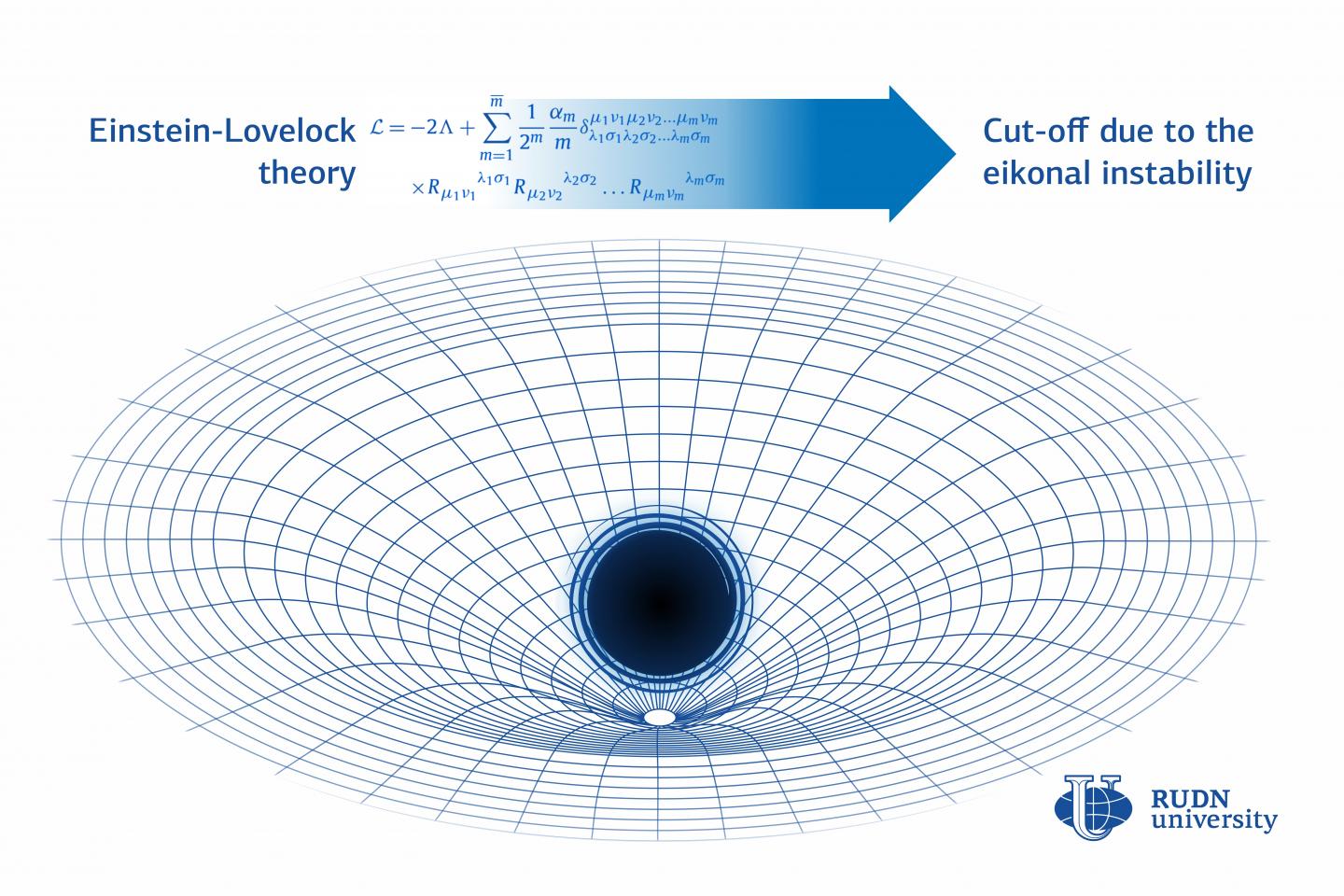
Allowing for quantum corrections, the Einstein-Lovelock theory describes black holes with an equation that contains an infinite number of terms. However, according to a RUDN University physicist, the geometry of a black hole in this theory can be presented in a compact form, and a limited number of terms can suffice to describe the observed values. This could help scientists study black holes in theories with quantum corrections to Einstein’s equations. The work was published in the Physics Letters B journal.

Einstein’s general theory of relativity predicted the existence of black holes–supermassive objects in the Universe that attract everything, including light. Black holes are described by many mathematical models, one of which is the Einstein-Lovelock theory that imposes quantum corrections to elaborate on the general theory of relativity. In it, a black hole is described by a sum of an infinite number of terms. However, a physicist from RUDN University confirmed that a limited number of terms can suffice to describe the effects observed in the vicinity of a black hole. Other components of the equation have a negligibly small contribution that can be ignored. This would considerably simplify calculations and help researchers study black holes in theories with quantum corrections.

According to Einstein’s theory, heavy objects warp space-time–a 4D construction that has three spatial and one temporal dimension. In 1971, Lovelock generalized this theory to include any number of dimensions. The Einstein-Lovelock equation is an infinite sum: the first two terms in it are Einstein’s representation, and each subsequent one details the space-time curvature.

Each term in the Einstein-Lovelock equation is multiplied by the so-called coupling constant. According to the physicist from RUDN University, if one sticks to the positive values of coupling constants, high curvature corrections can be ‘cut off’. This is due to the fact that each coupling constant has a critical value: after it is reached, a black hole becomes unstable, i.e. unable to exist in reality. Such a representation is still possible from the point of view of mathematics but has no physical sense. The more terms, the lower is the critical value for coupling constants. Therefore the stability of a black hole (i.e. the possibility of its physical existence) can be used as a criterion to remove redundant terms.

“With every new Lovelock’s term, the critical value of coupling constants becomes lower. This is an important observation: it confirms that in order to find the biggest possible correction to black hole geometry caused by a newly added Lovelock’s term, all other terms can be considered negligibly small,” said Roman Konoplya, a researcher at the Academic Research Institute for Gravitation and Cosmology, RUDN University.

According to the scientist and his team, the main observable values (such as the radius of a black hole shadow) remain virtually unchanged when the Lovelock corrections of higher than the fourth order in curvature are included. These findings can be useful not only for studying processes in the black holes but also for confirming theoretical predictions associated with possible generalizations of Einstein’s theory.

###

Media Contact
Valeriya Antonova
[email protected]

Related Journal Article

http://dx.doi.org/10.1016/j.physletb.2020.135607

Tags: AstrophysicsChemistry/Physics/Materials SciencesGeophysics/Gravity
Share12Tweet8Share2ShareShareShare2

Related Posts

Miniature Sensor Uses Light to Detect Touch — Chemistry

Miniature Sensor Uses Light to Detect Touch

May 8, 2026
Iron Minerals Determine Whether Dissolved Organic Matter Fuels Microbes or Becomes Long-Term Carbon Storage — Chemistry

Iron Minerals Determine Whether Dissolved Organic Matter Fuels Microbes or Becomes Long-Term Carbon Storage

May 8, 2026

Kate Evans Appointed Associate Lab Director for Biological and Environmental Systems Science at ORNL

May 8, 2026

Advancing Multiscale Modeling and Overcoming Operational Challenges in Autothermal COâ‚‚-to-Methanol Reactors

May 8, 2026
Please login to join discussion

POPULAR NEWS

  • Research Indicates Potential Connection Between Prenatal Medication Exposure and Elevated Autism Risk

    840 shares
    Share 336 Tweet 210
  • New Study Reveals Plants Can Detect the Sound of Rain

    727 shares
    Share 290 Tweet 181
  • Scientists Investigate Possible Connection Between COVID-19 and Increased Lung Cancer Risk

    68 shares
    Share 27 Tweet 17
  • Salmonella Haem Blocks Macrophages, Boosts Infection

    61 shares
    Share 24 Tweet 15

About

We bring you the latest biotechnology news from best research centers and universities around the world. Check our website.

Follow us

Recent News

Evaluating Digoxin Use in Patients with Symptomatic Rheumatic Heart Disease

Evaluating the Effectiveness and Safety of Digitalis Glycosides in Treating Heart Failure

Urdu Fall Risk Questionnaire Adapted for Elderly

Subscribe to Blog via Email

Success! An email was just sent to confirm your subscription. Please find the email now and click 'Confirm' to start subscribing.

Join 82 other subscribers
  • Contact Us

Bioengineer.org © Copyright 2023 All Rights Reserved.

Welcome Back!

Login to your account below

Forgotten Password?

Retrieve your password

Please enter your username or email address to reset your password.

Log In
No Result
View All Result
  • Homepages
    • Home Page 1
    • Home Page 2
  • News
  • National
  • Business
  • Health
  • Lifestyle
  • Science

Bioengineer.org © Copyright 2023 All Rights Reserved.