• HOME
  • NEWS
  • EXPLORE
    • CAREER
      • Companies
      • Jobs
    • EVENTS
    • iGEM
      • News
      • Team
    • PHOTOS
    • VIDEO
    • WIKI
  • BLOG
  • COMMUNITY
    • FACEBOOK
    • INSTAGRAM
    • TWITTER
Friday, July 10, 2026
BIOENGINEER.ORG
No Result
View All Result
  • Login
  • HOME
  • NEWS
  • EXPLORE
    • CAREER
      • Companies
      • Jobs
        • Lecturer
        • PhD Studentship
        • Postdoc
        • Research Assistant
    • EVENTS
    • iGEM
      • News
      • Team
    • PHOTOS
    • VIDEO
    • WIKI
  • BLOG
  • COMMUNITY
    • FACEBOOK
    • INSTAGRAM
    • TWITTER
  • HOME
  • NEWS
  • EXPLORE
    • CAREER
      • Companies
      • Jobs
        • Lecturer
        • PhD Studentship
        • Postdoc
        • Research Assistant
    • EVENTS
    • iGEM
      • News
      • Team
    • PHOTOS
    • VIDEO
    • WIKI
  • BLOG
  • COMMUNITY
    • FACEBOOK
    • INSTAGRAM
    • TWITTER
No Result
View All Result
Bioengineer.org
No Result
View All Result
Home NEWS Science News Chemistry

A route to ultra-fast amplitude-only spatial light modulation using phase-change materials

Bioengineer by Bioengineer
August 9, 2023
in Chemistry
Reading Time: 2 mins read
0
Why is it important not to affect the optical phase?
Share on FacebookShare on TwitterShare on LinkedinShare on RedditShare on Telegram

A team of researchers from the Center for Research and Innovation in Metamaterials at the University of Exeter and the Laser Processing Group at the Institute of Optics have presented in the journal Advanced Optical Materials a one-of-a-kind spatial light modulator capable of of performing a potentially ultra-fast, amplitude-only modulation without modifying the optical phase. This innovative technology is based on the use of chalcogenide phase change materials, and achieves improvements that could be exploited in fields such as wavefront shaping experiments, communications, detection and grayscale imaging.
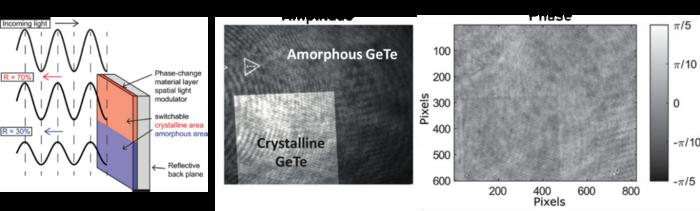
Why is it important not to affect the optical phase?

Credit: IO-CSIC

A team of researchers from the Center for Research and Innovation in Metamaterials at the University of Exeter and the Laser Processing Group at the Institute of Optics have presented in the journal Advanced Optical Materials a one-of-a-kind spatial light modulator capable of of performing a potentially ultra-fast, amplitude-only modulation without modifying the optical phase. This innovative technology is based on the use of chalcogenide phase change materials, and achieves improvements that could be exploited in fields such as wavefront shaping experiments, communications, detection and grayscale imaging.

The device consists of a thin GeTe layer, and operates like a reconfigurable mirror where by changing the material between its amorphous and crystalline states, a gradual change of the amplitude of the reflected light becomes accesible without modifying the optical phase.

Discrete, amplitude-only modulation of light can increase the degrees of freedom of wavefront shaping experiments, by combining such devices with their phase-only counter-parts based on liquid crystals.

The experimental results show an absolute intensity modulation of 38% (relative modulation of 233%), with a minimal shift in the optical phase of less than ≈π/50 along the measured areas. Moreover, the cycling of GeTe and other chalcogenides of its family is inherently fast, offering rapid transition rates of the order of nanoseconds or less (i.e. faster than current liquid cristal technologies).

The research team stresses that this work paves the way for the development of a new class of ultrafast, non-volatile, and energy-efficient spatial amplitude modulators. In addition, the device ease of fabrication combined with its inerently rapid switching speeds would allow its integration in electrically controlled pixelated devices.


Journal

Advanced Optical Materials

DOI

10.1002/adom.202300765

Share12Tweet8Share2ShareShareShare2

Related Posts

Artificial Intelligence Transforms Material Synthesis Methods

Artificial Intelligence Transforms Material Synthesis Methods

July 10, 2026
Computer Chip Uses Vibrations for Memory Storage

Computer Chip Uses Vibrations for Memory Storage

July 10, 2026

Rapid Screening Advances Discovery of Nanocrystals

July 10, 2026

New Eco-Friendly Method Developed for Alcohol Oxidation

July 10, 2026

POPULAR NEWS

  • Detection of EDCs in Breast Milk and Infant Urine Up to Six Months Highlights Early Exposure Risks

    77 shares
    Share 31 Tweet 19
  • New Drug Candidate Developed at McMaster Shows Potential for Treating Brain Cancer

    58 shares
    Share 23 Tweet 15
  • KTU Researchers Explore Ultrasound’s Role in Enhancing Blood Flow Beyond Diagnostics

    53 shares
    Share 21 Tweet 13
  • 高齢者の骨粗鬆症治療の持続性比較

    51 shares
    Share 20 Tweet 13

About

We bring you the latest biotechnology news from best research centers and universities around the world. Check our website.

Follow us

Recent News

Delirium Rates in German Nursing Homes Revealed in New Study

Unraveling How General Anesthesia Works at the Molecular Level

First Clinical Trial of Stem Cell Therapy for Huntington’s Disease Announced

Subscribe to Blog via Email

Enter your email address to subscribe to this blog and receive notifications of new posts by email.

Join 84 other subscribers
  • Contact Us

Bioengineer.org © Copyright 2023 All Rights Reserved.

Welcome Back!

Login to your account below

Forgotten Password?

Retrieve your password

Please enter your username or email address to reset your password.

Log In
No Result
View All Result
  • Homepages
    • Home Page 1
    • Home Page 2
  • News
  • National
  • Business
  • Health
  • Lifestyle
  • Science

Bioengineer.org © Copyright 2023 All Rights Reserved.