• HOME
  • NEWS
  • EXPLORE
    • CAREER
      • Companies
      • Jobs
    • EVENTS
    • iGEM
      • News
      • Team
    • PHOTOS
    • VIDEO
    • WIKI
  • BLOG
  • COMMUNITY
    • FACEBOOK
    • INSTAGRAM
    • TWITTER
Friday, April 17, 2026
BIOENGINEER.ORG
No Result
View All Result
  • Login
  • HOME
  • NEWS
  • EXPLORE
    • CAREER
      • Companies
      • Jobs
        • Lecturer
        • PhD Studentship
        • Postdoc
        • Research Assistant
    • EVENTS
    • iGEM
      • News
      • Team
    • PHOTOS
    • VIDEO
    • WIKI
  • BLOG
  • COMMUNITY
    • FACEBOOK
    • INSTAGRAM
    • TWITTER
  • HOME
  • NEWS
  • EXPLORE
    • CAREER
      • Companies
      • Jobs
        • Lecturer
        • PhD Studentship
        • Postdoc
        • Research Assistant
    • EVENTS
    • iGEM
      • News
      • Team
    • PHOTOS
    • VIDEO
    • WIKI
  • BLOG
  • COMMUNITY
    • FACEBOOK
    • INSTAGRAM
    • TWITTER
No Result
View All Result
Bioengineer.org
No Result
View All Result
Home NEWS Science News Chemistry

A red future for improving crop production?

Bioengineer by Bioengineer
September 28, 2020
in Chemistry
Reading Time: 2 mins read
0
IMAGE
Share on FacebookShare on TwitterShare on LinkedinShare on RedditShare on Telegram

IMAGE

Credit: Lawrence Atkin

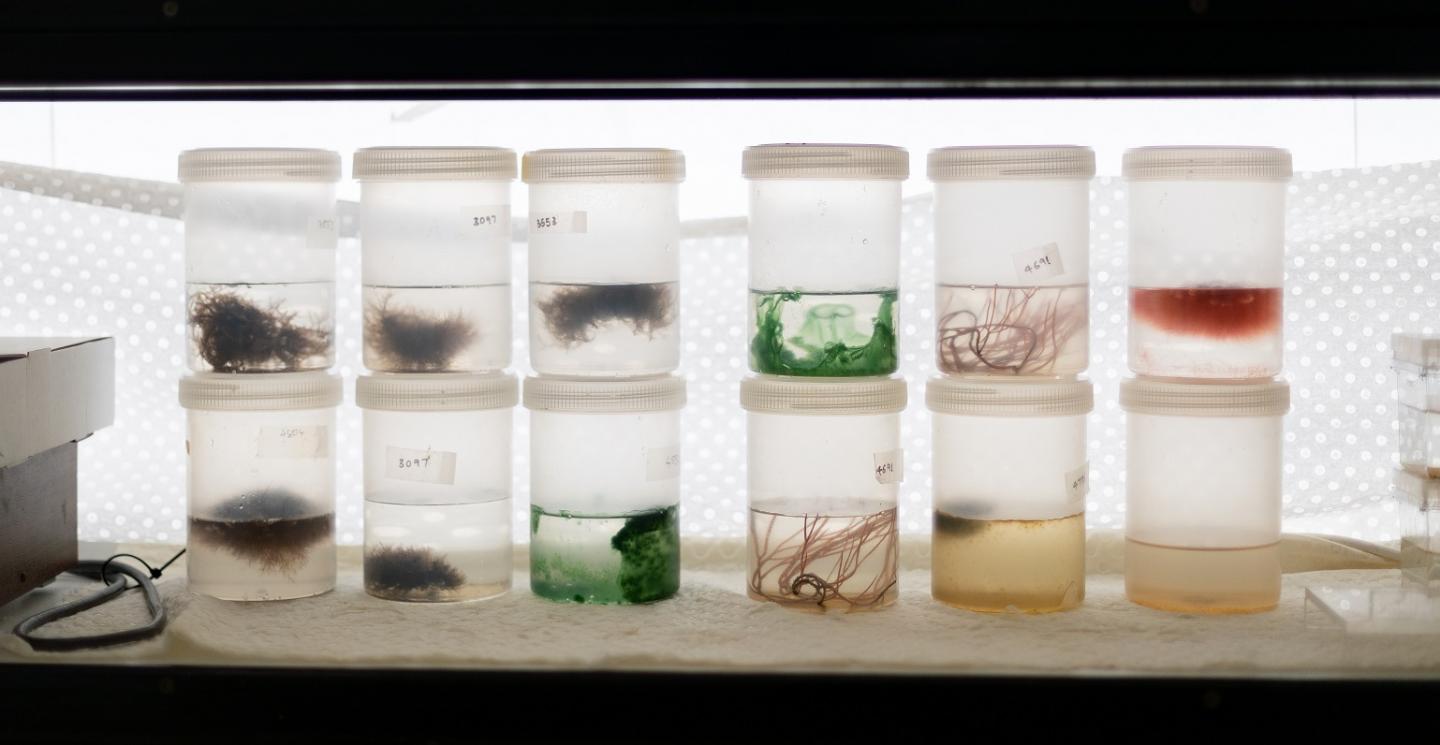
Researchers have found a way to engineer more efficient versions of the plant enzyme Rubisco by using a red-algae-like Rubisco from a bacterium.

For 50 years scientists have striven to boost the activity of Rubisco, a promising target to increase crop production as it controls how much and how fast plants fix carbon dioxide from the atmosphere into sugars and energy during photosynthesis.

“We discovered 20 years ago that red algae can produce more efficient versions of Rubisco than those found in plants but we have been frustrated by not being able to produce algae Rubisco in plants,” says lead researcher Professor Spencer Whitney, from the ARC Centre of Excellence for Translational Photosynthesis (CoETP) at The Australian National University (ANU).

The challenge of assembling more efficient Rubiscos – like the ones found in red-algae – inside crop plants stems from the complicated construction process needed to put together Rubiscos’ sixteen protein components. To hurdle this obstacle, Professor Whitney and his team turned their attention to the red-algae-like Rubisco from the photosynthetic bacterium Rhodobacter sphaeroides.

This work, published in the Proceedings of the National Academy of Sciences (PNAS), found that the red Rubisco of this bacterium meets all the criteria to be accepted inside plants chloroplasts.

“As the assembly requirements of this red Rubisco are relatively simple, we found that plants could make lots of it,” says co-author Dr Elena Martin-Avila.

“We also found that we needed to introduce its matching Rubisco activase, an enzyme in charge of unclogging the catalytic sites of Rubisco. The effect of co-introducing it is that the rates of photosynthesis and plant growth are stimulated two-fold,” remarks Dr Martin-Avila.

“Another very exciting result of our study is that we can now test how well modified versions of the red-Rubisco can be produced in plants by first expressing it in Escherichia coli, a bacterium used in laboratory testing,” explains co-author Dr Laura Gunn.

“The beauty of this is it allows us to rapidly identify better-performing versions of the red Rubisco before introducing into plants, a process that is both time-consuming and costly,” she says.

“We are already well on the way to doubling the CO2-fixation rate of this already very fast bacterial red-Rubisco using laboratory evolution. Our next step is to see how well the evolved red Rubisco isoforms can stimulate crop photosynthesis, growth and yield,” says Professor Whitney.

###

This research has been funded by the Australian Research Council (ARC) Centre of Excellence for Translational Photosynthesis (CoETP), led by the Australian National University, which aims to improve the process of photosynthesis to increase the production of major food crops such as sorghum, wheat and rice.

Media Contact
Natalia Bateman
[email protected]

Tags: AgricultureBacteriologyBiochemistryBiologyBiotechnologyCell BiologyGeneticsMolecular BiologyPlant Sciences
Share12Tweet8Share2ShareShareShare2

Related Posts

Vessel-Controlled Chemodivergence in Enantioconvergent Rearrangement

Vessel-Controlled Chemodivergence in Enantioconvergent Rearrangement

April 17, 2026
Paired Enzymes Drive Moldable Ring Cyclization Cascades

Paired Enzymes Drive Moldable Ring Cyclization Cascades

April 17, 2026

Student-Led Experiment Establishes New Limits in the Search for Axions

April 17, 2026

NIST Offers New Insights into the Enigma of the Gravitational Constant

April 16, 2026
Please login to join discussion

POPULAR NEWS

  • Scientists Investigate Possible Connection Between COVID-19 and Increased Lung Cancer Risk

    62 shares
    Share 25 Tweet 16
  • NSF funds machine-learning research at UNO and UNL to study energy requirements of walking in older adults

    100 shares
    Share 40 Tweet 25
  • Boosting Breast Cancer Risk Prediction with Genetics

    47 shares
    Share 19 Tweet 12
  • Popular Anti-Aging Compound Linked to Damage in Corpus Callosum, Study Finds

    46 shares
    Share 18 Tweet 12

About

We bring you the latest biotechnology news from best research centers and universities around the world. Check our website.

Follow us

Recent News

Regulatory Dendritic Cells Enable Early Drug Withdrawal in Liver Transplants

Politics Shapes Our Climate Future

Vessel-Controlled Chemodivergence in Enantioconvergent Rearrangement

Subscribe to Blog via Email

Enter your email address to subscribe to this blog and receive notifications of new posts by email.

Join 79 other subscribers
  • Contact Us

Bioengineer.org © Copyright 2023 All Rights Reserved.

Welcome Back!

Login to your account below

Forgotten Password?

Retrieve your password

Please enter your username or email address to reset your password.

Log In
No Result
View All Result
  • Homepages
    • Home Page 1
    • Home Page 2
  • News
  • National
  • Business
  • Health
  • Lifestyle
  • Science

Bioengineer.org © Copyright 2023 All Rights Reserved.