WASHINGTON, March 21, 2023 – 3D-printing food could address global challenges in food supply and nutrition. But there are hurdles involved in adapting additive manufacturing to produce edible materials.
Credit: Ezgi Pulatsu and Chibuike Udenigwe
WASHINGTON, March 21, 2023 – 3D-printing food could address global challenges in food supply and nutrition. But there are hurdles involved in adapting additive manufacturing to produce edible materials.
In Physics of Fluids, from AIP Publishing, University of Ottawa researchers Ezgi Pulatsu and Chibuike Udenigwe identify a range of factors that affect the print quality and shape complexity of food created with additive manufacturing. Accounting for these features can increase food quality, improve control, and speed up printing.
Additive manufacturing of food involves designing (3D shapes and their geometric codes), pre-processing (food ink preparation), manufacturing (deposition of layers to create shapes), and post-processing (baking, boiling, cooking, freezing, frying, or drying). Each step is an opportunity to create innovative foods.
Changing the printing patterns and ingredients of the initial mix or paste can affect the food’s matrix and microstructures and therefore its texture.
The flow of that mix in additive manufacturing is also crucial and is sometimes encouraged or discouraged by controlling ingredients and process conditions.
“Extrusion-based 3D printing is the most applicable technique for food,” said Pulatsu. “It involves a syringe loaded with a food paste – such as puree, dough, or frosting – being forced out of a nozzle by direct (pushing the plunger) or indirect force (compressed air).”
Creating a stable continuous flow is the first step to successful printing, so designed shapes can be produced by layering stringlike material in a controlled way.
“Once a layer is deposited, we no longer want it to flow; otherwise, it will destroy the shape we created,” said Pulatsu.
Post-processing – through baking, boiling, cooking, freezing, frying, or drying – physically and chemically transforms the food’s micro- and macromolecules and leads to various textures and tastes. At the same time, the shape should be conserved or carefully controlled.
“We also have other mechanisms of creating food structures via different 3D-printing techniques,” Pulatsu said. “For example, material jetting uses liquid binders deposited on powder to form self-supporting layers, and liquid inks that harden after deposition can also be used.”
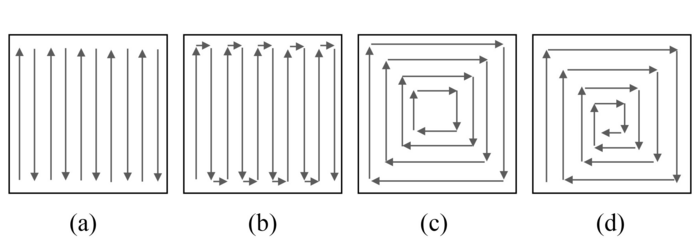
One way to make additive manufacturing more efficient for the food industry is by establishing a printing path (a series of computer-controlled movements), which is often skipped for food applications.
“Future studies should explore the cost efficiency of different technologies in terms of build time, where shape complexity and toolpath strategies – which involve the printing path, moving head speed, and nonprinting movements – are also considered,” said Pulatsu. “Food is essential to living, and it’s becoming more critical due to the increasing global population and environmental changes. Therefore, novel foods and matrices should be designed in consultation with chefs, food scientists, and engineers, and in line with current needs.”
###
The article “Perspectives, analyses, and progress in additive manufacturing of food” is authored by Ezgi Pulatsu and Chibuike Udenigwe. It will appear in Physics of Fluids on March 21, 2023 (DOI: 10.1063/5.0137328). After that date, it can be accessed at https://aip.scitation.org/doi/10.1063/5.0137328.
ABOUT THE JOURNAL
Physics of Fluids is devoted to the publication of original theoretical, computational, and experimental contributions to the dynamics of gases, liquids, and complex fluids. See https://aip.scitation.org/journal/phf.
###
Journal
Physics of Fluids
DOI
10.1063/5.0137328
Article Title
Perspectives, analyses, and progress in additive manufacturing of food
Article Publication Date
21-Mar-2023