• HOME
  • NEWS
  • EXPLORE
    • CAREER
      • Companies
      • Jobs
    • EVENTS
    • iGEM
      • News
      • Team
    • PHOTOS
    • VIDEO
    • WIKI
  • BLOG
  • COMMUNITY
    • FACEBOOK
    • INSTAGRAM
    • TWITTER
Monday, August 31, 2026
BIOENGINEER.ORG
No Result
View All Result
  • Login
  • HOME
  • NEWS
  • EXPLORE
    • CAREER
      • Companies
      • Jobs
        • Lecturer
        • PhD Studentship
        • Postdoc
        • Research Assistant
    • EVENTS
    • iGEM
      • News
      • Team
    • PHOTOS
    • VIDEO
    • WIKI
  • BLOG
  • COMMUNITY
    • FACEBOOK
    • INSTAGRAM
    • TWITTER
  • HOME
  • NEWS
  • EXPLORE
    • CAREER
      • Companies
      • Jobs
        • Lecturer
        • PhD Studentship
        • Postdoc
        • Research Assistant
    • EVENTS
    • iGEM
      • News
      • Team
    • PHOTOS
    • VIDEO
    • WIKI
  • BLOG
  • COMMUNITY
    • FACEBOOK
    • INSTAGRAM
    • TWITTER
No Result
View All Result
Bioengineer.org
No Result
View All Result
Home NEWS Science News

A quark like no other

Bioengineer by Bioengineer
January 18, 2017
in Science News
Reading Time: 3 mins read
0
Share on FacebookShare on TwitterShare on LinkedinShare on RedditShare on Telegram
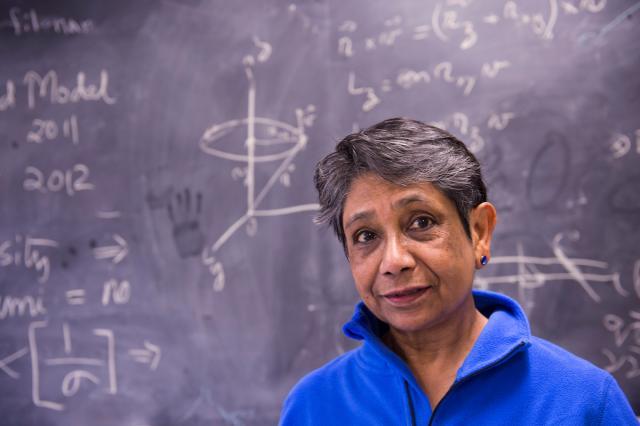
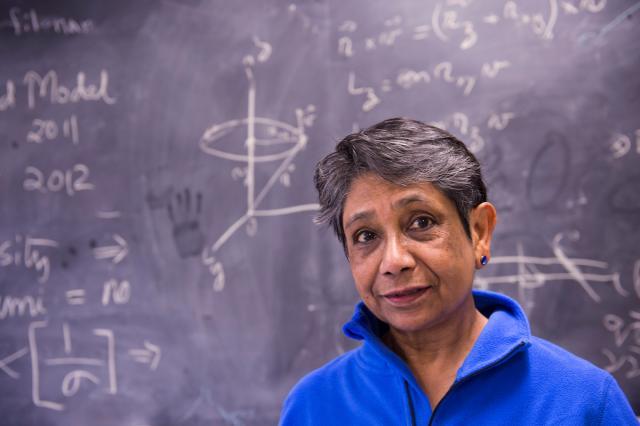
IMAGE

Credit: Tim Schoon, University of Iowa

A University of Iowa physicist is at the forefront of the search for a missing particle that could prove whether the Higgs boson–believed to give mass to all matter–exists.

Usha Mallik and her team used a grant from the U.S. Department of Energy to help build a sub-detector at the Large Hadron Collider, the world's largest and most powerful particle accelerator, located in Switzerland. They're running experiments on the sub-detector to search for a pair of bottom quarks–subatomic yin-and-yang particles that should be produced about 60 percent of the time a Higgs boson decays.

Evidence of these bottom quarks would confirm the existence of the Higgs boson, sometimes referred to as the "God particle." The Higgs' apparent discovery in 2012 seemed to support the Standard Model, the prevailing theory in physics about how the laws governing the universe work.

But since that find, there's been a hitch: The bottom quarks expected to arise from a Higgs boson's decay have yet to be seen, and scientists need that to happen to know for sure the Higgs, in fact, exists.

"Until we're sure whether it's a Standard Model Higgs or an imposter mixed with another kind of Higgs, we are desperate to learn what is beyond the Standard Model. The Higgs is our window beyond the Standard Model," Mallik says.

Still, the quest remains complicated: A Higgs boson is created about once in 10 trillion tries. Moreover, Higgs bosons decay into other particles almost instantly after they are produced, which makes detecting and defining their decaying constituents–such as the bottom quarks–even more challenging.

Mallik and her team hope to observe bottom quarks by following the post-collision clutter that arises from the decay of the Higgs or other new heavy particles similar to it.

"It's basically identifying, picking that needle in the haystack while not getting fooled by something else," says Mallik, who spent the past academic year at ATLAS, one of four particle detectors at the Large Hadron Collider. "That is the challenge."

Mallik, three postdoctoral researchers, a graduate student, and a software engineer from the UI have all been at ATLAS sifting through the voluminous data produced by the collisions. Their work is funded through the High Energy Physics program, part of the U.S. Department of Energy's Office of Science.

Anindya Ghosh, a first-year UI graduate student from India joined Mallik's group in 2015 after hearing her speak the year before at the Indian Institute of Technology in Madras, India. Ghosh worked with the ATLAS experiments over most of last summer.

He calls it "a fantastic place" to be, with hundreds of scientists, students, and teachers joined in the same quest.

"It's a really great opportunity for a new student like me to learn from the experts," Ghosh says.

The attempt to understand the underpinnings of the universe–and human existence–has always fascinated Mallik.

"It's always interested me," she says. "How did we come into being? What led to our universe? It's a fundamental question in many forms."

###

Media Contact

Richard Lewis
[email protected]
319-384-0012
@uiowa

http://www.uiowa.edu

############

Story Source: Materials provided by Scienmag
Share12Tweet8Share2ShareShareShare2

Related Posts

β-Sitosterol from Ipomoea carnea Jacq. As a promising anti-inflammatory agent: Evidence from in silico modeling and in vitro validation

β-Sitosterol from Ipomoea carnea Jacq. As a promising anti-inflammatory agent: Evidence from in silico modeling and in vitro validation

August 31, 2026
Design, fabrication and characterization of a wearable Fiber Bragg grating sensor for cardiorespiratory monitoring using finger plethysmography

Design, fabrication and characterization of a wearable Fiber Bragg grating sensor for cardiorespiratory monitoring using finger plethysmography

August 31, 2026

KAIST opens the era of industrial-scale microbial foods, proposing growth strategies for the next-generation protein market

August 31, 2026

Virologist awarded $2 million NIH grant to investigate how virus-infected cells live and die

August 31, 2026
Please login to join discussion

POPULAR NEWS

  • β-Sitosterol from Ipomoea carnea Jacq. As a promising anti-inflammatory agent: Evidence from in silico modeling and in vitro validation

    29 shares
    Share 12 Tweet 7
  • Design, fabrication and characterization of a wearable Fiber Bragg grating sensor for cardiorespiratory monitoring using finger plethysmography

    29 shares
    Share 12 Tweet 7
  • KAIST opens the era of industrial-scale microbial foods, proposing growth strategies for the next-generation protein market

    29 shares
    Share 12 Tweet 7
  • Virologist awarded $2 million NIH grant to investigate how virus-infected cells live and die

    29 shares
    Share 12 Tweet 7

About

We bring you the latest biotechnology news from best research centers and universities around the world. Check our website.

Follow us

Recent News

β-Sitosterol from Ipomoea carnea Jacq. As a promising anti-inflammatory agent: Evidence from in silico modeling and in vitro validation

Design, fabrication and characterization of a wearable Fiber Bragg grating sensor for cardiorespiratory monitoring using finger plethysmography

KAIST opens the era of industrial-scale microbial foods, proposing growth strategies for the next-generation protein market

Subscribe to Blog via Email

Enter your email address to subscribe to this blog and receive notifications of new posts by email.

Join 85 other subscribers
  • Contact Us

Bioengineer.org © Copyright 2023 All Rights Reserved.

Welcome Back!

Login to your account below

Forgotten Password?

Retrieve your password

Please enter your username or email address to reset your password.

Log In
No Result
View All Result
  • Homepages
    • Home Page 1
    • Home Page 2
  • News
  • National
  • Business
  • Health
  • Lifestyle
  • Science

Bioengineer.org © Copyright 2023 All Rights Reserved.