• HOME
  • NEWS
  • EXPLORE
    • CAREER
      • Companies
      • Jobs
    • EVENTS
    • iGEM
      • News
      • Team
    • PHOTOS
    • VIDEO
    • WIKI
  • BLOG
  • COMMUNITY
    • FACEBOOK
    • INSTAGRAM
    • TWITTER
Saturday, June 27, 2026
BIOENGINEER.ORG
No Result
View All Result
  • Login
  • HOME
  • NEWS
  • EXPLORE
    • CAREER
      • Companies
      • Jobs
        • Lecturer
        • PhD Studentship
        • Postdoc
        • Research Assistant
    • EVENTS
    • iGEM
      • News
      • Team
    • PHOTOS
    • VIDEO
    • WIKI
  • BLOG
  • COMMUNITY
    • FACEBOOK
    • INSTAGRAM
    • TWITTER
  • HOME
  • NEWS
  • EXPLORE
    • CAREER
      • Companies
      • Jobs
        • Lecturer
        • PhD Studentship
        • Postdoc
        • Research Assistant
    • EVENTS
    • iGEM
      • News
      • Team
    • PHOTOS
    • VIDEO
    • WIKI
  • BLOG
  • COMMUNITY
    • FACEBOOK
    • INSTAGRAM
    • TWITTER
No Result
View All Result
Bioengineer.org
No Result
View All Result
Home NEWS Science News

A pioneering study into the description of the architecture of a new standard for telecommunications

Bioengineer by Bioengineer
May 8, 2020
in Science News
Reading Time: 2 mins read
0
IMAGE
Share on FacebookShare on TwitterShare on LinkedinShare on RedditShare on Telegram

esented by members of the Wireless Networking and AI&ML research groups, led by the researchers Boris Bellalta and Anders Jonsson at the Department of Information and Communication Technologies
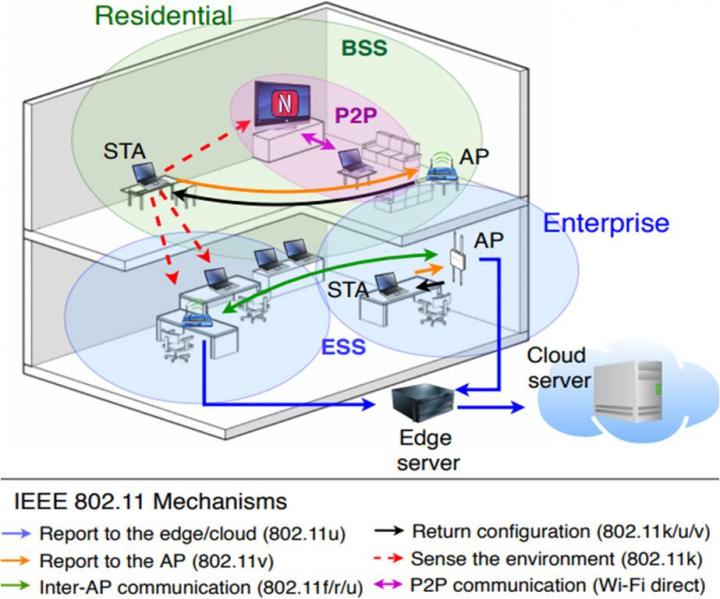
IMAGE

Credit: UPF

The International Telecommunication Union (ITU) is a United Nations Organization agency commissioned to regulate international telecommunications between different operating administrations and businesses. Pursuant to specific recommendations by this organization, on 1 July, standard Y.3172, an architecture for machine learning in future networks (5G and beyond), was approved for telecommunications networks. This new standard defines a logical network architecture that has been designed to include machine learning mechanisms intrinsically.

The agency StandICT.eu, which promotes the participation and contribution by academics to single digital market standards, such as 5G, cloud computing, cybersecurity, big data and IoT, granted members of the UPF Department of Information and Communication Technologies (DTIC) a “Short Term” grant, thanks to which they have been involved in three meetings of the ITU’s Focus Group on Machine Learning for Future Networks including 5G (FG-ML5G).

With this grant, the Wireless Networking and AI&ML research groups, led by Boris Bellalta and Anders Jonsson at the UPF DTIC, respectively, have studied how the application of machine learning can lead to a number of use cases that require transmissions of between 10 and 20 Gbps capacity, support large numbers of devices (1M/km2) or reduce latency to less than 5ms, with an error rate of less than 0.00001.

The research results were published by Francesc Wilhelmi, Sergio Barrachina, Boris Bellalta, Cristina Cano, Anders Jonsson, and Vishnu Ram in the IEEE Communications Magazine on 18 March. Their study also includes a use case that involves the association of users in dense networks using deep learning (i.e., neural networks). Thanks to the application of such techniques, it is possible to learn a series of complex patterns that current mechanisms cannot handle, as could be network load, interference received, or the status of each device.

###

Media Contact
Nuria Perez
[email protected]

Original Source

https://www.upf.edu/web/focus/noticies/-/asset_publisher/qOocsyZZDGHL/content/id/234499867/maximized

Related Journal Article

http://dx.doi.org/10.1109/MCOM.001.1900637

Tags: Electrical Engineering/ElectronicsTechnology/Engineering/Computer ScienceTelecommunications
Share12Tweet8Share2ShareShareShare2

Related Posts

Tracking Lanthanide-Labeled Microplastics in Plants

June 25, 2026

POSTECH Researchers Slash Cost of Reconstituted Cell-Free Systems by 95%

June 25, 2026

AI and Physics Collaborate to Design Advanced Hydrogen Storage Materials

June 25, 2026

Natural Hallucinogens: Evolution’s Ecological Tools, Not Mere Chemical Byproducts

June 25, 2026
Please login to join discussion

POPULAR NEWS

  • Saying Goodbye to PGY-6: Pediatric Fellowship Realities

    103 shares
    Share 41 Tweet 26
  • Multi-Hospital Study Reveals Long Covid Burden Is Twice as High as Current Estimates

    92 shares
    Share 36 Tweet 23
  • Detection of EDCs in Breast Milk and Infant Urine Up to Six Months Highlights Early Exposure Risks

    77 shares
    Share 31 Tweet 19
  • New Drug Candidate Developed at McMaster Shows Potential for Treating Brain Cancer

    58 shares
    Share 23 Tweet 15

About

We bring you the latest biotechnology news from best research centers and universities around the world. Check our website.

Follow us

Recent News

Tracking Lanthanide-Labeled Microplastics in Plants

POSTECH Researchers Slash Cost of Reconstituted Cell-Free Systems by 95%

AI and Physics Collaborate to Design Advanced Hydrogen Storage Materials

Subscribe to Blog via Email

Success! An email was just sent to confirm your subscription. Please find the email now and click 'Confirm' to start subscribing.

Join 82 other subscribers
  • Contact Us

Bioengineer.org © Copyright 2023 All Rights Reserved.

Welcome Back!

Login to your account below

Forgotten Password?

Retrieve your password

Please enter your username or email address to reset your password.

Log In
No Result
View All Result
  • Homepages
    • Home Page 1
    • Home Page 2
  • News
  • National
  • Business
  • Health
  • Lifestyle
  • Science

Bioengineer.org © Copyright 2023 All Rights Reserved.