There has been significant progress in the field of quantum computing. Big global players, such as Google and IBM, are already offering cloud-based quantum computing services. However, quantum computers cannot yet help with problems that occur when standard computers reach the limits of their capacities because the availability of qubits or quantum bits, i.e., the basic units of quantum information, is still insufficient. One of the reasons for this is that bare qubits are not of immediate use for running a quantum algorithm. While the binary bits of customary computers store information in the form of fixed values of either 0 or 1, qubits can represent 0 and 1 at one and the same time, bringing probability as to their value into play. This is known as quantum superposition. This makes them very susceptible to external influences, which means that the information they store can readily be lost. In order to ensure that quantum computers supply reliable results, it is necessary to generate a genuine entanglement to join together several physical qubits to form a logical qubit. Should one of these physical qubits fail, the other qubits will retain the information. However, one of the main difficulties preventing the development of functional quantum computers is the large number of physical qubits required.
Credit: ill./ ©: Peter van Loock
There has been significant progress in the field of quantum computing. Big global players, such as Google and IBM, are already offering cloud-based quantum computing services. However, quantum computers cannot yet help with problems that occur when standard computers reach the limits of their capacities because the availability of qubits or quantum bits, i.e., the basic units of quantum information, is still insufficient. One of the reasons for this is that bare qubits are not of immediate use for running a quantum algorithm. While the binary bits of customary computers store information in the form of fixed values of either 0 or 1, qubits can represent 0 and 1 at one and the same time, bringing probability as to their value into play. This is known as quantum superposition. This makes them very susceptible to external influences, which means that the information they store can readily be lost. In order to ensure that quantum computers supply reliable results, it is necessary to generate a genuine entanglement to join together several physical qubits to form a logical qubit. Should one of these physical qubits fail, the other qubits will retain the information. However, one of the main difficulties preventing the development of functional quantum computers is the large number of physical qubits required.
Advantages of a photon-based approach
Many different concepts are being employed to make quantum computing viable. Large corporations currently rely on superconducting solid-state systems, for example, but these have the disadvantage that they only function at temperatures close to absolute zero. Photonic concepts, on the other hand, work at room temperature. Single photons usually serve as physical qubits here. These photons, which are, in a sense, tiny particles of light, inherently operate more rapidly than solid-state qubits but, at the same time, are more easily lost. To avoid qubit losses and other errors, it is necessary to couple several single-photon light pulses together to construct a logical qubit – as in the case of the superconductor-based approach.
A qubit with the inherent capacity for error correction
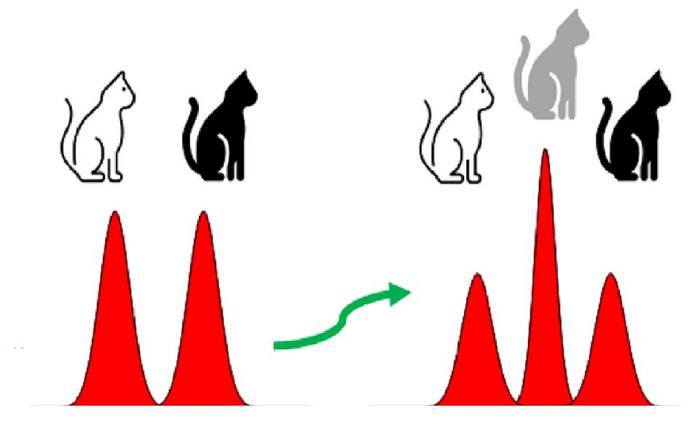
Researchers of the University of Tokyo together with colleagues from Johannes Gutenberg University Mainz (JGU) in Germany and Palacký University Olomouc in the Czech Republic have recently demonstrated a new means of constructing a photonic quantum computer. Rather than using a single photon, the team employed a laser-generated light pulse that can consist of several photons. “Our laser pulse was converted to a quantum optical state that gives us an inherent capacity to correct errors,” stated Professor Peter van Loock of Mainz University. “Although the system consists only of a laser pulse and is thus very small, it can – in principle – eradicate errors immediately.” Thus, there is no need to generate individual photons as qubits via numerous light pulses and then have them interact as logical qubits. “We need just a single light pulse to obtain a robust logical qubit,” added van Loock. To put it in other words, a physical qubit is already equivalent to a logical qubit in this system – a remarkable and unique concept. However, the logical qubit experimentally produced at the University of Tokyo was not yet of a sufficient quality to provide the necessary level of error tolerance. Nonetheless, the researchers have clearly demonstrated that it is possible to transform non-universally correctable qubits into correctable qubits using the most innovative quantum optical methods.
The corresponding research results have recently been published in Science. They are based on a collaboration going back some 20 years between the experimental group of Akira Furusawa in Japan and the theoretical team of Peter van Loock in Germany.
Related links:
- https://www.oqit.uni-mainz.de/ – Optical Quantum Information Theory group at JGU
- http://www.nanoquine.iis.u-tokyo.ac.jp/en/archives/1235 – News release of the University of Tokyo
- https://www.science.org/doi/10.1126/science.adm9946 – Science article “Qubits without qubits”
Read more:
- https://press.uni-mainz.de/quantum-teleportation-transfer-of-flying-quantum-bits-at-the-touch-of-a-button/ – press release “Quantum teleportation: Transfer of flying quantum bits at the touch of a button” (15 Aug. 2013)
Journal
Science
DOI
10.1126/science.adk7560
Article Title
Logical states for fault-tolerant quantum computation with propagating light
Article Publication Date
18-Jan-2024