• HOME
  • NEWS
  • EXPLORE
    • CAREER
      • Companies
      • Jobs
    • EVENTS
    • iGEM
      • News
      • Team
    • PHOTOS
    • VIDEO
    • WIKI
  • BLOG
  • COMMUNITY
    • FACEBOOK
    • INSTAGRAM
    • TWITTER
Sunday, June 21, 2026
BIOENGINEER.ORG
No Result
View All Result
  • Login
  • HOME
  • NEWS
  • EXPLORE
    • CAREER
      • Companies
      • Jobs
        • Lecturer
        • PhD Studentship
        • Postdoc
        • Research Assistant
    • EVENTS
    • iGEM
      • News
      • Team
    • PHOTOS
    • VIDEO
    • WIKI
  • BLOG
  • COMMUNITY
    • FACEBOOK
    • INSTAGRAM
    • TWITTER
  • HOME
  • NEWS
  • EXPLORE
    • CAREER
      • Companies
      • Jobs
        • Lecturer
        • PhD Studentship
        • Postdoc
        • Research Assistant
    • EVENTS
    • iGEM
      • News
      • Team
    • PHOTOS
    • VIDEO
    • WIKI
  • BLOG
  • COMMUNITY
    • FACEBOOK
    • INSTAGRAM
    • TWITTER
No Result
View All Result
Bioengineer.org
No Result
View All Result
Home NEWS Science News Biology

A pheromone that explains why puffer fish spawn on beaches under moonlight 

Bioengineer by Bioengineer
October 27, 2022
in Biology
Reading Time: 3 mins read
0
A pheromone that explains why puffer fish spawn on beaches under moonlight
Share on FacebookShare on TwitterShare on LinkedinShare on RedditShare on Telegram

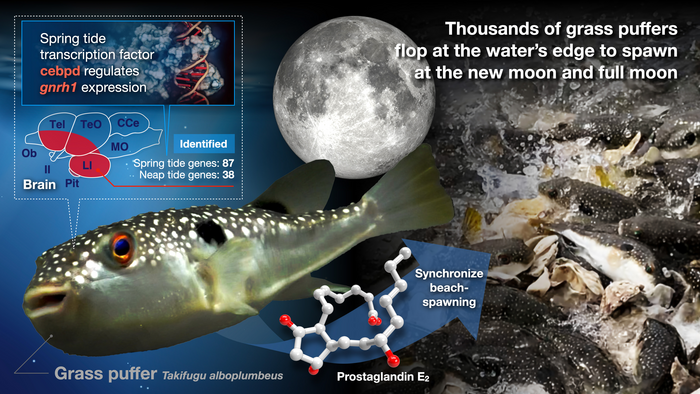
A group of animal biologists and chemists at the Institute of Transformative Bio-Molecules (ITbM) at Nagoya University in central Japan, in collaboration with Toyota Boshoku Corporation and Niigata University, have identified the pheromone involved in the mechanism that triggers puffer fish to spawn on beaches using moonlight. Their findings are reported in Current Biology.
A pheromone that explains why puffer fish spawn on beaches under moonlight

Credit: Issey Takahashi

A group of animal biologists and chemists at the Institute of Transformative Bio-Molecules (ITbM) at Nagoya University in central Japan, in collaboration with Toyota Boshoku Corporation and Niigata University, have identified the pheromone involved in the mechanism that triggers puffer fish to spawn on beaches using moonlight. Their findings are reported in Current Biology.


As described by Aristotle, people throughout history have been fascinated by the moon. Over the centuries, scientists have identified several connections between the lunar cycle and the behavior of living beings, including migration, mating, and feeding. However, while the lunar rhythm may be fundamental to life, the mechanism by which it affects behavior is not well understood. 


Along coastlines around the world, at the time of the spring tide (that is, new moon and full moon), thousands of puffer fish, gather at the water’s edge and perform a writhing motion as they spawn. These fish are known as ‘semilunar spawners’. Although this dramatic display is a popular attraction, scientists do not understand the mechanism by which the puffer fish synchronize their spawning with the lunar cycle.


Therefore, to better understand this phenomenon, the Nagoya University researchers applied an innovative genomic technique, called ecogenomics, to grass puffers. They identified 125 genes involved in their spawning behavior, including genes crucial for reproduction. During the spring tide, the researchers also noticed receptors for a particular pheromone, PGE2. When they applied PGE2 to a tank of puffer fish, both males and females demonstrated their characteristic writhing behavior when spawning. Furthermore, as the dose increased, the number of responding fish also rose. The researchers concluded that the spawning puffers release PGE2 into the seawater, triggering the synchronized beach-spawning behavior.  


“The synchronization of reproduction with the lunar cycle is not limited to organisms living along the shoreline,” explained lead researcher Professor Takashi Yoshimura. “For example, wildebeest mating and calf delivery in cows are also reported to be synchronized with the lunar cycle,” He believes that this kind of research also has implications for humans. “It is worth noting,” he said, “that menstrual cycles, sleep–wake cycles, and manic–depressive cycles are synchronized with the moon’s cycle in humans, and the lunar cycle generally affects human biology and behavior.”  


Journal

Current Biology

DOI

10.1016/j.cub.2022.09.062

Method of Research

Experimental study

Subject of Research

Animals

Article Title

Prostaglandin E2 synchronizes lunar-regulated beach-spawning in grass puffers

Article Publication Date

27-Oct-2022

Share12Tweet8Share2ShareShareShare2

Related Posts

Inbreeding Hits Small Males in Threatened Songbird — Biology

Inbreeding Hits Small Males in Threatened Songbird

June 21, 2026
Tiny Genetic Fragments Crucial for Signaling Brain Rest Identified — Biology

Tiny Genetic Fragments Crucial for Signaling Brain Rest Identified

June 19, 2026

How H5N1 Bird Flu Went Undetected for Weeks in Dairy Cattle

June 19, 2026

New Study Seeks to Prolong Immune System Longevity

June 18, 2026

POPULAR NEWS

  • Saying Goodbye to PGY-6: Pediatric Fellowship Realities

    103 shares
    Share 41 Tweet 26
  • Multi-Hospital Study Reveals Long Covid Burden Is Twice as High as Current Estimates

    92 shares
    Share 36 Tweet 23
  • Detection of EDCs in Breast Milk and Infant Urine Up to Six Months Highlights Early Exposure Risks

    77 shares
    Share 31 Tweet 19
  • New Drug Candidate Developed at McMaster Shows Potential for Treating Brain Cancer

    58 shares
    Share 23 Tweet 15

About

We bring you the latest biotechnology news from best research centers and universities around the world. Check our website.

Follow us

Recent News

Inbreeding Hits Small Males in Threatened Songbird

CCRT Boosts Cognition and Biomarkers in Older Adults

Inflammation and Metabolism Trigger Early Puberty in Obese Kids

Subscribe to Blog via Email

Enter your email address to subscribe to this blog and receive notifications of new posts by email.

Join 82 other subscribers
  • Contact Us

Bioengineer.org © Copyright 2023 All Rights Reserved.

Welcome Back!

Login to your account below

Forgotten Password?

Retrieve your password

Please enter your username or email address to reset your password.

Log In
No Result
View All Result
  • Homepages
    • Home Page 1
    • Home Page 2
  • News
  • National
  • Business
  • Health
  • Lifestyle
  • Science

Bioengineer.org © Copyright 2023 All Rights Reserved.