• HOME
  • NEWS
  • EXPLORE
    • CAREER
      • Companies
      • Jobs
    • EVENTS
    • iGEM
      • News
      • Team
    • PHOTOS
    • VIDEO
    • WIKI
  • BLOG
  • COMMUNITY
    • FACEBOOK
    • INSTAGRAM
    • TWITTER
Sunday, July 5, 2026
BIOENGINEER.ORG
No Result
View All Result
  • Login
  • HOME
  • NEWS
  • EXPLORE
    • CAREER
      • Companies
      • Jobs
        • Lecturer
        • PhD Studentship
        • Postdoc
        • Research Assistant
    • EVENTS
    • iGEM
      • News
      • Team
    • PHOTOS
    • VIDEO
    • WIKI
  • BLOG
  • COMMUNITY
    • FACEBOOK
    • INSTAGRAM
    • TWITTER
  • HOME
  • NEWS
  • EXPLORE
    • CAREER
      • Companies
      • Jobs
        • Lecturer
        • PhD Studentship
        • Postdoc
        • Research Assistant
    • EVENTS
    • iGEM
      • News
      • Team
    • PHOTOS
    • VIDEO
    • WIKI
  • BLOG
  • COMMUNITY
    • FACEBOOK
    • INSTAGRAM
    • TWITTER
No Result
View All Result
Bioengineer.org
No Result
View All Result
Home NEWS Science News Chemistry

A novel nanometer-scale proximity labeling method targeting histidine residues

Bioengineer by Bioengineer
September 6, 2025
in Chemistry
Reading Time: 2 mins read
0
IMAGE
Share on FacebookShare on TwitterShare on LinkedinShare on RedditShare on Telegram

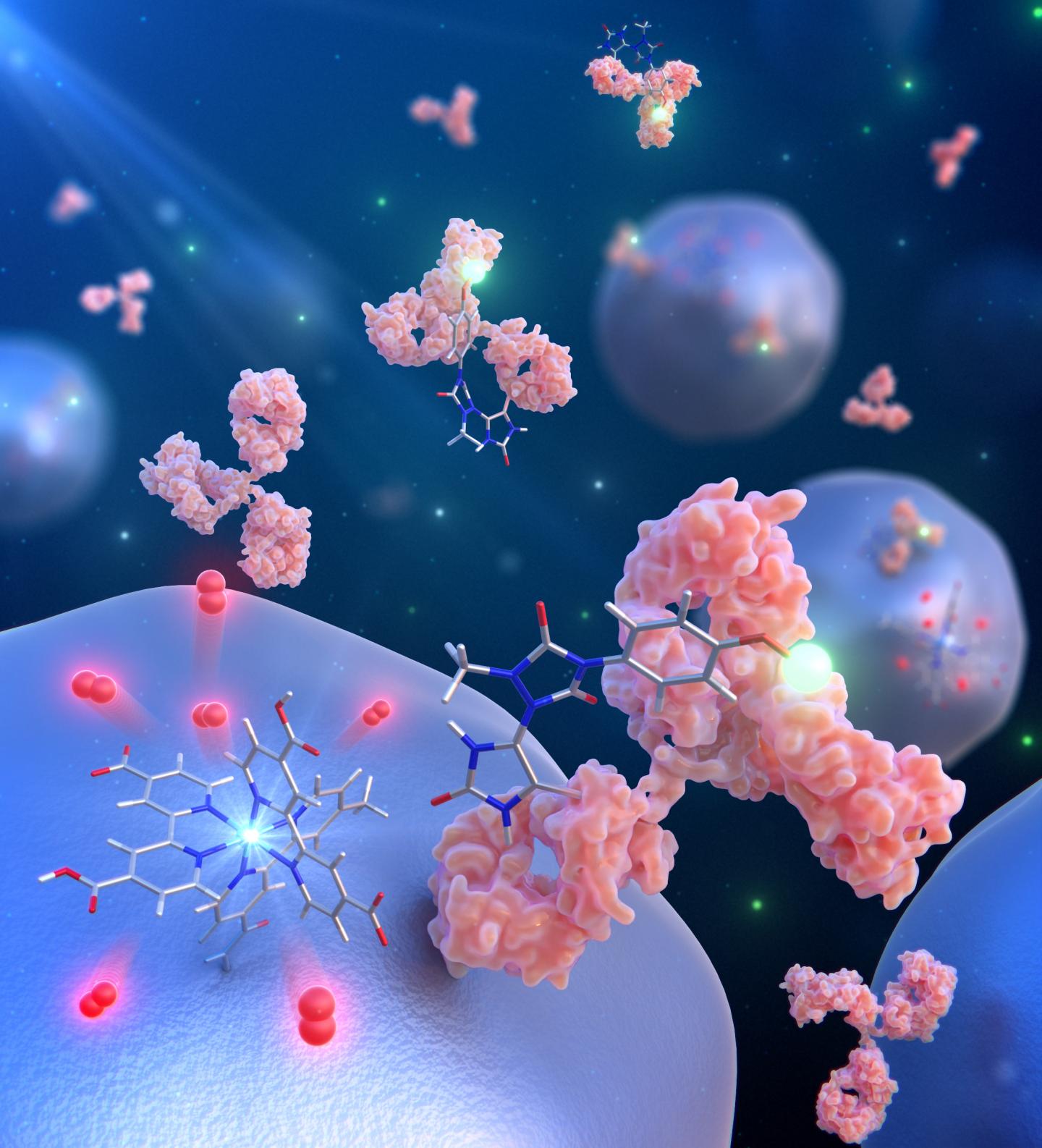
Researchers have created a new nanometer-scale proximity labeling system that targets histidine residues quickly, providing a new chemical tool in protein chemical modification.

The results of their research were published in the Journal of the American Chemical Society on April 27, 2021.

Protein chemical modification, a technology that introduces functions into the chemical structure of proteins through irreversible strong bonds, is used for the creation of protein-based biomaterials and for drug delivery systems.

In order to carry out modification, protein labeling is necessary. Proximity labeling is one of those techniques. It labels biomolecules located close to a protein of interest which can then also be marked and analyzed.

However, there are only a few chemical reactions that can be applied to protein chemical modification methods. Moreover, there have been very few reports on the selective modification of histidine residues.

In previous electrophilic approaches, the weak nucleophilic nature of histidine residues results in low selectivity for other nucleophilic amino acids.

A gaseous inorganic chemical known as singlet oxygen helped overcome this barrier. Singlet oxygen is a highly reactive chemical species with microsecond-scale lifetimes and nanometer-scale diffusion distances.

The research group employed nucleophiles to capture the electrophilic intermediates produced by the reaction of singlet oxygen with histidine residues. The high reactivity of singlet oxygen led to a rapid and complete reaction.

Conventional histidine labeling methods take several hours to chemically modify the histidine residues of proteins. Yet, this method modified the histidine residues in only a few minutes by visible light irradiation of the photocatalyst under physiological pH conditions.

Corresponding author Dr Shinichi Sato from the Frontier Research Institute for Interdisciplinary Sciences at Tohoku University says that their discovery has opened the door to protein analysis research using singlet oxygen. “Using conventional singlet oxygen production methods can potentially develop into a technology that clarifies unexplored intracellular signal transduction and protein-protein interactions.”

###

Media Contact
Shinichi Sato
[email protected]

Original Source

https://www.tohoku.ac.jp/en/press/nonometerscale_proximity_labeling_histidine_residue.html

Related Journal Article

http://dx.doi.org/10.1021/jacs.1c01626

Tags: Chemistry/Physics/Materials SciencesMaterials
Share12Tweet8Share2ShareShareShare2

Related Posts

Intelligent Microgrid Management Promises Lower Household Energy Bills and Reduced Diesel Emissions — Chemistry

Intelligent Microgrid Management Promises Lower Household Energy Bills and Reduced Diesel Emissions

July 4, 2026
Graz University of Technology Deciphers the Structural Secrets of MOF Thin Films — Chemistry

Graz University of Technology Deciphers the Structural Secrets of MOF Thin Films

July 2, 2026

Breaking Thermodynamic Limits: Wavelength-Driven Catalysis Advances Ammonia Synthesis

July 2, 2026

From Quantum Mechanics to AI-Powered Materials Discovery: MARVEL Marks 12 Years of Transforming Computational Science

July 2, 2026
Please login to join discussion

POPULAR NEWS

  • Detection of EDCs in Breast Milk and Infant Urine Up to Six Months Highlights Early Exposure Risks

    77 shares
    Share 31 Tweet 19
  • Saying Goodbye to PGY-6: Pediatric Fellowship Realities

    103 shares
    Share 41 Tweet 26
  • New Drug Candidate Developed at McMaster Shows Potential for Treating Brain Cancer

    58 shares
    Share 23 Tweet 15
  • KTU Researchers Explore Ultrasound’s Role in Enhancing Blood Flow Beyond Diagnostics

    53 shares
    Share 21 Tweet 13

About

We bring you the latest biotechnology news from best research centers and universities around the world. Check our website.

Follow us

Recent News

Quasi-Bound States Boost Quantum Well Photoresponse

Lysine Pyruvylation Links Glycolysis to Epigenetics

Multiphysics Coupling: Single vs. Multiple DeepONet Branches

Subscribe to Blog via Email

Success! An email was just sent to confirm your subscription. Please find the email now and click 'Confirm' to start subscribing.

Join 83 other subscribers
  • Contact Us

Bioengineer.org © Copyright 2023 All Rights Reserved.

Welcome Back!

Login to your account below

Forgotten Password?

Retrieve your password

Please enter your username or email address to reset your password.

Log In
No Result
View All Result
  • Homepages
    • Home Page 1
    • Home Page 2
  • News
  • National
  • Business
  • Health
  • Lifestyle
  • Science

Bioengineer.org © Copyright 2023 All Rights Reserved.