Kanazawa, Japan – Malaria remains a deadly disease that affects people worldwide, particularly in Africa. Caused by a parasite that can enter the human bloodstream via mosquito bite, the parasites can then infect and reproduce within the person’s liver. Significant effort has been made to develop an anti-malaria vaccine; unfortunately, previous vaccine candidates have had low-to-modest efficacies. Now, in an article in Frontiers in Immunology, researchers at Kanazawa University have identified a new vaccine platform as a potentially better-performing inducer of anti-malaria immunity in the liver.
Credit: Kanazawa University
Kanazawa, Japan – Malaria remains a deadly disease that affects people worldwide, particularly in Africa. Caused by a parasite that can enter the human bloodstream via mosquito bite, the parasites can then infect and reproduce within the person’s liver. Significant effort has been made to develop an anti-malaria vaccine; unfortunately, previous vaccine candidates have had low-to-modest efficacies. Now, in an article in Frontiers in Immunology, researchers at Kanazawa University have identified a new vaccine platform as a potentially better-performing inducer of anti-malaria immunity in the liver.
Malaria vaccines are often designed to generate an immune response to the Plasmodium falciparum circumsporozoite protein (PfCSP), which is present at pre-erythrocytic stages. Plasmodium falciparum is the specific parasite that causes the deadliest form of malaria. Because of the nature of this parasite’s biology, previous attempts have indicated that a successful vaccine needs to induce a T cell-mediated response in the liver that can clear the infection within a week of beginning—and thus before the parasites have multiplied, matured, and re-entered the bloodstream.
The research team published earlier results targeting PfCSP using a vaccine backbone known as adeno-associated virus serotype 1 (AAV1). AAV1 worked best when used as a booster. However, the group hypothesized that another type of backbone, AAV8, would be more effective.
“AAV8 is a hepatotropic virus, which means it specifically targets the liver,” explains Mohammad Shahnaij, lead author of the study. “We believed it would address the timing concerns associated with suboptimal anti-malaria vaccine candidates.”
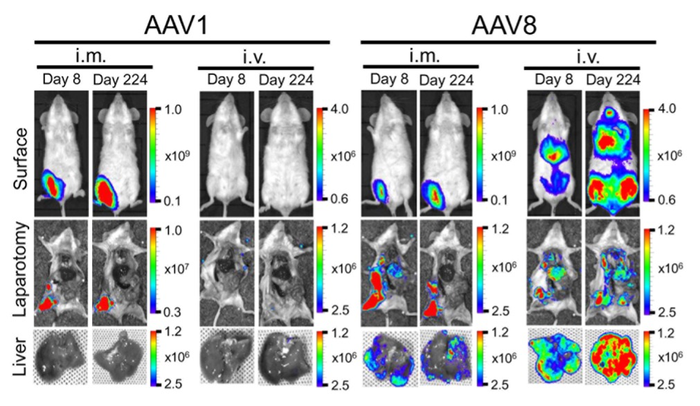
The researchers created a vaccine that expresses PfCSP with AAV8 as the backbone. Lab mice were primed with another vaccine known as human adenovirus type 5-PfCSP. Then, one group of mice was given AAV8-PfCSP intravenously (IV), while another group was treated with it intramuscularly (IM). AAV8-PfCSP served as a booster shot in these experiments.
“IV injection caused the vaccine to be about 2.5 times better at entering the mouse liver cells than IM injection,” explains Shigeto Yoshida, senior author. “We also found that an IV booster shot with AAV8-PfCSP was significantly more efficacious than an IM booster with this vaccine, and more effective than using either an IM or IV dose of AAV1-PfCSP.”
The group also examined immune cell responses following a single IV dose of AAV8-PfCSP. Notably, T cells were significantly recruited to the liver compared with mice injected with a saline solution.
“We observed a large population of cytotoxic T cells, especially effector memory T cells, in the livers of mice given IV injections of AAV8-PfCSP,” says Shahnaij. “These cells are extremely important for removing parasites and infected liver cells.”
These findings may revolutionize the field of anti-malaria therapy and potentially help save the lives of countless people living in parts of the world ravaged by this disease.
Journal
Frontiers in Immunology
DOI
10.3389/fimmu.2021.612910
Article Title
Liver-Directed AAV8 Booster Vaccine Expressing Plasmodium falciparum Antigen Following Adenovirus Vaccine Priming Elicits Sterile Protection in a Murine Model