

• HOME
  • NEWS
  • EXPLORE
    • CAREER
      • Companies
      • Jobs
    • EVENTS
    • iGEM
      • News
      • Team
    • PHOTOS
    • VIDEO
    • WIKI
  • BLOG
  • COMMUNITY
    • FACEBOOK
    • INSTAGRAM
    • TWITTER
Friday, January 2, 2026
BIOENGINEER.ORG
No Result
View All Result
  • Login
  • HOME
  • NEWS
  • EXPLORE
    • CAREER
      • Companies
      • Jobs
        • Lecturer
        • PhD Studentship
        • Postdoc
        • Research Assistant
    • EVENTS
    • iGEM
      • News
      • Team
    • PHOTOS
    • VIDEO
    • WIKI
  • BLOG
  • COMMUNITY
    • FACEBOOK
    • INSTAGRAM
    • TWITTER
  • HOME
  • NEWS
  • EXPLORE
    • CAREER
      • Companies
      • Jobs
        • Lecturer
        • PhD Studentship
        • Postdoc
        • Research Assistant
    • EVENTS
    • iGEM
      • News
      • Team
    • PHOTOS
    • VIDEO
    • WIKI
  • BLOG
  • COMMUNITY
    • FACEBOOK
    • INSTAGRAM
    • TWITTER
No Result
View All Result
Bioengineer.org
No Result
View All Result
Home NEWS Science News Cancer

A novel data-driven method to personalize cancer treatment

Bioengineer by Bioengineer
May 31, 2018
in Cancer
Reading Time: 2 mins read
0
Share on FacebookShare on TwitterShare on LinkedinShare on RedditShare on Telegram
IMAGE

Credit: Spanish National Cancer Research Centre (CNIO)

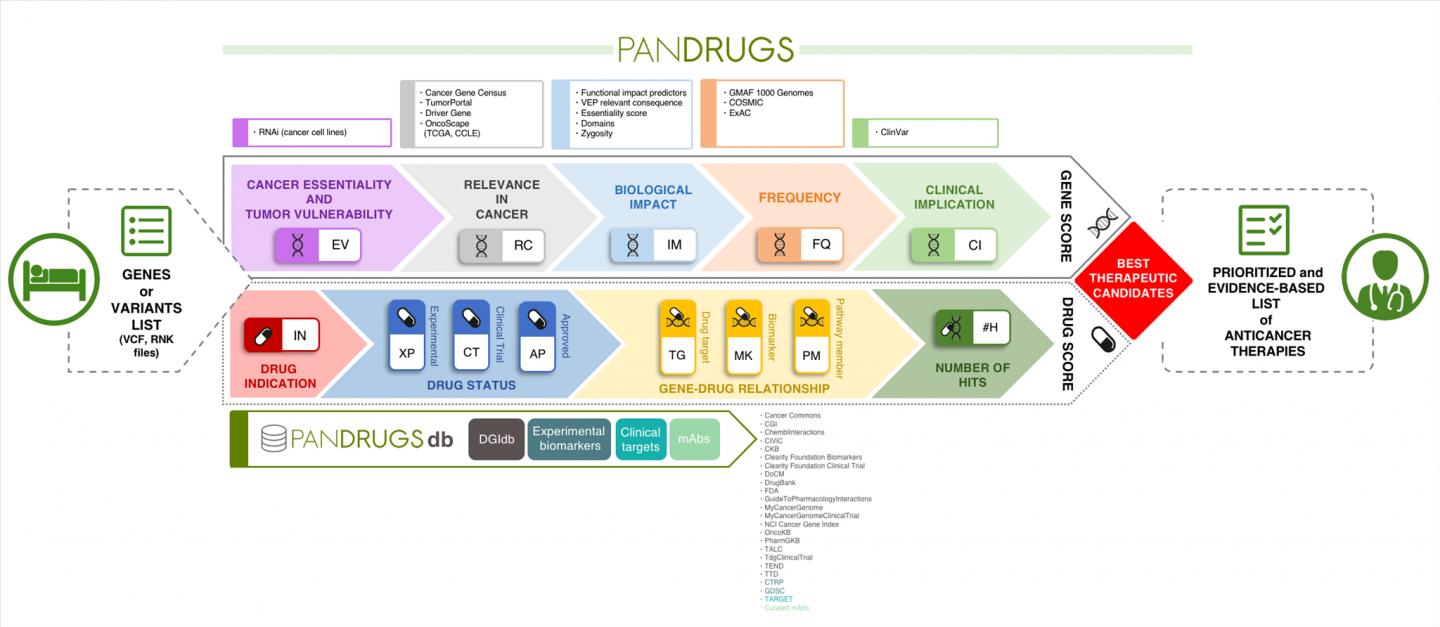
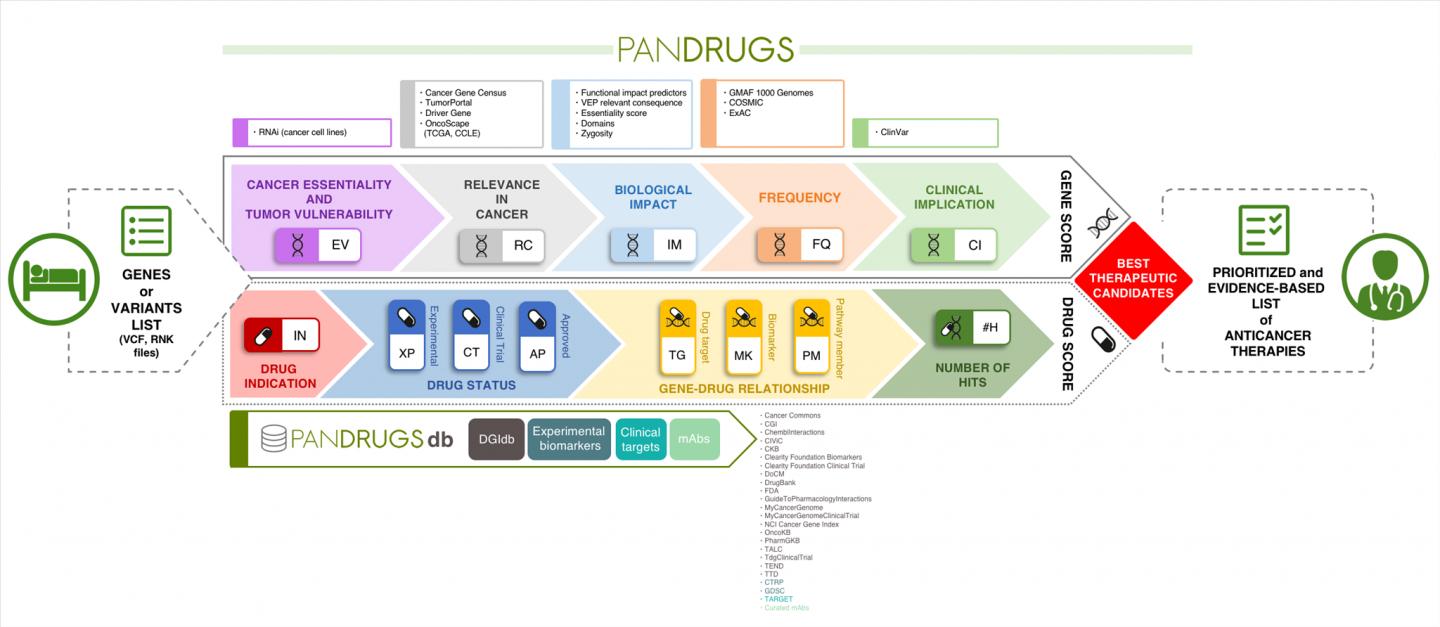
Identify and prioritize treatment options based on a patient's profile of genetic alterations is a major challenge in personalized cancer medicine. Data-driven approaches such as PanDrugs can help to this end. This new computational resource has been developed by researchers from the Bioinformatics Unit at the Spanish National Cancer Research Centre (CNIO) and is described in a paper published in Genome Medicine.

A large majority of cancers carry a long list of genetic alterations whose biological and clinical relevance, and susceptibility to be pharmacologically-targeted isn't always clear. Several tools have been developed to identify clinically actionable genomic alterations and to suggest targeted therapies but they have some limitations and there's still a gap between raw genomic data and clinical usefulness.

To overcome this, researchers lead by Fátima Al-Shahrour, head of the Bioinformatics Unit at the CNIO, have implement this novel method called PanDrugs. "The main novelty introduced in this methodology compared with current tools is the broadening of the search space to provide therapeutic options", explains Al-Shahrour.

In other words, PanDrugs suggests treatments for direct targets (e.g. genes that contribute to disease phenotype and can be directly targeted by a drug) and biomarkers (e.g. genes that have a genetic status associated with drug response but the protein product is not the drug target itself). But also, PanDrugs integrates a systems biology knowledge-based layer that automatically inspects biological circuits expanding cancer candidate therapies from beyond limited cancer-related gene lists to the whole druggable pathway.

"This novel strategy (called 'pathway member') extends the treatment opportunities of cancer patients by enriching the therapeutic arsenal against tumours and opens new avenues for personalized medicine", states Al-Shahrour. Thanks to pathway member strategy, the paper describes how PanDrugs is able to identify treatments used in clinical practice that might benefit prostate, breast and colorectal cancer patients without druggable cancer driver altered genes.

Researchers emphasize that PanDrugs database represents, by itself, a remarkable contribution. "This database is the largest public repository of drug-target associations available from well-known targeted therapies to preclinical drugs. Current version of PanDrugsdb integrates data from 24 primary sources and supports >56000 drug-target associations".

PanDrugs can be fully integrated with custom pipelines through its programmatic API and its docker image facilitates PanDrugs in-house installation, enhancing reproducibility and improving performance. PanDrugs and PanDrugsdb are open-source and fully available at http://www.pandrugs.org.

###

Media Contact

Cristina de Martos
[email protected]
34-917-328-000
@CNIO_Cancer

Inicio

Original Source

https://www.cnio.es/ing/publicaciones/a-novel-data-driven-method-to-personalise-cancer-treatment http://dx.doi.org/10.1186/s13073-018-0546-1

Share12Tweet8Share2ShareShareShare2

Related Posts

Derazantinib Boosts Gemcitabine by Blocking MUC5AC

December 30, 2025

FOCUS Study Reveals Insights on Melphalan for Uveal Melanoma

December 29, 2025

Black Grape Anthocyanins Boost 5-FU Cancer Therapy

December 29, 2025

Girdin Silencing Boosts Mebendazole’s Ovarian Cancer Fight

December 29, 2025
Please login to join discussion

POPULAR NEWS

  • blank

    PTSD, Depression, Anxiety in Childhood Cancer Survivors, Parents

    115 shares
    Share 46 Tweet 29
  • NSF funds machine-learning research at UNO and UNL to study energy requirements of walking in older adults

    71 shares
    Share 28 Tweet 18
  • Exploring Audiology Accessibility in Johannesburg, South Africa

    52 shares
    Share 21 Tweet 13
  • SARS-CoV-2 Subvariants Affect Outcomes in Elderly Hip Fractures

    44 shares
    Share 18 Tweet 11

About

We bring you the latest biotechnology news from best research centers and universities around the world. Check our website.

Follow us

Recent News

OAM Multiplication Sparks Advanced Holographic Multiplexing

IL-10 Targeting LDL Lowers Vascular Inflammation in Atherosclerosis

Insights on Eco-Friendly Cataract Surgery Practices

Subscribe to Blog via Email

Success! An email was just sent to confirm your subscription. Please find the email now and click 'Confirm' to start subscribing.

Join 71 other subscribers
  • Contact Us

Bioengineer.org © Copyright 2023 All Rights Reserved.

Welcome Back!

Login to your account below

Forgotten Password?

Retrieve your password

Please enter your username or email address to reset your password.

Log In
No Result
View All Result
  • Homepages
    • Home Page 1
    • Home Page 2
  • News
  • National
  • Business
  • Health
  • Lifestyle
  • Science

Bioengineer.org © Copyright 2023 All Rights Reserved.
