• HOME
  • NEWS
  • EXPLORE
    • CAREER
      • Companies
      • Jobs
    • EVENTS
    • iGEM
      • News
      • Team
    • PHOTOS
    • VIDEO
    • WIKI
  • BLOG
  • COMMUNITY
    • FACEBOOK
    • INSTAGRAM
    • TWITTER
Thursday, June 25, 2026
BIOENGINEER.ORG
No Result
View All Result
  • Login
  • HOME
  • NEWS
  • EXPLORE
    • CAREER
      • Companies
      • Jobs
        • Lecturer
        • PhD Studentship
        • Postdoc
        • Research Assistant
    • EVENTS
    • iGEM
      • News
      • Team
    • PHOTOS
    • VIDEO
    • WIKI
  • BLOG
  • COMMUNITY
    • FACEBOOK
    • INSTAGRAM
    • TWITTER
  • HOME
  • NEWS
  • EXPLORE
    • CAREER
      • Companies
      • Jobs
        • Lecturer
        • PhD Studentship
        • Postdoc
        • Research Assistant
    • EVENTS
    • iGEM
      • News
      • Team
    • PHOTOS
    • VIDEO
    • WIKI
  • BLOG
  • COMMUNITY
    • FACEBOOK
    • INSTAGRAM
    • TWITTER
No Result
View All Result
Bioengineer.org
No Result
View All Result
Home NEWS Science News Biology

A new view of microscopic interactions

Bioengineer by Bioengineer
June 30, 2020
in Biology
Reading Time: 3 mins read
0
IMAGE
Share on FacebookShare on TwitterShare on LinkedinShare on RedditShare on Telegram

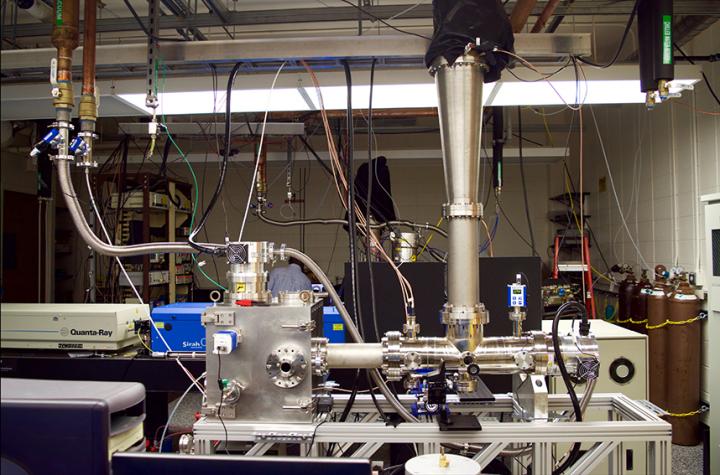
MU chemist adds the details of ‘cold collisions of hot molecules’ to existing theories of molecular interactions
IMAGE

Credit: University of Missouri

When two cars collide at an intersection — from opposite directions — the impact is much different than when two cars — traveling in the same direction — “bump” into each other. In the laboratory, similar types of collisions can be made to occur between molecules to study chemistry at very low temperatures, or “cold collisions.”

A team of scientists led by Arthur Suits at the University of Missouri has developed a new experimental approach to study chemistry using these cold “same direction” molecular collisions. Suits said their approach hasn’t been done before.

“When combined with the use of a laser that ‘excites’ the molecules, our approach produces specific ‘hot’ states of molecules, allowing us to study their individual properties and provide more accurate experimental theories,” said Suits, a Curators Distinguished Professor of Chemistry in the College of Arts and Science. “This is a condition that does not occur naturally but allows for a better understanding of molecular interactions.

Suits equated their efforts to analyzing the results of a marathon race.

“If you only look at the average time it takes everyone to complete the Boston Marathon, then you don’t really learn much detail about a runner’s individual capabilities,” he said. “By doing it this way we can look at the fastest ‘runner,’ the slowest ‘runner,’ and also see the range and different behaviors of individual ‘runners,’ or molecules in this case. Using lasers, we can also design the race to have a desired outcome, which shows we are gaining direct control of the chemistry.”

Suits said this is one of the first detailed approaches of its kind in this field.

“Chemistry is really about the collisions of molecules coming together and what causes chemical reactions to occur,” he said. “Here, instead of crossing two beams of molecules with each other as researchers have often done before, we are now pointing both beams of molecules in the same direction. By also preparing the molecules in those beams to be in specific states, we can study collisions in extreme detail that happen very slowly, including close to absolute zero, which is the equivalent of the low temperature states needed for quantum computing.”

###

“State-to-state scattering of highly vibrationally excited NO at broadly tunable energies,” was published in Nature Chemistry. Other authors include Chandika Amarasinghe, Hongwei Li and Chatura A. Perera at MU; Matthieu Besemer, Ad van der Avoird and Gerrit C. Groenenboom at Radboud University in the Netherlands; Junxiang Zuo and Hua Guo at the University of New Mexico; Changjian Xie at the University of New Mexico and Northwest University in China; and Jacek K?os at the University of Maryland.

The research was supported by the U.S. Army Research Office, the U.S. Air Force Office of Scientific Research, the U.S. National Science Foundation, the Netherlands Organization for Scientific Research and the European Research Council under the European Union’s Horizon 2020 Research and Innovation Program. The content is solely the responsibility of the authors and does not necessarily represent the official views of the funding agencies.

Media Contact
Eric Stann
[email protected]

Original Source

https://news.missouri.edu/2020/a-new-view-of-microscopic-interactions/

Related Journal Article

http://dx.doi.org/10.1038/s41557-020-0466-8

Tags: Atomic/Molecular/Particle PhysicsBiomedical/Environmental/Chemical EngineeringChemistry/Physics/Materials SciencesMolecular PhysicsTechnology/Engineering/Computer Science
Share12Tweet8Share2ShareShareShare2

Related Posts

Natural Hallucinogens: Evolution’s Ecological Tools, Not Mere Chemical Byproducts

June 25, 2026

This Famous Butterfly Revealed: Three Distinct Species Hidden in One

June 25, 2026

Scientists Attack Soybean Cyst Nematode by Starving Its Food Source

June 25, 2026

Decoding the Secret Code of a Crucial Immune Sensor

June 24, 2026
Please login to join discussion

POPULAR NEWS

  • Saying Goodbye to PGY-6: Pediatric Fellowship Realities

    103 shares
    Share 41 Tweet 26
  • Multi-Hospital Study Reveals Long Covid Burden Is Twice as High as Current Estimates

    92 shares
    Share 36 Tweet 23
  • Detection of EDCs in Breast Milk and Infant Urine Up to Six Months Highlights Early Exposure Risks

    77 shares
    Share 31 Tweet 19
  • New Drug Candidate Developed at McMaster Shows Potential for Treating Brain Cancer

    58 shares
    Share 23 Tweet 15

About

We bring you the latest biotechnology news from best research centers and universities around the world. Check our website.

Follow us

Recent News

Tracking Lanthanide-Labeled Microplastics in Plants

POSTECH Researchers Slash Cost of Reconstituted Cell-Free Systems by 95%

AI and Physics Collaborate to Design Advanced Hydrogen Storage Materials

Subscribe to Blog via Email

Success! An email was just sent to confirm your subscription. Please find the email now and click 'Confirm' to start subscribing.

Join 82 other subscribers
  • Contact Us

Bioengineer.org © Copyright 2023 All Rights Reserved.

Welcome Back!

Login to your account below

Forgotten Password?

Retrieve your password

Please enter your username or email address to reset your password.

Log In
No Result
View All Result
  • Homepages
    • Home Page 1
    • Home Page 2
  • News
  • National
  • Business
  • Health
  • Lifestyle
  • Science

Bioengineer.org © Copyright 2023 All Rights Reserved.