• HOME
  • NEWS
  • EXPLORE
    • CAREER
      • Companies
      • Jobs
    • EVENTS
    • iGEM
      • News
      • Team
    • PHOTOS
    • VIDEO
    • WIKI
  • BLOG
  • COMMUNITY
    • FACEBOOK
    • INSTAGRAM
    • TWITTER
Wednesday, September 2, 2026
BIOENGINEER.ORG
No Result
View All Result
  • Login
  • HOME
  • NEWS
  • EXPLORE
    • CAREER
      • Companies
      • Jobs
        • Lecturer
        • PhD Studentship
        • Postdoc
        • Research Assistant
    • EVENTS
    • iGEM
      • News
      • Team
    • PHOTOS
    • VIDEO
    • WIKI
  • BLOG
  • COMMUNITY
    • FACEBOOK
    • INSTAGRAM
    • TWITTER
  • HOME
  • NEWS
  • EXPLORE
    • CAREER
      • Companies
      • Jobs
        • Lecturer
        • PhD Studentship
        • Postdoc
        • Research Assistant
    • EVENTS
    • iGEM
      • News
      • Team
    • PHOTOS
    • VIDEO
    • WIKI
  • BLOG
  • COMMUNITY
    • FACEBOOK
    • INSTAGRAM
    • TWITTER
No Result
View All Result
Bioengineer.org
No Result
View All Result
Home NEWS Science News

A new system to detect spinal deformity

Bioengineer by Bioengineer
November 21, 2016
in Science News
Reading Time: 2 mins read
0
Share on FacebookShare on TwitterShare on LinkedinShare on RedditShare on Telegram
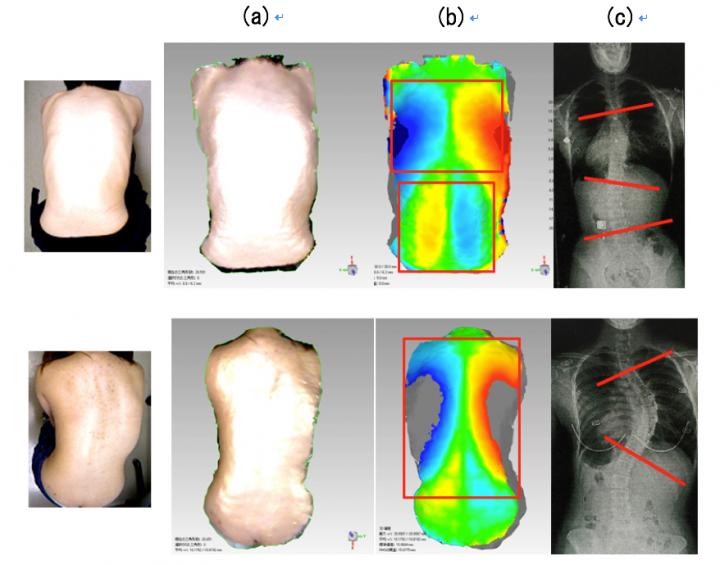
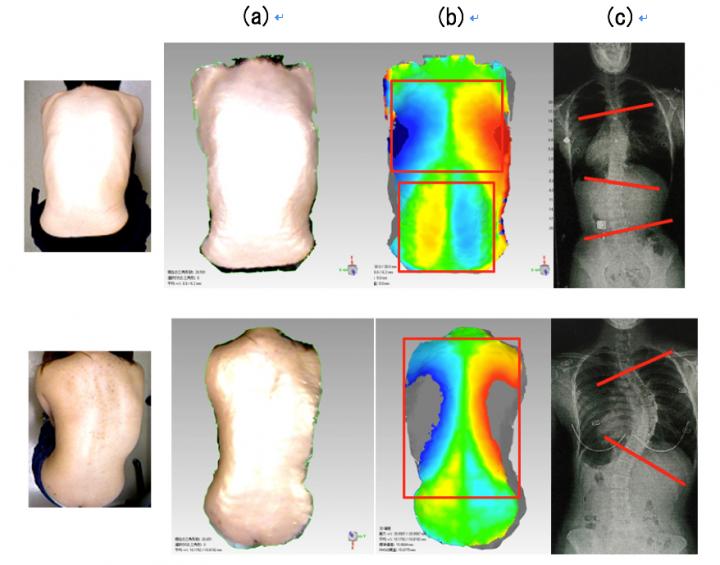
IMAGE

Credit: Images: Hokkaido University/Noa Co., Ltd.

Hokkaido University researchers have developed a symmetry-recognition system for the surface of the human back that can three-dimensionally detect the early stages of idiopathic scoliosis, a type of spinal deformity, without the help of a specialist doctor.

Individuals with idiopathic scoliosis, many of whom are pubescent girls, suffer from serious curvature of the spine. The disease has a characteristically high affliction rate, affecting one in 50 people.

Early detection of the progressive ailment is regarded as essential for treatment, as it is effective to wear a special brace when the spine is curved by 30 degrees or more. In recent years, genetic study of the disease has progressed, boosting the development of treatments.

In accordance with stipulations in the Japanese School Health and Safety Act, elementary and junior high schools conduct physical check-ups aimed at detecting idiopathic scoliosis. However, the law leaves it up to the respective medical associations or education boards in each municipality to decide how to conduct the checks, giving rise to regional gaps in the detection rate. Another related problem is the burden placed on doctors who have to examine a large number of students within a limited time frame.

To address these issues, two scientists from different fields of research, Associate Professor Hideki Sudo of Hokkaido University's Graduate School of Medicine and Professor Satoshi Kanai of the Graduate School of Information Science and Technology developed a system to evaluate the level of asymmetry on the surface of the back when measured three-dimensionally.

In a collaboration between the university and Noa Co., Ltd., the researchers developed a prototype device for detecting idiopathic scoliosis. The device is expected to go through clinical testing so that it can be used in clinics and for physical examinations at schools.

The device three-dimensionally scans multiple points on the back, enabling the evaluation of the back's symmetry from any angle in a few seconds. In this way, it is expected to enable speedy and accurate detections of idiopathic scoliosis. In the future, the researchers hope to gain government approval for the clinical use of their device.

###

Media Contact

Naoki Namba
[email protected]
81-117-068-034
@hokkaido_uni

http://www.oia.hokudai.ac.jp/

############

Story Source: Materials provided by Scienmag

Share12Tweet8Share2ShareShareShare2

Related Posts

β-Sitosterol from Ipomoea carnea Jacq. As a promising anti-inflammatory agent: Evidence from in silico modeling and in vitro validation

β-Sitosterol from Ipomoea carnea Jacq. As a promising anti-inflammatory agent: Evidence from in silico modeling and in vitro validation

August 31, 2026
Design, fabrication and characterization of a wearable Fiber Bragg grating sensor for cardiorespiratory monitoring using finger plethysmography

Design, fabrication and characterization of a wearable Fiber Bragg grating sensor for cardiorespiratory monitoring using finger plethysmography

August 31, 2026

KAIST opens the era of industrial-scale microbial foods, proposing growth strategies for the next-generation protein market

August 31, 2026

Virologist awarded $2 million NIH grant to investigate how virus-infected cells live and die

August 31, 2026
Please login to join discussion

POPULAR NEWS

  • β-Sitosterol from Ipomoea carnea Jacq. As a promising anti-inflammatory agent: Evidence from in silico modeling and in vitro validation

    29 shares
    Share 12 Tweet 7
  • Design, fabrication and characterization of a wearable Fiber Bragg grating sensor for cardiorespiratory monitoring using finger plethysmography

    29 shares
    Share 12 Tweet 7
  • KAIST opens the era of industrial-scale microbial foods, proposing growth strategies for the next-generation protein market

    29 shares
    Share 12 Tweet 7
  • Virologist awarded $2 million NIH grant to investigate how virus-infected cells live and die

    29 shares
    Share 12 Tweet 7

About

We bring you the latest biotechnology news from best research centers and universities around the world. Check our website.

Follow us

Recent News

β-Sitosterol from Ipomoea carnea Jacq. As a promising anti-inflammatory agent: Evidence from in silico modeling and in vitro validation

Design, fabrication and characterization of a wearable Fiber Bragg grating sensor for cardiorespiratory monitoring using finger plethysmography

KAIST opens the era of industrial-scale microbial foods, proposing growth strategies for the next-generation protein market

Subscribe to Blog via Email

Success! An email was just sent to confirm your subscription. Please find the email now and click 'Confirm' to start subscribing.

Join 85 other subscribers
  • Contact Us

Bioengineer.org © Copyright 2023 All Rights Reserved.

Welcome Back!

Login to your account below

Forgotten Password?

Retrieve your password

Please enter your username or email address to reset your password.

Log In
No Result
View All Result
  • Homepages
    • Home Page 1
    • Home Page 2
  • News
  • National
  • Business
  • Health
  • Lifestyle
  • Science

Bioengineer.org © Copyright 2023 All Rights Reserved.