• HOME
  • NEWS
  • EXPLORE
    • CAREER
      • Companies
      • Jobs
    • EVENTS
    • iGEM
      • News
      • Team
    • PHOTOS
    • VIDEO
    • WIKI
  • BLOG
  • COMMUNITY
    • FACEBOOK
    • INSTAGRAM
    • TWITTER
Sunday, July 19, 2026
BIOENGINEER.ORG
No Result
View All Result
  • Login
  • HOME
  • NEWS
  • EXPLORE
    • CAREER
      • Companies
      • Jobs
        • Lecturer
        • PhD Studentship
        • Postdoc
        • Research Assistant
    • EVENTS
    • iGEM
      • News
      • Team
    • PHOTOS
    • VIDEO
    • WIKI
  • BLOG
  • COMMUNITY
    • FACEBOOK
    • INSTAGRAM
    • TWITTER
  • HOME
  • NEWS
  • EXPLORE
    • CAREER
      • Companies
      • Jobs
        • Lecturer
        • PhD Studentship
        • Postdoc
        • Research Assistant
    • EVENTS
    • iGEM
      • News
      • Team
    • PHOTOS
    • VIDEO
    • WIKI
  • BLOG
  • COMMUNITY
    • FACEBOOK
    • INSTAGRAM
    • TWITTER
No Result
View All Result
Bioengineer.org
No Result
View All Result
Home NEWS Science News Health

A new, streamlined approach to diagnosing and treating bowel cancer

Bioengineer by Bioengineer
April 17, 2018
in Health
Reading Time: 2 mins read
0
Share on FacebookShare on TwitterShare on LinkedinShare on RedditShare on Telegram
IMAGE

Credit: Dr Susan Woods, SAHMRI

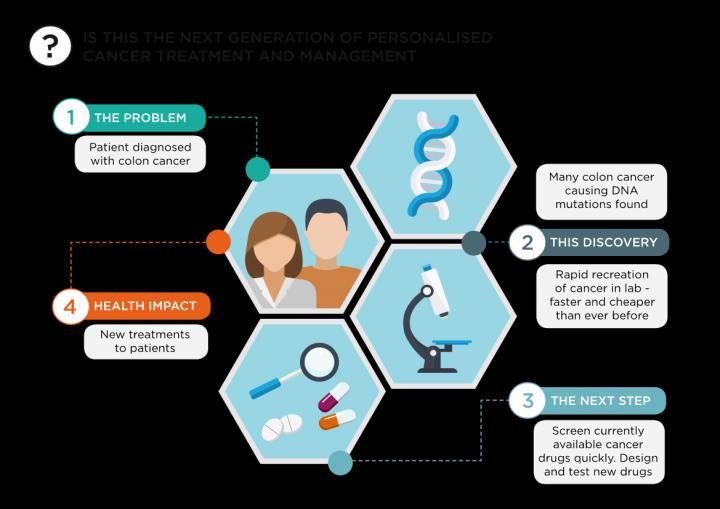
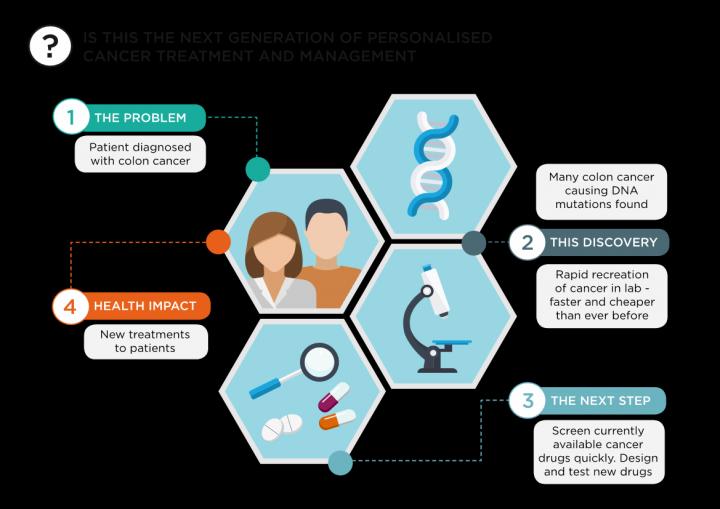
Researchers at the South Australian Health and Medical Research Institute (SAHMRI) and the University of Adelaide have discovered a faster, more cost-effective way to determine which DNA mutations cause human bowel cancer.

This research, published in Gut, a premier world journal for colorectal cancer research, outlines a new preclinical pipeline, where different DNA changes are engineered into the normal colon in rapid time, cutting years off traditional laboratory experiments. The growing cancers can then be monitored in the state-of-the-art SAHMRI imaging centre by colonoscopy, CT, special in vivo imaging and PET.

Harnessing the power of technology to improve health outcomes for bowel cancer

More than 4,000 Australians die from bowel cancer each year, and more than 17,000 new cases of this cancer will be diagnosed in 2018 – the Gastrointestinal Cancer Biology Group are working to understand the genetic drivers of bowel cancer, with a special interest in those cancers which are the hardest to treat, and which have the poorest prognosis.

Study Co-Lead, Dr Susan Woods, said that with recent advances in genome sequencing more information than ever before is available about changes to the inherited material, or DNA, that occur in bowel cancer. Combined with exciting new gene editing technology (CRISPR), we can now deliver the same outcomes in less than a quarter of the time, meaning we can take research from the bench to the patient far more rapidly, and with far less cost.

"Now, we have rapidly made new models of bowel cancer that mimic the complex genetic (DNA) changes that we see in human tumours and recapitulate features of the human disease," Dr Woods said.

"Our new technology allows us to screen and repurpose existing drugs which may not have been tested in bowel cancer, to screen potential new life-saving drugs as they are developed, and to improve bowel cancer detection, by being able to watch the cancer develop in real time."

A new way forward

This new method helps determine which DNA changes are important to the cancer, in a fraction of the time, at less expense and using fewer animals than traditional genetically-engineered models that are used in cancer research. Analysis of the models, combined with patient data, has suggested potential drug vulnerabilities that are being tested.

###

Media Contact

Hannah Brown
[email protected]
61-041-482-3795
@UniofAdelaide

http://www.adelaide.edu.au

Related Journal Article

http://dx.doi.org/10.1136/gutjnl-2017-315920

Share12Tweet8Share2ShareShareShare2

Related Posts

Cognitive reserve helps older adults resist frailty and recover better

July 19, 2026

Physical Activity and Health Inequality in China’s Older Adults

July 19, 2026

Factors Influencing Elderly Preference for Dental Services

July 18, 2026

Frequency-Dependent Deep Brain Stimulation in Motor Thalamus Alters Speech and Swallowing

July 18, 2026
Please login to join discussion

POPULAR NEWS

  • Groundbreaking Discovery: New Shark Species Identified for the First Time — Technology and Engineering

    Groundbreaking Discovery: New Shark Species Identified for the First Time

    34 shares
    Share 14 Tweet 9
  • Controlled Study Defines Pediatric Long COVID Features

    32 shares
    Share 13 Tweet 8
  • Behavioral Nudge Boosts Medication Prescriptions for Alcohol Reduction

    35 shares
    Share 14 Tweet 9
  • Clean Cooking and Remittances Slash Somalia’s Ecological Footprints

    31 shares
    Share 12 Tweet 8

About

We bring you the latest biotechnology news from best research centers and universities around the world. Check our website.

Follow us

Recent News

Cognitive reserve helps older adults resist frailty and recover better

Physical Activity and Health Inequality in China’s Older Adults

Topological Jackiw-Rebbi States in Photonic Van der Waals Heterostructures

Subscribe to Blog via Email

Enter your email address to subscribe to this blog and receive notifications of new posts by email.

Join 85 other subscribers
  • Contact Us

Bioengineer.org © Copyright 2023 All Rights Reserved.

Welcome Back!

Login to your account below

Forgotten Password?

Retrieve your password

Please enter your username or email address to reset your password.

Log In
No Result
View All Result
  • Homepages
    • Home Page 1
    • Home Page 2
  • News
  • National
  • Business
  • Health
  • Lifestyle
  • Science

Bioengineer.org © Copyright 2023 All Rights Reserved.