• HOME
  • NEWS
  • EXPLORE
    • CAREER
      • Companies
      • Jobs
    • EVENTS
    • iGEM
      • News
      • Team
    • PHOTOS
    • VIDEO
    • WIKI
  • BLOG
  • COMMUNITY
    • FACEBOOK
    • INSTAGRAM
    • TWITTER
Saturday, August 22, 2026
BIOENGINEER.ORG
No Result
View All Result
  • Login
  • HOME
  • NEWS
  • EXPLORE
    • CAREER
      • Companies
      • Jobs
        • Lecturer
        • PhD Studentship
        • Postdoc
        • Research Assistant
    • EVENTS
    • iGEM
      • News
      • Team
    • PHOTOS
    • VIDEO
    • WIKI
  • BLOG
  • COMMUNITY
    • FACEBOOK
    • INSTAGRAM
    • TWITTER
  • HOME
  • NEWS
  • EXPLORE
    • CAREER
      • Companies
      • Jobs
        • Lecturer
        • PhD Studentship
        • Postdoc
        • Research Assistant
    • EVENTS
    • iGEM
      • News
      • Team
    • PHOTOS
    • VIDEO
    • WIKI
  • BLOG
  • COMMUNITY
    • FACEBOOK
    • INSTAGRAM
    • TWITTER
No Result
View All Result
Bioengineer.org
No Result
View All Result
Home NEWS Science News

A new spintronic phenomenon: Chiral-spin rotation found in non-collinear antiferromagnet

Bioengineer by Bioengineer
May 21, 2021
in Science News
Reading Time: 2 mins read
0
IMAGE
Share on FacebookShare on TwitterShare on LinkedinShare on RedditShare on Telegram

IMAGE

Credit: S.Fukami

Researchers at Tohoku University and the Japan Atomic Energy Agency (JAEA) have discovered a new spintronic phenomenon – a persistent rotation of chiral-spin structure.

Their discovery was published in the journal Nature Materials on May 13, 2021.

Tohoku University and JAEA researchers studied the response of chiral-spin structure of a non-collinear antiferromagnet Mn3Sn thin film to electron spin injection and found that the chiral-spin structure shows persistent rotation at zero magnetic field. Moreover, their frequency can be tuned by the applied current.

“The electrical control of magnetic structure has been of paramount interest in the spintronics community for the last quarter of a century. The phenomenon shown here provides a very efficient scheme to manipulate magnetic structures, offering new opportunities for application, such as oscillators, random number generators, and nonvolatile memory,” said Professor Shunsuke Fukami, who spearheaded the project.

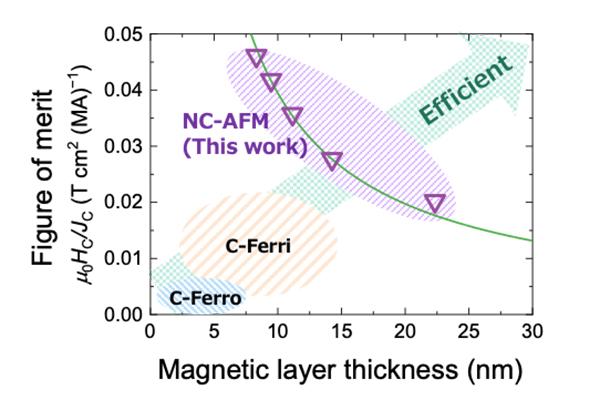
Figure 1 compares the efficiency of manipulating the magnetic structure on a non-collinear antiferromagnet, as seen in the present work, with those reported for other material systems. The current-induced chiral-spin rotation is much more efficient even for thick magnetic layers above 20 nm.

The schematics of chiral-spin rotation as well as the experimental setup are shown in figure 2.

The researchers used a high-quality heterostructure consisting of non-collinear antiferromagnet Mn3Sn sandwiched between heavy metals W/Ta and Pt. They revealed that, when a current is applied to the heterostructure, the chiral-spin structure rotates persistently at zero magnetic field because of the torque originating from the spin current generated in the heavy metals. Meanwhile, the rotation frequency, typically above 1 GHz, depends on the applied current.

Spintronics is an interdisciplinary field, where electric and magnetic degrees of freedom of electrons are utilized simultaneously, allowing for an electrical manipulation of magnetic structure. Representative schemes established so far are summarized in figure 3.

Magnetization switching, magnetic-phase transition, oscillation, and resonance have been observed in ferromagnets, which are promising since they may lead to the realization of functional devices in nonvolatile memory, wireless communication, and so on.

Additionally, in antiferromagnets, the 90-degree rotation of Néel vector in collinear systems and the 180 degree switching of chiral-spin structures in non-collinear systems have been observed recently. The chiral-spin persistent rotation in the current work is totally different from all the previously found phenomena and thus should open a new horizon of the spintronics research.

“The obtained insight is not only interesting in terms of physics and material science but also attractive for functional device applications,” added Dr. Yutaro Takeuchi, the first author of the paper. “We would like to further improve the material and device technique in the near future and demonstrate new functional devices such as tunable oscillator and high-quality true random number generator.”

###

Media Contact
Shunsuke Fukami
[email protected]

Original Source

https://www.tohoku.ac.jp/en/press/chiral_spin_rotation.html

Related Journal Article

http://dx.doi.org/10.1038/s41563-021-01005-3

Tags: Technology/Engineering/Computer Science
Share12Tweet8Share2ShareShareShare2

Related Posts

Ge/SiGe Quantum-Well Photodetectors Integrated with SiN Waveguides on 200-mm Silicon Wafers

Ge/SiGe Quantum-Well Photodetectors Integrated with SiN Waveguides on 200-mm Silicon Wafers

August 22, 2026

Consensus Roadmap Guides Clinical Trials for Rare Childhood CNS Tumors

August 22, 2026

Proteomics Links Environmental and Genetic Parkinson’s Models to Purine Metabolism

August 22, 2026

Wearable Devices Track Activity Rhythms to Reveal Biological Aging Over Time

August 22, 2026
Please login to join discussion

POPULAR NEWS

  • Ge/SiGe Quantum-Well Photodetectors Integrated with SiN Waveguides on 200-mm Silicon Wafers

    29 shares
    Share 12 Tweet 7
  • Consensus Roadmap Guides Clinical Trials for Rare Childhood CNS Tumors

    29 shares
    Share 12 Tweet 7
  • Proteomics Links Environmental and Genetic Parkinson’s Models to Purine Metabolism

    29 shares
    Share 12 Tweet 7
  • Wearable Devices Track Activity Rhythms to Reveal Biological Aging Over Time

    29 shares
    Share 12 Tweet 7

About

We bring you the latest biotechnology news from best research centers and universities around the world. Check our website.

Follow us

Recent News

Ge/SiGe Quantum-Well Photodetectors Integrated with SiN Waveguides on 200-mm Silicon Wafers

Consensus Roadmap Guides Clinical Trials for Rare Childhood CNS Tumors

Proteomics Links Environmental and Genetic Parkinson’s Models to Purine Metabolism

Subscribe to Blog via Email

Enter your email address to subscribe to this blog and receive notifications of new posts by email.

Join 85 other subscribers
  • Contact Us

Bioengineer.org © Copyright 2023 All Rights Reserved.

Welcome Back!

Login to your account below

Forgotten Password?

Retrieve your password

Please enter your username or email address to reset your password.

Log In
No Result
View All Result
  • Homepages
    • Home Page 1
    • Home Page 2
  • News
  • National
  • Business
  • Health
  • Lifestyle
  • Science

Bioengineer.org © Copyright 2023 All Rights Reserved.