• HOME
  • NEWS
  • EXPLORE
    • CAREER
      • Companies
      • Jobs
    • EVENTS
    • iGEM
      • News
      • Team
    • PHOTOS
    • VIDEO
    • WIKI
  • BLOG
  • COMMUNITY
    • FACEBOOK
    • INSTAGRAM
    • TWITTER
Thursday, July 2, 2026
BIOENGINEER.ORG
No Result
View All Result
  • Login
  • HOME
  • NEWS
  • EXPLORE
    • CAREER
      • Companies
      • Jobs
        • Lecturer
        • PhD Studentship
        • Postdoc
        • Research Assistant
    • EVENTS
    • iGEM
      • News
      • Team
    • PHOTOS
    • VIDEO
    • WIKI
  • BLOG
  • COMMUNITY
    • FACEBOOK
    • INSTAGRAM
    • TWITTER
  • HOME
  • NEWS
  • EXPLORE
    • CAREER
      • Companies
      • Jobs
        • Lecturer
        • PhD Studentship
        • Postdoc
        • Research Assistant
    • EVENTS
    • iGEM
      • News
      • Team
    • PHOTOS
    • VIDEO
    • WIKI
  • BLOG
  • COMMUNITY
    • FACEBOOK
    • INSTAGRAM
    • TWITTER
No Result
View All Result
Bioengineer.org
No Result
View All Result
Home NEWS Science News Biology

A new species of mammal may have been found in Africa’s montane forests

Bioengineer by Bioengineer
December 22, 2020
in Biology
Reading Time: 2 mins read
0
IMAGE
Share on FacebookShare on TwitterShare on LinkedinShare on RedditShare on Telegram

IMAGE

Credit: Hanna Rosti

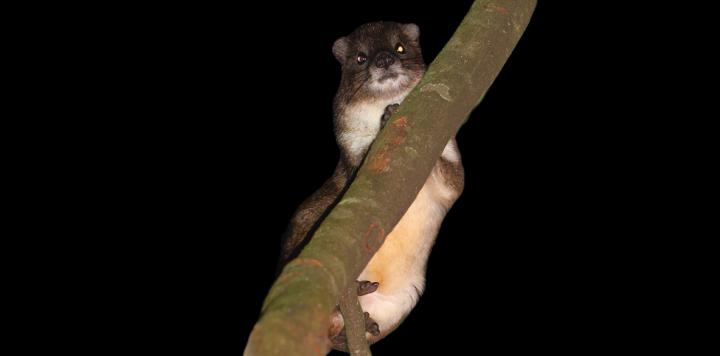
A research team from the University of Helsinki has discovered a tree hyrax in the Taita Hills, Kenya, which may belong to a species previously unknown to science.

The discovery, which was part of a study of the vocalisations of nocturnal animals in the Taita Hills, was published in mid-December in the scientific journal Discovery.

Very little is known about the diversity and ecology of tree hyraxes because these animals, which look like large guinea pigs but are distant relatives of elephants, are mainly active at night in the tree canopies in Africa’s tropical forests. These animals are known to be able to scream with the strength of more than one hundred decibels, but the ‘strangled thwack’ calls that have been recorded in Taita’s forests have not been described anywhere else.

The re­cord­ings re­veal that the Taita tree hyraxes sing

The tree hyrax song may continue for more than twelve minutes, and it consists of different syllables that are combined and repeated in various ways.

“The singing animals are probably males attempting to attract females that are willing to mate,” postulates Hanna Rosti, who spent three months in Taita’s forests, following the nocturnal mammals and recording their vocalisations.

The results suggest that the two populations of dwarf galago in the Taita Hills may belong to different species. The calls of the animals of the smaller population are very similar to those of the Kenya coast dwarf galago, a species that has previously been thought to live only in coastal, low elevation forests. The peculiar calls of the second population cannot yet be linked with certainty to any known species.

“The taxonomy of many nocturnal mammals remains poorly known, and many populations have not been studied at all yet,” says researcher Henry Pihlström, who reviewed the complex taxonomy of tree hyraxes and galagos for the published study.

###

Media Contact
Hanna Rosti
[email protected]

Original Source

https://www.helsinki.fi/en/news/life-science-news/strangers-in-the-night-a-new-species-of-mammal-may-have-been-found-in-africas-montane-forests

Related Journal Article

http://dx.doi.org/10.3390/d12120473

Tags: BiodiversityBiologyEcology/Environment
Share12Tweet8Share2ShareShareShare2

Related Posts

Evolution-Inspired Biosensors Revolutionize Lipid Tracking in Real Time — Biology

Evolution-Inspired Biosensors Revolutionize Lipid Tracking in Real Time

July 2, 2026
New Study Reveals How to Reduce Risk of Dangerous Wildlife Encounters This Summer — Biology

New Study Reveals How to Reduce Risk of Dangerous Wildlife Encounters This Summer

July 2, 2026

Hepatic IFRD1 Alleviates Metabolic Dysfunction-Linked Steatohepatitis Through the GLUD1/α-KG Pathway

July 2, 2026

Intricate Food Webs Support Ecosystem Health and Stability

July 2, 2026
Please login to join discussion

POPULAR NEWS

  • Detection of EDCs in Breast Milk and Infant Urine Up to Six Months Highlights Early Exposure Risks

    77 shares
    Share 31 Tweet 19
  • Saying Goodbye to PGY-6: Pediatric Fellowship Realities

    103 shares
    Share 41 Tweet 26
  • New Drug Candidate Developed at McMaster Shows Potential for Treating Brain Cancer

    58 shares
    Share 23 Tweet 15
  • KTU Researchers Explore Ultrasound’s Role in Enhancing Blood Flow Beyond Diagnostics

    53 shares
    Share 21 Tweet 13

About

BIOENGINEER.ORG

We bring you the latest biotechnology news from best research centers and universities around the world. Check our website.

Follow us

Recent News

Steatosis Drives Liver Metastasis Diversity in CRC

Unlocking the Mysteries of Alzheimer’s Disease

Pensoft Introduces New Peer-Reviewed Journal of Regeneration to Advance Restorative Biology Across Species

Subscribe to Blog via Email

Enter your email address to subscribe to this blog and receive notifications of new posts by email.

Join 83 other subscribers
  • Contact Us

Bioengineer.org © Copyright 2023 All Rights Reserved.

Welcome Back!

Login to your account below

Forgotten Password?

Retrieve your password

Please enter your username or email address to reset your password.

Log In
No Result
View All Result
  • Homepages
    • Home Page 1
    • Home Page 2
  • News
  • National
  • Business
  • Health
  • Lifestyle
  • Science

Bioengineer.org © Copyright 2023 All Rights Reserved.