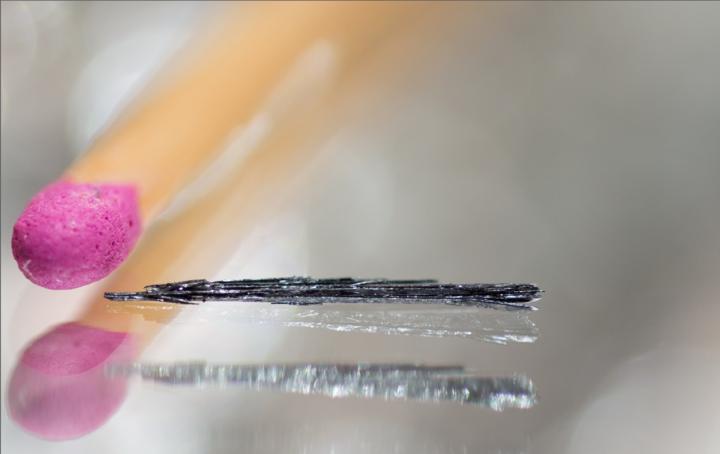
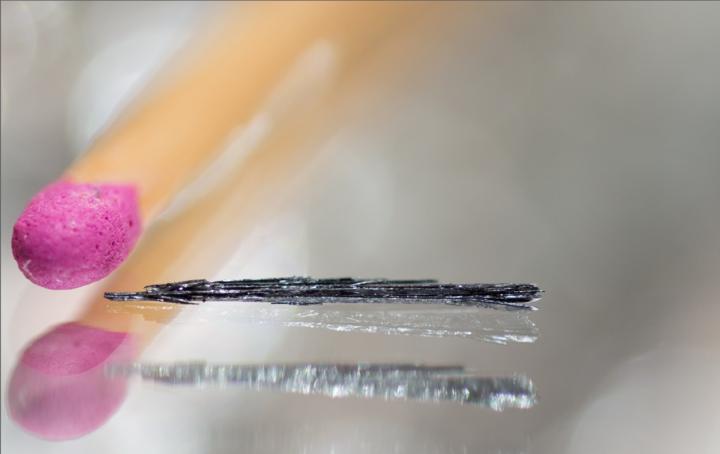
Credit: László Forró/EPFL
EPFL scientists have developed a new perovskite material with unique properties that can be used to build next-generation hard drives.
As we generate more and more data, we need storage systems, e.g. hard drives, with higher density and efficiency. But this also requires materials whose magnetic properties can be quickly and easily manipulated in order to write and access data on them. EPFL scientists have now developed a perovskite material whose magnetic order can be rapidly changed without disrupting it due to heating. The work, which describes the first ever magnetic photoconductor, is published in Nature Communications.
The lab of Laszló Forró, in a project led by postdoc Bálint Náfrádi, synthesized a ferromagnetic photovoltaic material. Perovskite photovoltaics are gradually becoming a cheaper alternative to current silicon systems, drawing much interest from energy scientists. But this particular material, which is a modified version of perovskite, exhibits some unique properties that make it particularly interesting as a material to build next-generation digital storage systems.
Magnetism in material arises from the interactions of localized and moving electrons of the material; in a way, it is the result of competition between different movements of electrons. This means that the resulting magnetic state is wired in the material and it cannot be reversed without changing the structure of electrons in the material's chemistry or crystal structure. But an easy way to modify magnetic properties would be an enormous advantage in many applications such as magnetic data storage.
The new material that the EPFL scientists developed offers exactly that. "We have essentially discovered the first magnetic photoconductor," says Bálint Náfrádi. This new crystal structure combines the advantages of both ferromagnets, whose magnetic moments are aligned in a well-defined order, and photoconductors, where light illumination generates high density free conduction electrons.
The combination of the two properties produced an entirely new phenomenon: the "melting" of magnetization by photo-electrons, which are electrons that are emitted from a material when light hits it. In the new perovskite material, a simple red LED — much weaker than a laser pointer — is enough to disrupt, or "melt" the material's magnetic order and generate a high density of travelling electrons, which can be freely and continuously tuned by changing the light's intensity. The timescale for shifting the magnetic in this material is also very fast, virtually needing only quadrillionths of a second.
Though still experimental, all these properties mean that the new material can be used to build the next generation of memory-storage systems, featuring higher capacities with low energy demands. "This study provides the basis for the development of a new generation of magneto-optical data storage devices," says Náfrádi. "These would combine the advantages of magnetic storage — long-term stability, high data density, non-volatile operation and re-writability– with the speed of optical writing and reading."
###
This work included contributions from the European Synchrotron Radiation Facility and the University of Geneva. It was funded by the Swiss National Science Foundation, the European Research Council (PICOPROP and TopoMat) and the NCCR-MARVEL.
Reference
B. Náfrádi, P. Szirmai, M. Spina, H. Lee, O. V. Yazyev, A. Arakcheeva, D. Chernyshov, M. Gibert, L. Forró, E. Horváth. Optically switched magnetism in photovoltaic perovskite CH3NH3(Mn:Pb)I3. Nature Communications 24 November 2016. DOI: 10.1038/ncomms13406 D
Media Contact
Nik Papageorgiou
[email protected]
41-216-932-105
@EPFL_en
http://www.epfl.ch/index.en.html
############
Story Source: Materials provided by Scienmag