• HOME
  • NEWS
  • EXPLORE
    • CAREER
      • Companies
      • Jobs
    • EVENTS
    • iGEM
      • News
      • Team
    • PHOTOS
    • VIDEO
    • WIKI
  • BLOG
  • COMMUNITY
    • FACEBOOK
    • INSTAGRAM
    • TWITTER
Friday, June 5, 2026
BIOENGINEER.ORG
No Result
View All Result
  • Login
  • HOME
  • NEWS
  • EXPLORE
    • CAREER
      • Companies
      • Jobs
        • Lecturer
        • PhD Studentship
        • Postdoc
        • Research Assistant
    • EVENTS
    • iGEM
      • News
      • Team
    • PHOTOS
    • VIDEO
    • WIKI
  • BLOG
  • COMMUNITY
    • FACEBOOK
    • INSTAGRAM
    • TWITTER
  • HOME
  • NEWS
  • EXPLORE
    • CAREER
      • Companies
      • Jobs
        • Lecturer
        • PhD Studentship
        • Postdoc
        • Research Assistant
    • EVENTS
    • iGEM
      • News
      • Team
    • PHOTOS
    • VIDEO
    • WIKI
  • BLOG
  • COMMUNITY
    • FACEBOOK
    • INSTAGRAM
    • TWITTER
No Result
View All Result
Bioengineer.org
No Result
View All Result
Home NEWS Science News Chemistry

A new member in AIE family

Bioengineer by Bioengineer
September 24, 2019
in Chemistry
Reading Time: 2 mins read
0
IMAGE
Share on FacebookShare on TwitterShare on LinkedinShare on RedditShare on Telegram

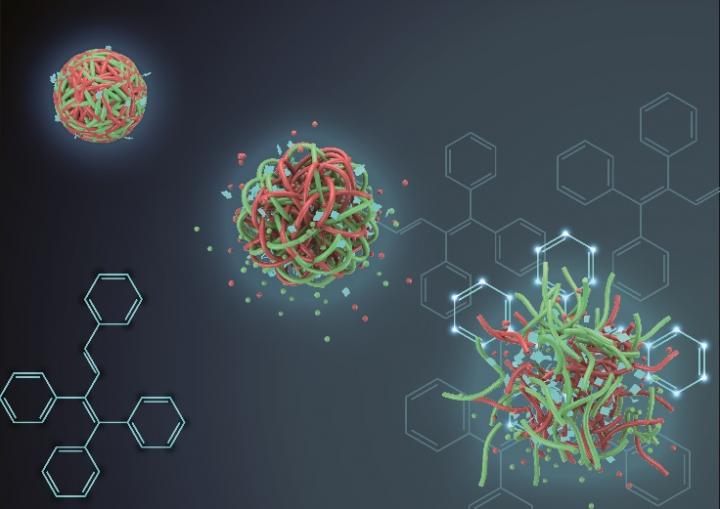
Conformational sensitive asymmetry 1,1,2,4-tetraphenyl-1,3-butadiene derivatives
IMAGE

Credit: ©Science China Press

Aggregation-induced emission (AIE) was first reported by Tang`s group in 2001. Many research efforts have been devoted to the exploration structure-property-application of AIE. The focal points and hot spots of AIE are to design new structural systems and to illuminate the relationship of structural properties. Many new compounds with AIE characteristics have been designed and synthesized to enrich the members in AIE family. However, there are almost no reports thus far on the analog 1,1,2,4-tetraphenyl-1,3-butadiene (TPB) that was studied in AIE fields.

Recently, Professor Yuping Dong’s group, from Beijing Institute of Technology, demonstrated a new member of AIE family: TPB with conformational sensitivity. The experimental results show that TPB-1, TPB-2 and TPB-3 have typical AIE characteristics, that is, there is no fluorescence in the solution, and strong fluorescence in the aggregate state. Unlike the existing AIE molecules, the TPB derivative does not have a strong electron-withdrawing electron group. The emission wavelength of the aggregated state is nearly 80 nm larger than that of the molecular state. All the experimental results indicated that 4-position of arylene group had a sensitively changing conformation in different state, which resulted in the emission wavelength movement.

Conformational sensitivity was used to monitor the critical transition point of polyelectrolyte complexes of PSS/PADAMA in different KBr concentration. Inserting TPB-3 molecule into PSS/PADAMA system with a mass fraction of 0.15% detected the critical transition point of PSS/PADAMA polyelectrolyte complexes in about 1.8 mol/L of KBr.

###

See the article: Zhang Y, Xu H, Xu W, Zhang C, Shi J, Tong B, Cai Z, Dong Y. Conformational sensitivity of tetraphenyl-1,3-butadiene derivatives with aggregation-induced emission characteristics. Sci. China Chem., 2019, DOI: 10.1007/s11426-019-9576-7.

http://engine.scichina.com/publisher/scp/journal/SCC/doi/10.1007/s11426-019-9576-7

Media Contact
Yuping Dong
[email protected]

Related Journal Article

http://dx.doi.org/10.1007/s11426-019-9576-7

Tags: Chemistry/Physics/Materials Sciences
Share12Tweet8Share2ShareShareShare2

Related Posts

How Asymmetric Alloying Is Revolutionizing the Next Generation of Luminescent Materials — Chemistry

How Asymmetric Alloying Is Revolutionizing the Next Generation of Luminescent Materials

June 5, 2026
Biochar and Beneficial Fungi Collaborate to Rehabilitate Soils Degraded by Coal Mining — Chemistry

Biochar and Beneficial Fungi Collaborate to Rehabilitate Soils Degraded by Coal Mining

June 4, 2026

Boston University Partners with National Science Foundation Institute to Advance Frontiers in Physics and AI

June 4, 2026

JWST Successfully Measures Mass of Dormant Black Hole from the Early Universe for the First Time

June 4, 2026
Please login to join discussion

POPULAR NEWS

  • ESMO 2025: mRNA COVID Vaccines Enhance Efficacy of Cancer Immunotherapy

    321 shares
    Share 128 Tweet 80
  • Multi-Hospital Study Reveals Long Covid Burden Is Twice as High as Current Estimates

    88 shares
    Share 35 Tweet 22
  • Saying Goodbye to PGY-6: Pediatric Fellowship Realities

    76 shares
    Share 30 Tweet 19
  • Common Food Preservatives Associated with Elevated Blood Pressure and Increased Heart Disease Risk

    57 shares
    Share 23 Tweet 14

About

We bring you the latest biotechnology news from best research centers and universities around the world. Check our website.

Follow us

Recent News

Exploring Protein Structures Globally with Folddisco

Proteogenomics Uncovers Medulloblastoma Progression Subtypes

Sociopolitical Polarization and Misinformation in 2022 Brazil

Subscribe to Blog via Email

Enter your email address to subscribe to this blog and receive notifications of new posts by email.

Join 82 other subscribers
  • Contact Us

Bioengineer.org © Copyright 2023 All Rights Reserved.

Welcome Back!

Login to your account below

Forgotten Password?

Retrieve your password

Please enter your username or email address to reset your password.

Log In
No Result
View All Result
  • Homepages
    • Home Page 1
    • Home Page 2
  • News
  • National
  • Business
  • Health
  • Lifestyle
  • Science

Bioengineer.org © Copyright 2023 All Rights Reserved.