• HOME
  • NEWS
  • EXPLORE
    • CAREER
      • Companies
      • Jobs
    • EVENTS
    • iGEM
      • News
      • Team
    • PHOTOS
    • VIDEO
    • WIKI
  • BLOG
  • COMMUNITY
    • FACEBOOK
    • INSTAGRAM
    • TWITTER
Friday, May 15, 2026
BIOENGINEER.ORG
No Result
View All Result
  • Login
  • HOME
  • NEWS
  • EXPLORE
    • CAREER
      • Companies
      • Jobs
        • Lecturer
        • PhD Studentship
        • Postdoc
        • Research Assistant
    • EVENTS
    • iGEM
      • News
      • Team
    • PHOTOS
    • VIDEO
    • WIKI
  • BLOG
  • COMMUNITY
    • FACEBOOK
    • INSTAGRAM
    • TWITTER
  • HOME
  • NEWS
  • EXPLORE
    • CAREER
      • Companies
      • Jobs
        • Lecturer
        • PhD Studentship
        • Postdoc
        • Research Assistant
    • EVENTS
    • iGEM
      • News
      • Team
    • PHOTOS
    • VIDEO
    • WIKI
  • BLOG
  • COMMUNITY
    • FACEBOOK
    • INSTAGRAM
    • TWITTER
No Result
View All Result
Bioengineer.org
No Result
View All Result
Home NEWS Science News Biology

A new mechanism helps explain differences between eukaryotic and bacterial proteomes

Bioengineer by Bioengineer
January 11, 2019
in Biology
Reading Time: 2 mins read
0
IMAGE
Share on FacebookShare on TwitterShare on LinkedinShare on RedditShare on Telegram

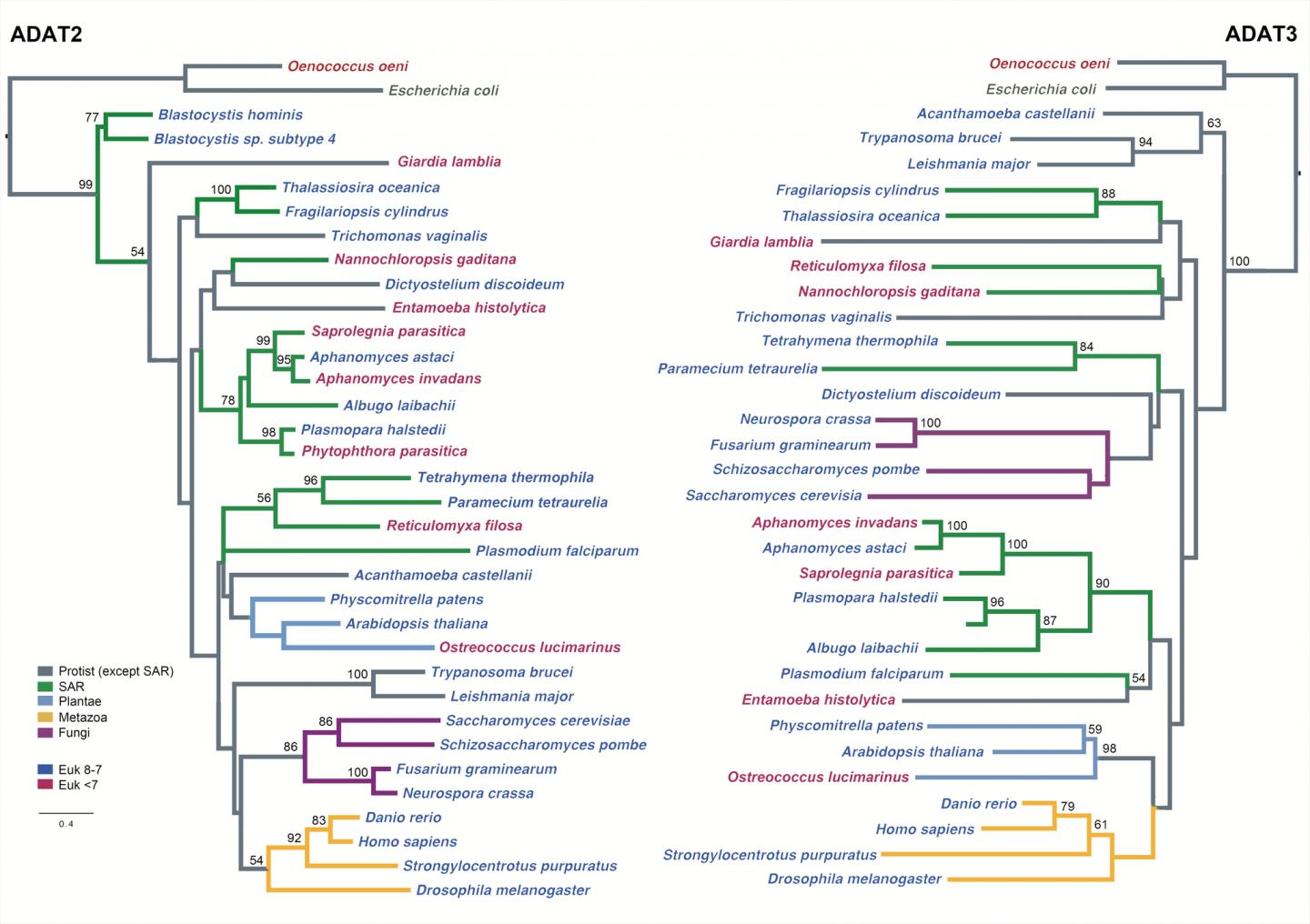
IMAGE

Credit: Molecular Biology and Evolution


What makes distinct species have different proteins? Is there a key that allows eukaryotic cells to produce proteins involved in multicellularity that are mostly absent in prokaryotes?

These are some of the questions addressed by the scientists headed by ICREA researcher Lluís Ribas, group leader of the Gene Translation lab at the Institute for Research in Biomedicine (IRB Barcelona). Their work has led to the discovery of a mechanism that allows eukaryotic cells to synthesize proteins that bacteria find hard to produce.

Published recently in the journal Molecular Biology and Evolution, the study has been done in collaboration with the team headed by Iñaki Ruiz-Trillo, ICREA researcher at the Institute of Evolutionary Biology in Barcelona.

“We discovered and described a mechanism evolved in eukaryotes that facilitates the synthesis of large, unstructured proteins such as those present in the extracellular matrix. Those are the proteins that surround each cell and allow them to associate and communicate with their environment” says Lluís Ribas.

The results of the research explain that the emergence of this functional improvement in some transfer RNAs (tRNA) facilitated the synthesis of proteins highly enriched in a specific set of amino acids, and drove an enrichment of genes coding for these tRNAs in eukaryotic genomes.

Many of these proteins are highly relevant to human health, and understanding the mechanisms essential to their synthesis may allow the development of strategies to inhibit their production in those diseases caused by their overabundance.

###

This study has been supported by the Ministry of Economy and Competitiveness (now called Ministry of Science, Innovation and Universities).

Reference article:

Àlbert Rafels-Ybern, Adrian Gabriel Torres, Noelia Camacho, Andrea Herencia-Ropero, Helena Roura Frigolé, Thomas F Wulff, Marina Raboteg, Albert Bordons, Xavier Grau-Bove, Iñaki Ruiz-Trillo, Lluís Ribas de Pouplana

The expansion of Inosine at the wobble position of tRNAs, and its role in the evolution of proteomes Molecular Biology and Evolution (2018) DOI: 10.1093/molbev/msy245

Media Contact
Sònia Armengou
[email protected]
34-934-037-255

Original Source

https://www.irbbarcelona.org/en/news/a-new-mechanism-helps-explain-differences-between-eukaryotic-and-bacterial-proteomes

Related Journal Article

http://dx.doi.org/10.1093/molbev/msy245

Tags: BiologyCell BiologyGenes
Share12Tweet8Share2ShareShareShare2

Related Posts

61 Newly Discovered Beetle Species Highlight How Much We Still Have to Learn About Biodiversity — Biology

61 Newly Discovered Beetle Species Highlight How Much We Still Have to Learn About Biodiversity

May 15, 2026
Supercomputer Simulations Uncover How Bacterial Enzyme Pumps Sodium Ions, Opening Doors to Novel Antibiotics — Biology

Supercomputer Simulations Uncover How Bacterial Enzyme Pumps Sodium Ions, Opening Doors to Novel Antibiotics

May 15, 2026

New Astrobiology Special Collection Highlights Emerging Evidence Supporting Land-Based Origins of Life

May 14, 2026

Revolutionizing Textiles: Engineered Protein Fibers Pave the Way for Sustainable, Recyclable Fabrics

May 14, 2026
Please login to join discussion

POPULAR NEWS

  • Research Indicates Potential Connection Between Prenatal Medication Exposure and Elevated Autism Risk

    843 shares
    Share 337 Tweet 211
  • New Study Reveals Plants Can Detect the Sound of Rain

    729 shares
    Share 291 Tweet 182
  • Salmonella Haem Blocks Macrophages, Boosts Infection

    62 shares
    Share 25 Tweet 16
  • Breastmilk Balances E. coli and Beneficial Bacteria in Infant Gut Microbiomes

    58 shares
    Share 23 Tweet 15

About

We bring you the latest biotechnology news from best research centers and universities around the world. Check our website.

Follow us

Recent News

Hanyang University Researchers Pinpoint 2.5 Nanometers as Minimum Coating Thickness for Durable Solid-State EV Batteries

Axonic Spine Synapses Trigger Action Potentials, Direct Signals

New Study Uncovers Why Breast Cancer Becomes More Lethal with Age

Subscribe to Blog via Email

Enter your email address to subscribe to this blog and receive notifications of new posts by email.

Join 82 other subscribers
  • Contact Us

Bioengineer.org © Copyright 2023 All Rights Reserved.

Welcome Back!

Login to your account below

Forgotten Password?

Retrieve your password

Please enter your username or email address to reset your password.

Log In
No Result
View All Result
  • Homepages
    • Home Page 1
    • Home Page 2
  • News
  • National
  • Business
  • Health
  • Lifestyle
  • Science

Bioengineer.org © Copyright 2023 All Rights Reserved.