

• HOME
  • NEWS
  • EXPLORE
    • CAREER
      • Companies
      • Jobs
    • EVENTS
    • iGEM
      • News
      • Team
    • PHOTOS
    • VIDEO
    • WIKI
  • BLOG
  • COMMUNITY
    • FACEBOOK
    • INSTAGRAM
    • TWITTER
Monday, August 31, 2026
BIOENGINEER.ORG
No Result
View All Result
  • Login
  • HOME
  • NEWS
  • EXPLORE
    • CAREER
      • Companies
      • Jobs
        • Lecturer
        • PhD Studentship
        • Postdoc
        • Research Assistant
    • EVENTS
    • iGEM
      • News
      • Team
    • PHOTOS
    • VIDEO
    • WIKI
  • BLOG
  • COMMUNITY
    • FACEBOOK
    • INSTAGRAM
    • TWITTER
  • HOME
  • NEWS
  • EXPLORE
    • CAREER
      • Companies
      • Jobs
        • Lecturer
        • PhD Studentship
        • Postdoc
        • Research Assistant
    • EVENTS
    • iGEM
      • News
      • Team
    • PHOTOS
    • VIDEO
    • WIKI
  • BLOG
  • COMMUNITY
    • FACEBOOK
    • INSTAGRAM
    • TWITTER
No Result
View All Result
Bioengineer.org
No Result
View All Result
Home NEWS Science News Biology

A new genetic marker accounts for up to 1.4 percent of cases of hereditary colon cancer

Bioengineer by Bioengineer
October 10, 2017
in Biology
Reading Time: 2 mins read
0
Share on FacebookShare on TwitterShare on LinkedinShare on RedditShare on Telegram
IMAGE

Credit: IDIBELL

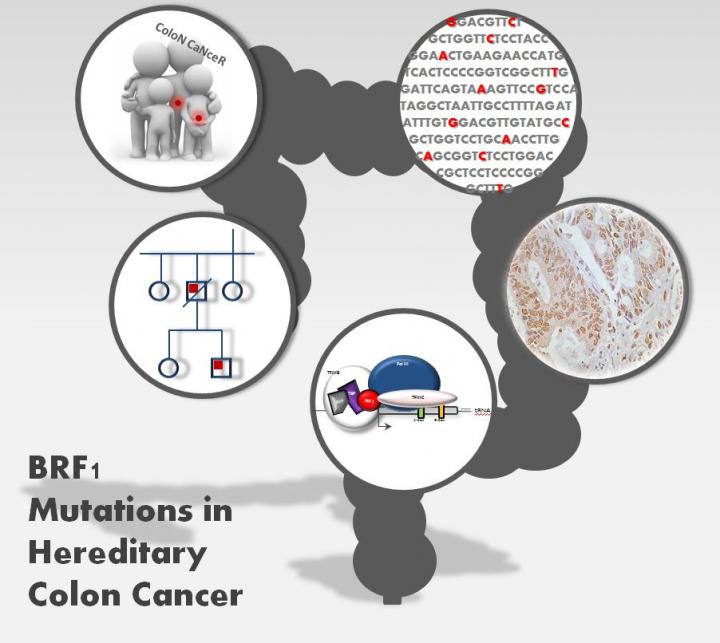
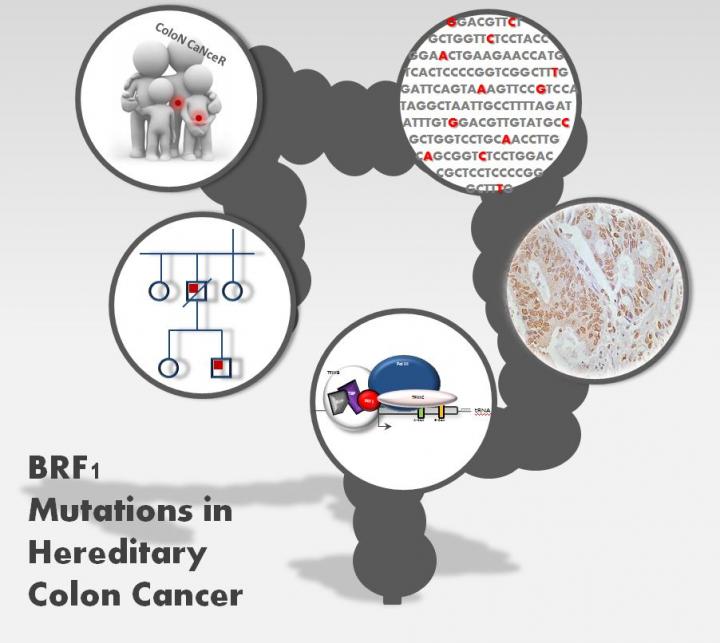
Researchers from the Hereditary Cancer group of the Oncobell Program of the Bellvitge Biomedical Research Institute (IDIBELL) – Hereditary Cancer Program of the Catalan Institute of Oncology (ICO) have found a new genetic marker that would explain up to 1.4% of those inherited colon cancer cases not related to the mutations currently associated with this disease. This finding, made possible by the new techniques of genetic sequencing, was the result of collaboration among several other research groups at national and international level.

"Our group primarily focuses on genetic markers of hereditary colon cancer," said Dr. Laura Valle, lead author of the study. "In recent years, we have sequenced the exome – all genes – from high-risk families with several members affected by colon cancer but who do not have the genetic mutations currently associated with this disease. The aim is to identify the altered genes that cause the aggregation of cancer in these families. If we do so, mutation carriers can enter into personalized follow-up programs to detect early onset of cancer, and even prevent it."

As for the work published by the journal Gastroenterology, the researchers singled out the BRF1 gene as a family colon cancer gene. "This gene has been mutated in tumors but has never been associated with cancer risk", says Dr. Valle. Sequencing of this gene in more than 500 samples from families with familial cancer aggregation but without alterations in normal high risk genes revealed 11 new rare gene variants. After several functional studies, the researchers concluded that 7 of the 11 variants could be related to the increased risk of developing cancer in carrier families.

Thus, 1.4% of cases of hereditary colon cancer could be explained by alterations in the BRF1 gene. "It's a low percentage," admits the IDIBELL researcher, "but we have reached a point where the "big genes" responsible for hereditary cancer have already been discovered. We only have "minor genes" to unveil, but obviously the impact for those affected is still enormous".

The finding, once validated by other research groups, could allow patients with mutations in this gene to follow a clinical approach much more consistent with their genetics. "In that sense, we keep working on the identification of genetic mutations and other types of not-so-conventional alterations that allow us to explain how many more cases of hereditary cancer," concludes Valle.

###

Media Contact

Gemma Fornons
[email protected]
34-638-685-074
@idibell_en

Inicio

Original Source

http://www.idibell.cat/modul/news/en/1022/a-new-genetic-marker-accounts-for-up-to-14-of-cases-of-hereditary-colon-cancer http://dx.doi.org/10.1053/j.gastro.2017.09.005

Share12Tweet7Share2ShareShareShare1

Related Posts

Development of HPLC–PDA method for steviol glycosides analysis in food matrices

Development of HPLC–PDA method for steviol glycosides analysis in food matrices

August 31, 2026
Gut microbial alterations and functional shifts in patients with hypertriglyceridemia: insights from a northwestern Chinese metagenomic study

Gut microbial alterations and functional shifts in patients with hypertriglyceridemia: insights from a northwestern Chinese metagenomic study

August 31, 2026

Ant colonies show varied disease susceptibility and grooming across social levels

August 31, 2026

Leptospira bacteria detected in cattle and rodents across Papua New Guinea provinces

August 31, 2026
Please login to join discussion

POPULAR NEWS

  • Development of HPLC–PDA method for steviol glycosides analysis in food matrices

    29 shares
    Share 12 Tweet 7
  • FOMO’s Underlying Dimensions Are Differentially Related to Problematic Smartphone Use but Equally Related to Depression, Anxiety, Rumination, and Distress Tolerance

    29 shares
    Share 12 Tweet 7
  • Differential expression of long non-coding RNAs can effectively distinguish monozygotic twins

    29 shares
    Share 12 Tweet 7
  • Gut microbial alterations and functional shifts in patients with hypertriglyceridemia: insights from a northwestern Chinese metagenomic study

    29 shares
    Share 12 Tweet 7

About

We bring you the latest biotechnology news from best research centers and universities around the world. Check our website.

Follow us

Recent News

Development of HPLC–PDA method for steviol glycosides analysis in food matrices

FOMO’s Underlying Dimensions Are Differentially Related to Problematic Smartphone Use but Equally Related to Depression, Anxiety, Rumination, and Distress Tolerance

Differential expression of long non-coding RNAs can effectively distinguish monozygotic twins

Subscribe to Blog via Email

Enter your email address to subscribe to this blog and receive notifications of new posts by email.

Join 85 other subscribers
  • Contact Us

Bioengineer.org © Copyright 2023 All Rights Reserved.

Welcome Back!

Login to your account below

Forgotten Password?

Retrieve your password

Please enter your username or email address to reset your password.

Log In
No Result
View All Result
  • Homepages
    • Home Page 1
    • Home Page 2
  • News
  • National
  • Business
  • Health
  • Lifestyle
  • Science

Bioengineer.org © Copyright 2023 All Rights Reserved.
