• HOME
  • NEWS
  • EXPLORE
    • CAREER
      • Companies
      • Jobs
    • EVENTS
    • iGEM
      • News
      • Team
    • PHOTOS
    • VIDEO
    • WIKI
  • BLOG
  • COMMUNITY
    • FACEBOOK
    • INSTAGRAM
    • TWITTER
Thursday, June 25, 2026
BIOENGINEER.ORG
No Result
View All Result
  • Login
  • HOME
  • NEWS
  • EXPLORE
    • CAREER
      • Companies
      • Jobs
        • Lecturer
        • PhD Studentship
        • Postdoc
        • Research Assistant
    • EVENTS
    • iGEM
      • News
      • Team
    • PHOTOS
    • VIDEO
    • WIKI
  • BLOG
  • COMMUNITY
    • FACEBOOK
    • INSTAGRAM
    • TWITTER
  • HOME
  • NEWS
  • EXPLORE
    • CAREER
      • Companies
      • Jobs
        • Lecturer
        • PhD Studentship
        • Postdoc
        • Research Assistant
    • EVENTS
    • iGEM
      • News
      • Team
    • PHOTOS
    • VIDEO
    • WIKI
  • BLOG
  • COMMUNITY
    • FACEBOOK
    • INSTAGRAM
    • TWITTER
No Result
View All Result
Bioengineer.org
No Result
View All Result
Home NEWS Science News Chemistry

A new force for optical tweezers awakens

Bioengineer by Bioengineer
June 18, 2019
in Chemistry
Reading Time: 2 mins read
0
IMAGE
Share on FacebookShare on TwitterShare on LinkedinShare on RedditShare on Telegram

IMAGE

Credit: Giovanni Volpe

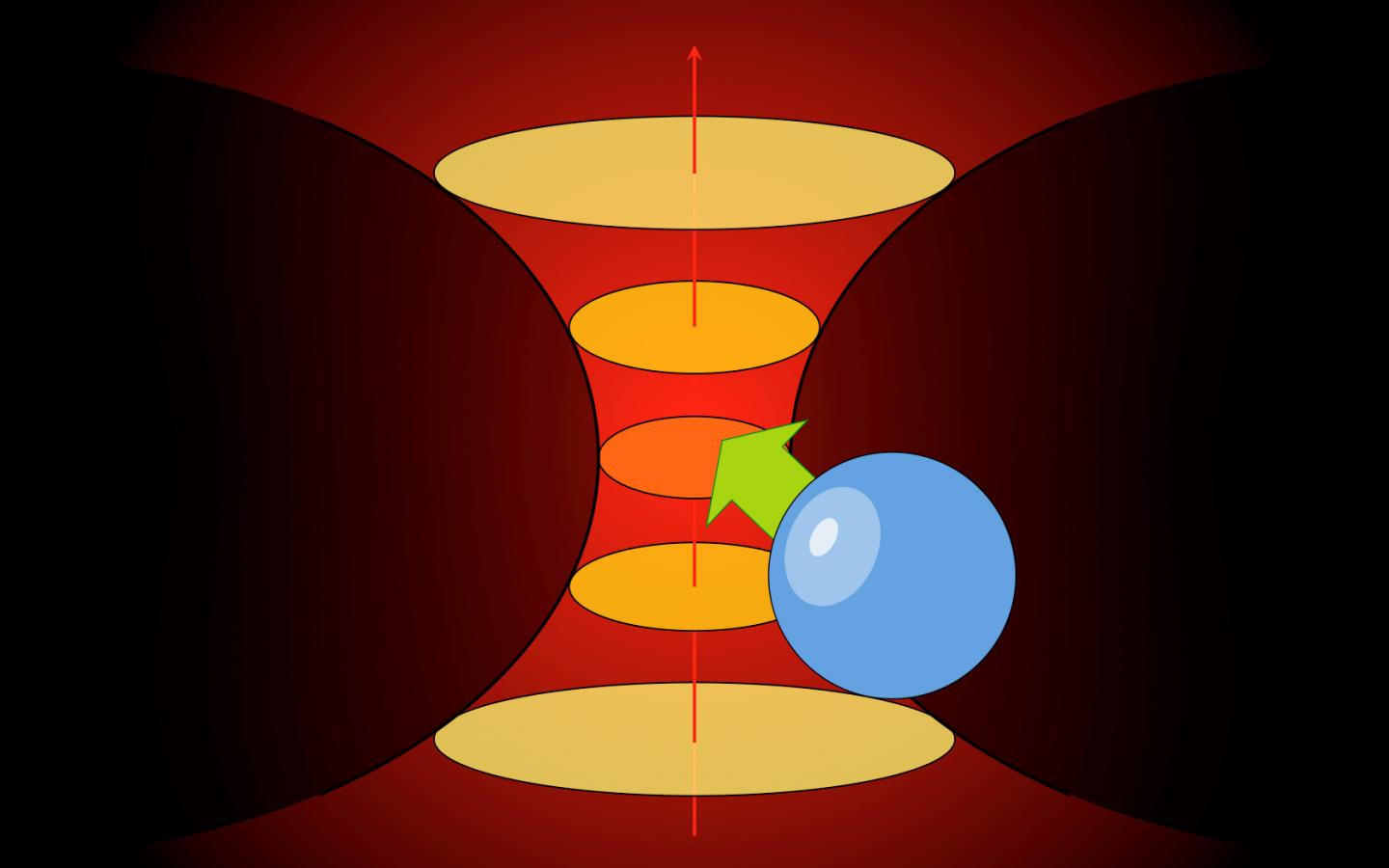
When studying biological cells using optical tweezers, one main issue is the damage caused to the cell by the tool. Giovanni Volpe, University of Gothenburg, has discovered a new type of force that will greatly reduce the amount of light used by optical tweezers – and improve the study of all kinds of cells and particles.

“We call it ‘intra-cavity feedback force’. The basic idea is that, depending on where the particle or cell you want to study is, the amount of laser light used to trap it changes automatically. Whenever the particle is in focus, the laser switches off. When the particle tries to escape, the laser switches on again”, says Giovanny Volpe, senior lecturer at the Department of Physics, University of Gothenburg.

An optical tweezer is a focused laser beam that can trap particles. Previously, two different types of forces that emerge from this type of tool have been identified: gradient force (which means the particle goes against the intensity of the laser) and scattering force (where the particle is pushed towards the laser). Giovanni Volpe and his team have discovered a third type of force in this realm, and a new way of constructing optical tweezers. These break-throughs are poised to greatly improve the study of single biological cells.

“With this method, as much as 100 times less light is needed, in some cases, compared to using a traditional optical tweezer,” Giovanni Volpe explains. “With less light, you cause less photo damage to the cell you are studying.”

This could be useful for studying any cell that is usually suspended in a solution – a blood cell or a yeast cell, for example – that a researcher would want to study over a long period of time.

“One of the main issues when using optical tweezers is that the light raises the temperature of the cell, which is damaging. A rise of 10 degrees might not be tolerable, but the rise of 0,1 degrees might be fine. So using less light, and therefore limiting the rise in temperature, could make a huge difference. Experiments could be done in a more realistic manner in relation to the cell’s natural life cycle,” says Giovanni Volpe.

###

The findings are published in Nature Communications.

Title: “Intracavity optical trapping of microscopic particles in a ring-cavity fiber laser”

Link: https://www.nature.com/articles/s41467-019-10662-7

Media Contact
Giovanni Volpe
[email protected]

Original Source

https://www.gu.se/english/about_the_university/news-calendar/News_detail//a-new-force-for-optical-tweezers-awakens.cid1633080

Related Journal Article

http://dx.doi.org/10.1038/s41467-019-10662-7

Tags: Atomic/Molecular/Particle PhysicsChemistry/Physics/Materials SciencesOptics
Share12Tweet8Share2ShareShareShare2

Related Posts

AI and Physics Collaborate to Design Advanced Hydrogen Storage Materials

June 25, 2026

International Team Including Dresden Scientists Develops Novel Designer Proteins for Advanced Study of Living Tissue

June 25, 2026

New Study Uncovers Key Factors Driving Water Chemistry in Nanoscale Environments

June 25, 2026

Plasma Technology Extends Catalyst Lifespan in Hydrogen Production

June 24, 2026
Please login to join discussion

POPULAR NEWS

  • Saying Goodbye to PGY-6: Pediatric Fellowship Realities

    103 shares
    Share 41 Tweet 26
  • Multi-Hospital Study Reveals Long Covid Burden Is Twice as High as Current Estimates

    92 shares
    Share 36 Tweet 23
  • Detection of EDCs in Breast Milk and Infant Urine Up to Six Months Highlights Early Exposure Risks

    77 shares
    Share 31 Tweet 19
  • New Drug Candidate Developed at McMaster Shows Potential for Treating Brain Cancer

    58 shares
    Share 23 Tweet 15

About

We bring you the latest biotechnology news from best research centers and universities around the world. Check our website.

Follow us

Recent News

Tracking Lanthanide-Labeled Microplastics in Plants

POSTECH Researchers Slash Cost of Reconstituted Cell-Free Systems by 95%

AI and Physics Collaborate to Design Advanced Hydrogen Storage Materials

Subscribe to Blog via Email

Enter your email address to subscribe to this blog and receive notifications of new posts by email.

Join 82 other subscribers
  • Contact Us

Bioengineer.org © Copyright 2023 All Rights Reserved.

Welcome Back!

Login to your account below

Forgotten Password?

Retrieve your password

Please enter your username or email address to reset your password.

Log In
No Result
View All Result
  • Homepages
    • Home Page 1
    • Home Page 2
  • News
  • National
  • Business
  • Health
  • Lifestyle
  • Science

Bioengineer.org © Copyright 2023 All Rights Reserved.