Chemical engineers at East China University of Science and Technology have developed a hot-pressing method to transform ultrafine carbon waste from coal gasification into durable briquettes using an alkali-and-urea-treated corn stalk binder.
Coal gasification serves as a critical technological pathway for the clean and efficient utilization of coal, yet it generates substantial quantities of coal gasification fine slag. This byproduct is characterized by high moisture content and sluggish residual carbon reactivity. Storing or landfilling the slag occupies valuable land, poses risks of secondary environmental contamination, and results in lost fuel potential. Direct reuse within existing gasification systems has historically proven unfeasible because the ultrafine particle size prevents the residue from being safely or effectively re-fed into standard gasifiers.
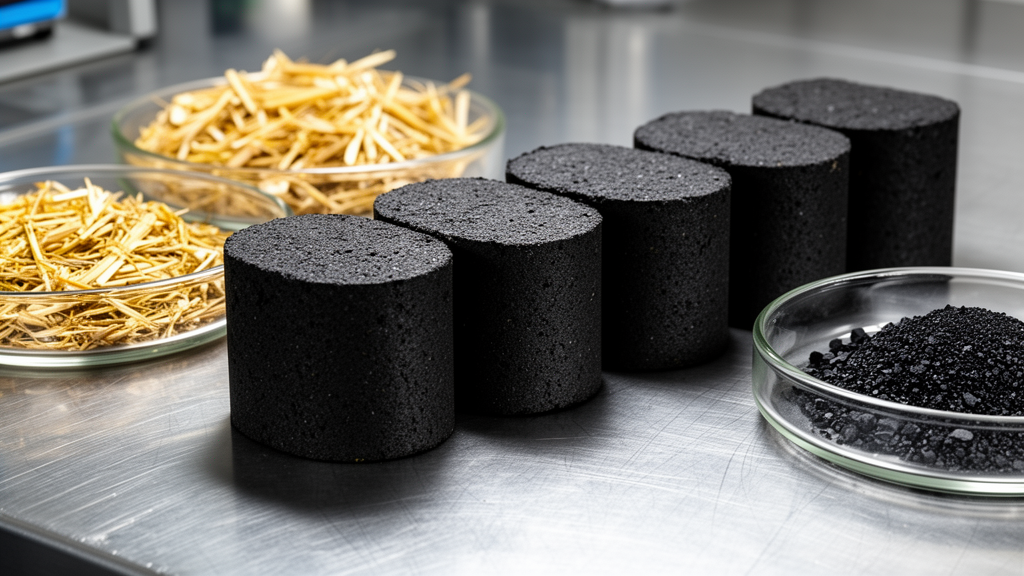
To overcome this operational challenge, the research team isolated a carbon-rich residue containing a fixed carbon content of 81.21% from the coal gasification fine slag. Because fine carbon particles cannot hold form on their own, the researchers formulated an organic binder derived from corn stalk powder modified with a sodium hydroxide and urea solution. They blended the carbon-rich residue with this modified biomass binder and subjected the mixture to controlled hot-pressing, producing structured briquetted carbon-rich residue samples designed for industrial handling and thermal conversion.
The researchers systematically investigated the briquetting parameters to determine the conditions necessary to produce structurally intact specimens. When the corn stalk binder concentration dropped below 15%, the blended material experienced severe delamination and failed to retain structural coherence. Systematic two-factor orthogonal experiments demonstrated that optimal mechanical integrity occurred at a binder concentration of 25%, a hot-pressing temperature of 175 °C, and a molding pressure of 7.5 MPa. Under these specified conditions, all tested briquette specimens exhibited drop strengths exceeding 99.7%.
Physical dimensions exerted a substantial influence on the structural and functional performance of the briquettes. Testing across various height-to-diameter ratios revealed that the sample prepared with a ratio of 0.8 achieved the highest individual mechanical resistance, recording a compressive strength of 620.8 N. However, experimental evaluations indicated that increasing the height-to-diameter ratio compressed internal pore structures, which restricted gas diffusion and reduced overall gasification reactivity. Evaluating this functional trade-off, the researchers identified the sample with a height-to-diameter ratio of 0.4—which yielded a compressive strength of 333.0 N—as delivering the optimal balance between physical durability and reaction kinetics.
In addition to securing mechanical resilience well above the standard industrial benchmark of 300 N, the hot-pressing process enhanced gasification reactivity during thermal processing. When subjected to gasification testing at 1000 °C, raw carbon-rich residue required 13.9 minutes to reach a 90% carbon conversion threshold. In contrast, briquetted specimens with a height-to-diameter ratio of 0.2 completed the identical conversion stage in 8.9 minutes, cutting the necessary processing time by 5.0 minutes and demonstrating marked improvements in reaction efficiency over unconsolidated slag residue.
Mechanistic analyses clarified how the chemical treatment and thermal pressing interact to bind the briquettes together. During the initial binder preparation phase, sodium hydroxide disrupts the intermolecular hydrogen bonding network of the corn stalks, liberating lignin, while urea undergoes an amidation reaction that yields viscous, amide-nitrogen active compounds. When heated to 175 °C during pressing, the softened lignin spreads across the surfaces of the carbon particles while the amide components form strong attachments, establishing a dense matrix reinforced by chemical bonding, physical filling, and thermal consolidation.
The study authors emphasize that this processing approach integrates straightforwardly with commercial coal chemical solid waste management infrastructures. Standard continuous roller-molding equipment can scale the laboratory hot-pressing parameters to commercial production volumes without requiring modifications to core gasifiers. By facilitating the direct reuse of residual carbon while eliminating costly equipment overhauls, the strategy provides an economically viable method to reduce solid waste landfill liabilities and lower virgin raw material procurement requirements.
Subject of Research: Conversion of coal gasification fine slag into high-strength briquettes using a modified biomass binder
Article Title: Turning coal gasification waste and corn stalks into high-strength briquettes for cleaner reuse
Article References: Turning coal gasification waste and corn stalks into high-strength briquettes for cleaner reuse. Original publication (Bibliographic details unavailable.)
Image Credits: AI Generated
DOI: Not provided
Keywords: coal gasification, gasification fine slag, carbon-rich residue, corn stalk binder, hot-pressing, biomass recycling, briquetted fuel, compressive strength, drop strength, gasification reactivity, solid waste management, alkali-urea treatment, lignin bonding, carbon conversion, clean coal technology, East China University of Science and Technology
News Source: Bethany Barker. (November 13, 2026). Corn Stalk Binder Helps Convert Coal Waste Into High-Strength Briquettes. Scienmag.