• HOME
  • NEWS
  • EXPLORE
    • CAREER
      • Companies
      • Jobs
    • EVENTS
    • iGEM
      • News
      • Team
    • PHOTOS
    • VIDEO
    • WIKI
  • BLOG
  • COMMUNITY
    • FACEBOOK
    • INSTAGRAM
    • TWITTER
Monday, August 31, 2026
BIOENGINEER.ORG
No Result
View All Result
  • Login
  • HOME
  • NEWS
  • EXPLORE
    • CAREER
      • Companies
      • Jobs
        • Lecturer
        • PhD Studentship
        • Postdoc
        • Research Assistant
    • EVENTS
    • iGEM
      • News
      • Team
    • PHOTOS
    • VIDEO
    • WIKI
  • BLOG
  • COMMUNITY
    • FACEBOOK
    • INSTAGRAM
    • TWITTER
  • HOME
  • NEWS
  • EXPLORE
    • CAREER
      • Companies
      • Jobs
        • Lecturer
        • PhD Studentship
        • Postdoc
        • Research Assistant
    • EVENTS
    • iGEM
      • News
      • Team
    • PHOTOS
    • VIDEO
    • WIKI
  • BLOG
  • COMMUNITY
    • FACEBOOK
    • INSTAGRAM
    • TWITTER
No Result
View All Result
Bioengineer.org
No Result
View All Result
Home NEWS Science News Biology

A new estimate of biodiversity on Earth

Bioengineer by Bioengineer
August 30, 2017
in Biology
Reading Time: 2 mins read
0
Share on FacebookShare on TwitterShare on LinkedinShare on RedditShare on Telegram
IMAGE

Credit: Brendan B. Larsen, Elizabeth C. Miller, Matthew K. Rhodes, and John J. Wiens

Anyone who has studied biology, watched a nature documentary, or, for that matter, simply enjoyed time in the outdoors, has likely been amazed by the variety of plant and animal life on our planet.

To date, about 1.5 million species have been formally described in the scientific literature, most of them insects. Proportionally, bacteria comprise less than 1% of all described species.

Scientists generally agree that many more species exist than are formally described, but they disagree about how many there really are. Some studies have estimated 2 million or fewer, whereas others suggest as many as 12 million (one recent study even suggested the planet could be home to a trillion species).

In a new paper published in The Quarterly Review of Biology (September 2017), researchers from the University of Arizona have estimated that there are roughly 2 billion living species on Earth, over a thousand times more than the current number of described species.

In coming up with their estimate, the researchers took advantage of the fact that many estimates now agree on the projected number of insect species, around 6.8 million. They incorporated new estimates of species boundaries revealed by DNA sequences, which suggest there might be six times as many insect species, increasing the total to 40 million for insect species alone.

They then reviewed all groups of organisms associated with insects as parasites or symbionts. They found that each insect species most likely hosts a unique species of mite, roundworm (nematode), a one-celled fungus called a microsporidian, and a one-celled organism called an apicomplexan protist (which cause malaria in humans).

Most importantly, the researchers estimated that each insect species is likely to host at least 10 bacterial species found nowhere else. Based on these estimates, they deduce that there should be around 2 billion species on Earth.

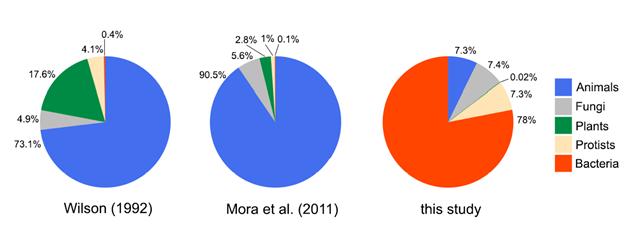
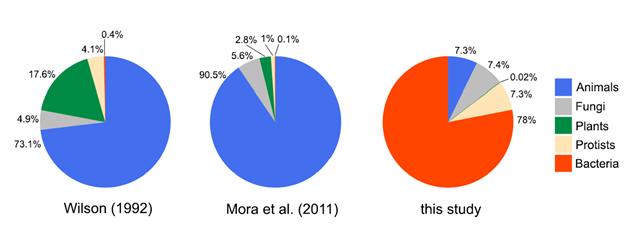
The authors also suggest that the diagram of which taxonomic groups contain the most species, or the "Pie of Life," is very different from traditional estimates. Rather than being dominated by insects, as traditionally shown, their estimates show a pie dominated by bacteria (70 to 90% of all species), with insects (and animals in general) having a much smaller slice.

###

The premier review journal in biology, The Quarterly Review of Biology has presented insightful historical, philosophical, and technical treatments of important biological topics since 1926. The QRB publishes outstanding review articles of generous length that are guided by an expansive, inclusive, and often humanistic understanding of biology. Beyond the core biological sciences, the QRB is also an important review journal for scholars in related areas, which include policy studies and the history and philosophy of science. A comprehensive section of reviews on new biological books provides educators and researchers alike with information on the latest publications in the life sciences.

Media Contact

John Wiens
[email protected]
@ChicagoJournals

http://www.journals.uchicago.edu

Original Source

http://www.journals.uchicago.edu/journals/qrb/pr/170803 http://dx.doi.org/10.1086/693564

Share12Tweet8Share2ShareShareShare2

Related Posts

Methylation puts parasites in motion

Methylation puts parasites in motion

August 31, 2026
Desiccation promotes DNA damage and rifampin resistance in Mycobacterium tuberculosis

Desiccation promotes DNA damage and rifampin resistance in Mycobacterium tuberculosis

August 31, 2026

Gastrointestinal Parasitism in Cattle and Water Buffaloes in Pakistan: Prevalence and Associated Risk Factors

August 31, 2026

Development of HPLC–PDA method for steviol glycosides analysis in food matrices

August 31, 2026
Please login to join discussion

POPULAR NEWS

  • β-Sitosterol from Ipomoea carnea Jacq. As a promising anti-inflammatory agent: Evidence from in silico modeling and in vitro validation

    29 shares
    Share 12 Tweet 7
  • Design, fabrication and characterization of a wearable Fiber Bragg grating sensor for cardiorespiratory monitoring using finger plethysmography

    29 shares
    Share 12 Tweet 7
  • KAIST opens the era of industrial-scale microbial foods, proposing growth strategies for the next-generation protein market

    29 shares
    Share 12 Tweet 7
  • Virologist awarded $2 million NIH grant to investigate how virus-infected cells live and die

    29 shares
    Share 12 Tweet 7

About

We bring you the latest biotechnology news from best research centers and universities around the world. Check our website.

Follow us

Recent News

β-Sitosterol from Ipomoea carnea Jacq. As a promising anti-inflammatory agent: Evidence from in silico modeling and in vitro validation

Design, fabrication and characterization of a wearable Fiber Bragg grating sensor for cardiorespiratory monitoring using finger plethysmography

KAIST opens the era of industrial-scale microbial foods, proposing growth strategies for the next-generation protein market

Subscribe to Blog via Email

Enter your email address to subscribe to this blog and receive notifications of new posts by email.

Join 85 other subscribers
  • Contact Us

Bioengineer.org © Copyright 2023 All Rights Reserved.

Welcome Back!

Login to your account below

Forgotten Password?

Retrieve your password

Please enter your username or email address to reset your password.

Log In
No Result
View All Result
  • Homepages
    • Home Page 1
    • Home Page 2
  • News
  • National
  • Business
  • Health
  • Lifestyle
  • Science

Bioengineer.org © Copyright 2023 All Rights Reserved.