• HOME
  • NEWS
  • EXPLORE
    • CAREER
      • Companies
      • Jobs
    • EVENTS
    • iGEM
      • News
      • Team
    • PHOTOS
    • VIDEO
    • WIKI
  • BLOG
  • COMMUNITY
    • FACEBOOK
    • INSTAGRAM
    • TWITTER
Thursday, July 30, 2026
BIOENGINEER.ORG
No Result
View All Result
  • Login
  • HOME
  • NEWS
  • EXPLORE
    • CAREER
      • Companies
      • Jobs
        • Lecturer
        • PhD Studentship
        • Postdoc
        • Research Assistant
    • EVENTS
    • iGEM
      • News
      • Team
    • PHOTOS
    • VIDEO
    • WIKI
  • BLOG
  • COMMUNITY
    • FACEBOOK
    • INSTAGRAM
    • TWITTER
  • HOME
  • NEWS
  • EXPLORE
    • CAREER
      • Companies
      • Jobs
        • Lecturer
        • PhD Studentship
        • Postdoc
        • Research Assistant
    • EVENTS
    • iGEM
      • News
      • Team
    • PHOTOS
    • VIDEO
    • WIKI
  • BLOG
  • COMMUNITY
    • FACEBOOK
    • INSTAGRAM
    • TWITTER
No Result
View All Result
Bioengineer.org
No Result
View All Result
Home NEWS Science News Chemistry

A new concept of designing photocatalytic systems with reversed configurations

Bioengineer by Bioengineer
May 13, 2020
in Chemistry
Reading Time: 2 mins read
0
IMAGE
Share on FacebookShare on TwitterShare on LinkedinShare on RedditShare on Telegram

IMAGE

Credit: ©Science China Press

Photocatalytic water splitting is one of the most promising ways to convert solar energy into the chemical one. Generally, the activity of a photocatalytic system composed of photocatalysts and cocatalysts is integrally determined by the efficiencies of basic processes such as light absorption, charge separation and surface catalysis. Conventionally, the nanoparticles of cocatalysts have been loaded on the surface of nanosized/microsized semiconductors.

However, this conventional configuration of photocatalysts has to confront the competition of light harvesting caused by deposited cocatalysts and ineffective interface contacts between photocatalysts and cocatalysts. This greatly retards the enhancement of photocatalytic performances.

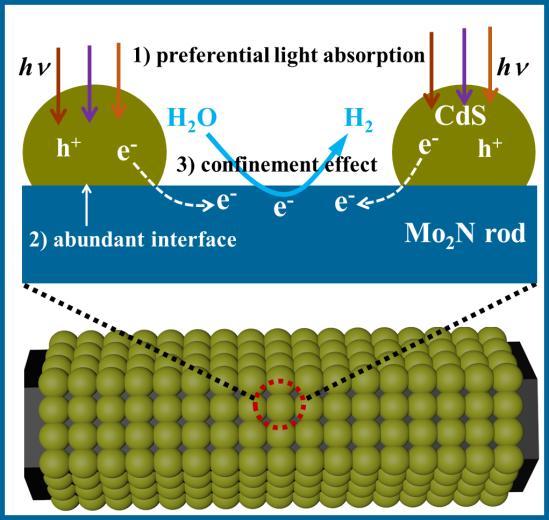
Very recently, Prof. Fuxiang Zhang and his colleagues in Dalian Institute of Chemical Physicals, Chinese Academy of Sciences, introduced a reversed configuration of photocatalysts fabricated by depositing nanosized CdS (semiconductor) on the surface of microsized Mo2N hexagonal rods (cocatalyst).

The as-obtained reversed photocatalyst is denoted as Mo2N@CdS. For comparison, the photocatalyst with conventional configurations was fabricated by depositing nanosized Mo2N (cocatalyst) on the surface of bulk CdS (light harvester, photocatalyst), and the corresponding sample is denoted as Mo2N/CdS. The photocatalytic H2 evolution activity of the Mo2N@CdS sample under visible light irradiation is remarkably superior to that of Mo2N/CdS, during which the basic processes such as light absorption, charge separation and surface catalysis between the conventional and reversed configurations have been discussed and compared.

The reversed configuration of photocatalyst in this work shows advantages in light absorption, charge separation and surface catalysis with respect to the conventional configuration. Specifically, the reversed configuration can ensure the preferential light absorption of the CdS semiconductor to avoid the competition of light harvesting caused by the Mo2N cocatalyst. Secondly, much better charge separation is observed for the reversed configuration with respect to the conventional ones. Finally, the electron interactions between CdS and Mo2N and the pore-confined space of CdS particle stack make an effective confinement effect to promote the surface catalysis of Mo2N.

The novel design concept on the reversed configuration can be extended into more other systems, reactions and the fabrication of composites with inner 1D (or 2D) cocatalysts and outer 0D photocatalysts to promote the solar-to-chemical conversion.

###

See the article: Lian J, Qi Y, Bao Y, Yin Z, Zhang Y, Yang N, Guan N, Jin S, Li L, Zhang F. Reversed configuration of photocatalysts to exhibit improved properties of basic processes compared to conventional one. Sci China Chem., 2020, 63, DOI: 10.1007/s11426-020-9752-x.

http://engine.scichina.com/publisher/scp/journal/SCC/doi/10.1007/s11426-020-9752-x

Media Contact
Fuxiang Zhang
[email protected]

Related Journal Article

http://dx.doi.org/10.1007/s11426-020-9752-x

Tags: Chemistry/Physics/Materials Sciences
Share12Tweet8Share2ShareShareShare2

Related Posts

Crystallization engineering enhances high-frequency performance of thick carbon electrodes

Crystallization engineering enhances high-frequency performance of thick carbon electrodes

July 30, 2026
Paper-based smart packaging offers sustainable path to cut food waste and plastic pollution

Paper-based smart packaging offers sustainable path to cut food waste and plastic pollution

July 30, 2026

Shaping light like never before – with photonic time crystals

July 30, 2026

Sensing-storage monolithically integrated system for wearable physiological sensing

July 30, 2026
Please login to join discussion

POPULAR NEWS

  • Pilot study to validate endothelium collection from pulmonary artery balloon catheter in children

    29 shares
    Share 12 Tweet 7
  • Ferroptotic propagation: from single-cell execution to tissue-scale death programs

    29 shares
    Share 12 Tweet 7
  • Residential proximity to major roadways and prevalent diabetes in older adults: a cross-sectional study based on CLHLS

    29 shares
    Share 12 Tweet 7
  • Reusability report: Exploring the utility and extensibility of an integrated modelling framework for liquid electrolyte design

    29 shares
    Share 12 Tweet 7

About

We bring you the latest biotechnology news from best research centers and universities around the world. Check our website.

Follow us

Recent News

Pilot study to validate endothelium collection from pulmonary artery balloon catheter in children

Ferroptotic propagation: from single-cell execution to tissue-scale death programs

Residential proximity to major roadways and prevalent diabetes in older adults: a cross-sectional study based on CLHLS

Subscribe to Blog via Email

Enter your email address to subscribe to this blog and receive notifications of new posts by email.

Join 85 other subscribers
  • Contact Us

Bioengineer.org © Copyright 2023 All Rights Reserved.

Welcome Back!

Login to your account below

Forgotten Password?

Retrieve your password

Please enter your username or email address to reset your password.

Log In
No Result
View All Result
  • Homepages
    • Home Page 1
    • Home Page 2
  • News
  • National
  • Business
  • Health
  • Lifestyle
  • Science

Bioengineer.org © Copyright 2023 All Rights Reserved.