• HOME
  • NEWS
  • EXPLORE
    • CAREER
      • Companies
      • Jobs
    • EVENTS
    • iGEM
      • News
      • Team
    • PHOTOS
    • VIDEO
    • WIKI
  • BLOG
  • COMMUNITY
    • FACEBOOK
    • INSTAGRAM
    • TWITTER
Thursday, June 25, 2026
BIOENGINEER.ORG
No Result
View All Result
  • Login
  • HOME
  • NEWS
  • EXPLORE
    • CAREER
      • Companies
      • Jobs
        • Lecturer
        • PhD Studentship
        • Postdoc
        • Research Assistant
    • EVENTS
    • iGEM
      • News
      • Team
    • PHOTOS
    • VIDEO
    • WIKI
  • BLOG
  • COMMUNITY
    • FACEBOOK
    • INSTAGRAM
    • TWITTER
  • HOME
  • NEWS
  • EXPLORE
    • CAREER
      • Companies
      • Jobs
        • Lecturer
        • PhD Studentship
        • Postdoc
        • Research Assistant
    • EVENTS
    • iGEM
      • News
      • Team
    • PHOTOS
    • VIDEO
    • WIKI
  • BLOG
  • COMMUNITY
    • FACEBOOK
    • INSTAGRAM
    • TWITTER
No Result
View All Result
Bioengineer.org
No Result
View All Result
Home NEWS Science News Biology

A new class of branched single chain surfactant for enhanced oil recovery reported

Bioengineer by Bioengineer
March 28, 2019
in Biology
Reading Time: 2 mins read
0
IMAGE
Share on FacebookShare on TwitterShare on LinkedinShare on RedditShare on Telegram

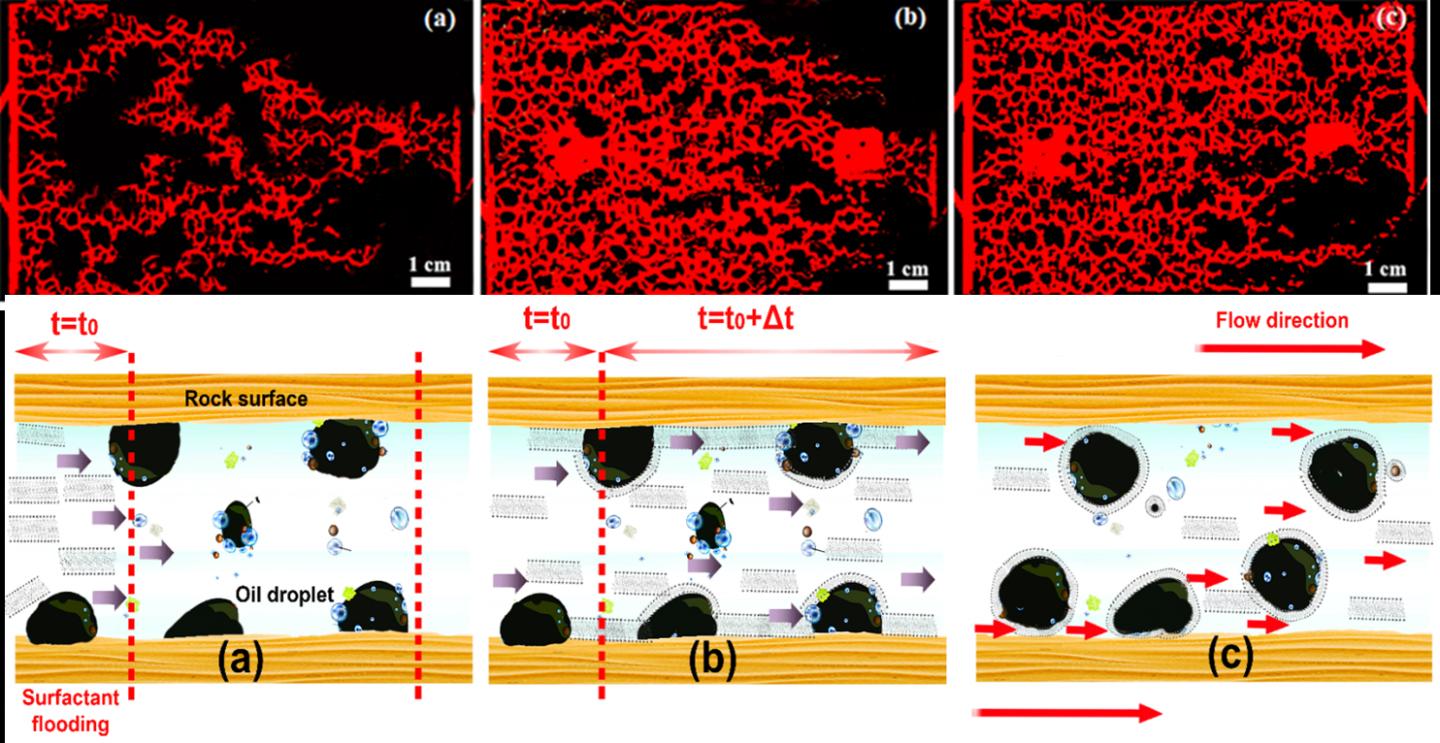
A new type of green low surface energy surfactant that is stable in the harsh conditions of enhanced oil recovery (EOR) has been reported
IMAGE

Credit: Sajad Kiani, Swansea University.

This efficient surfactant was examined by a research team led by Dr Shirin Alexander and Professor Andrew R. Barron at ESRI, Swansea University. It is shown to improve the oil recovery by 72% in both low and high brine solutions, a remarkable result for only a single chain surfactant flooding, compared to 45% recovery in the presence of other surfactants alone.

Fabrication of a glass micromodel and testing of these materials were carried out by PhD student Sajad Kiani.

Sajad designed a quasi-two-dimensional glass microfluidic pattern with heterogeneous form to evaluate the suitability of the surfactant for oil displacing in EOR. Such heterogeneous pattern was replicated from a cross-section of sandstone rock and has been used to investigate the visual mechanism of the fluid flow on porous mediums.

Dr Alexander said: “It is a revelation that a single chain surfactant alone, without addition of any nanoparticle, polymer or alkaline, can achieve such a large recovery of oil. The effectiveness of this surfactant in EOR is due to its ability in reducing the surface and interfacial tension of the water/oil remarkably, compared to the other single chain surfactants. This is also because of its effective wettability alteration and capability to maintain the aggregation structure under extreme heat and salinity.”

Professor Barron said: “Despite the desire to shift to renewable energy, the global demand for oil is not abating, and we must find ways to enhance recovery of resources using methods with low environmental impact. So-called green hydrocarbon technology is one of the focus areas of ESRI, along with CCUS and alternative sustainable energy sources, for a multifaceted approach to lowering emissions and the environmental impact of energy and resource production”.

The results of this work opens up insight into the future role of this green and cost effective LSES in EOR formulations.

###

Co-authors of the papers are Dr Masanobu Sagisaka an associate professor at Department of Frontier Materials Chemistry in Hirosaki University, Japan and Dr Sarah Rogers an instrument scientist for SANS2D at ISIS-STFC, in Rutherford Appleton Laboratory, UK. Professor Barron is the Founder and Director of ESRI and the Sêr Cymru Chair of Low Carbon Energy and Environment at Swansea. Dr Alexander is a Sêr Cymru Research Fellow.

Media Contact
Delyth Purchase
[email protected]

Related Journal Article

http://dx.doi.org/10.1021/acs.energyfuels.9b00391

Tags: Biomedical/Environmental/Chemical EngineeringEnergy SourcesTechnology/Engineering/Computer Science
Share13Tweet8Share2ShareShareShare2

Related Posts

This Famous Butterfly Revealed: Three Distinct Species Hidden in One

June 25, 2026

Scientists Attack Soybean Cyst Nematode by Starving Its Food Source

June 25, 2026

Decoding the Secret Code of a Crucial Immune Sensor

June 24, 2026

Decades of Data Reveal Which Orcas Call Puget Sound Home

June 24, 2026
Please login to join discussion

POPULAR NEWS

  • Saying Goodbye to PGY-6: Pediatric Fellowship Realities

    103 shares
    Share 41 Tweet 26
  • Multi-Hospital Study Reveals Long Covid Burden Is Twice as High as Current Estimates

    92 shares
    Share 36 Tweet 23
  • Detection of EDCs in Breast Milk and Infant Urine Up to Six Months Highlights Early Exposure Risks

    77 shares
    Share 31 Tweet 19
  • New Drug Candidate Developed at McMaster Shows Potential for Treating Brain Cancer

    58 shares
    Share 23 Tweet 15

About

We bring you the latest biotechnology news from best research centers and universities around the world. Check our website.

Follow us

Recent News

Energy-Saving Membrane Technology Developed by KAIST and Georgia Tech Enables Crude Oil Separation Without Boiling

Cracking the Code: How Cancer Evades Antibody-Drug Conjugates and New Strategies to Overcome Resistance

Chiral Laser Gyroscopes Surpass Lock-In Limit

Subscribe to Blog via Email

Enter your email address to subscribe to this blog and receive notifications of new posts by email.

Join 82 other subscribers
  • Contact Us

Bioengineer.org © Copyright 2023 All Rights Reserved.

Welcome Back!

Login to your account below

Forgotten Password?

Retrieve your password

Please enter your username or email address to reset your password.

Log In
No Result
View All Result
  • Homepages
    • Home Page 1
    • Home Page 2
  • News
  • National
  • Business
  • Health
  • Lifestyle
  • Science

Bioengineer.org © Copyright 2023 All Rights Reserved.