• HOME
  • NEWS
  • EXPLORE
    • CAREER
      • Companies
      • Jobs
    • EVENTS
    • iGEM
      • News
      • Team
    • PHOTOS
    • VIDEO
    • WIKI
  • BLOG
  • COMMUNITY
    • FACEBOOK
    • INSTAGRAM
    • TWITTER
Saturday, July 11, 2026
BIOENGINEER.ORG
No Result
View All Result
  • Login
  • HOME
  • NEWS
  • EXPLORE
    • CAREER
      • Companies
      • Jobs
        • Lecturer
        • PhD Studentship
        • Postdoc
        • Research Assistant
    • EVENTS
    • iGEM
      • News
      • Team
    • PHOTOS
    • VIDEO
    • WIKI
  • BLOG
  • COMMUNITY
    • FACEBOOK
    • INSTAGRAM
    • TWITTER
  • HOME
  • NEWS
  • EXPLORE
    • CAREER
      • Companies
      • Jobs
        • Lecturer
        • PhD Studentship
        • Postdoc
        • Research Assistant
    • EVENTS
    • iGEM
      • News
      • Team
    • PHOTOS
    • VIDEO
    • WIKI
  • BLOG
  • COMMUNITY
    • FACEBOOK
    • INSTAGRAM
    • TWITTER
No Result
View All Result
Bioengineer.org
No Result
View All Result
Home NEWS Science News Chemistry

A nanoprobe developed for visual quantitative detection of pesticides

Bioengineer by Bioengineer
July 28, 2023
in Chemistry
Reading Time: 2 mins read
0
A Nanoprobe Developed for Visual Quantitative Detection of Pesticides
Share on FacebookShare on TwitterShare on LinkedinShare on RedditShare on Telegram

Recently, Prof. JIANG Changlong and his research team at the Institute of Solid State Physics, Hefei Institutes of Physical Science (HFIPS) of Chinese Academy of Sciences (CAS), developed and synthesized two highly effective ratiometric fluorescence nanoprobes. These nanoprobes, when combined with the color recognition capabilities of smartphones, enabled the visual and quantitative detection of pesticides in food and environmental water.
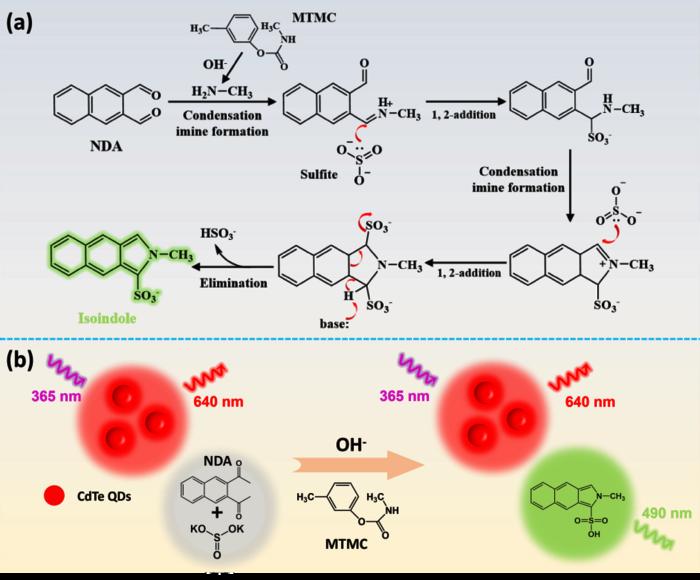
A Nanoprobe Developed for Visual Quantitative Detection of Pesticides

Credit: XU Shihao

Recently, Prof. JIANG Changlong and his research team at the Institute of Solid State Physics, Hefei Institutes of Physical Science (HFIPS) of Chinese Academy of Sciences (CAS), developed and synthesized two highly effective ratiometric fluorescence nanoprobes. These nanoprobes, when combined with the color recognition capabilities of smartphones, enabled the visual and quantitative detection of pesticides in food and environmental water.

The research has been published in Chemical Engineering Journal and ACS Sustainable Chemistry & Engineering.

Carbamate compounds and organophosphorus pesticides are widely used in agriculture. Their residues can be found in crops due their slow degradation in nature. These pesticide residues can enter the body through respiration, skin absorption, or ingestion, posing a serious risk to human organ function and consumer safety. Currently, the main analytical methods for pesticide residue detection have limitations including high cost, complex operation, and long processing time. Therefore, it is crucial to develop new methods for pesticide detection that are fast, cost-effective, highly specific, and sensitive.

In this study, researchers developed an enzyme-free fluorescence probe using CdTe quantum dots (CdTe QD) as a background fluorescence to visually detect carbamate pesticides (CPs). The probe was based on the principle of 2,3-naphthalaldehyde (NDA) and sulfite-induced Strecker reactions. Upon the addition of CPs, a nucleophilic condensation reaction occurred, resulting in the production of green fluorescent isoindole. This reaction caused a distinct color change from red to green, allowing for rapid visual detection of carbamates. The probe exhibited a low detection limit (LOD) of 18.6 nM, which is below the national maximum residue standard.

Furthermore, a proportional fluorescence probe was developed by combining green carbon dots and CdTe quantum dots (CdTe QD) for the selective quantitative detection of methyl parathion (MP). Under alkaline conditions, MP underwent rapid hydrolysis to form p-nitrophenol (p-NP). The interaction between carbon dots and p-NP led to the quenching of green fluorescence through hydrogen bond strengthening, resulting in a sensitive color change from green to red. The LOD for MP detection was as low as 8.9 nM.

This work provides a new strategy for the detection of carbamate pesticide residues and organophosphorus pesticide residues, and widens the application of chemical-sensitive luminescent materials in environmental protection and food safety, according to the team.


Journal

ACS Sustainable Chemistry & Engineering

Article Title

Ratiometric Fluorescent Sensor Based on Hydrogen-Bond Triggering the Internal Filter Effect for Enzyme-Free and Visual Monitoring Pesticide Residues

Article Publication Date

19-Jul-2023

Share12Tweet8Share2ShareShareShare2

Related Posts

Blue Light and Chemistry Simplify Complex Drug Production Steps

Blue Light and Chemistry Simplify Complex Drug Production Steps

July 10, 2026
New Discovery Promises Brighter, More Energy-Efficient Digital Displays

New Discovery Promises Brighter, More Energy-Efficient Digital Displays

July 10, 2026

New Crystalline 3D Frameworks Linked by Spiroborates Developed

July 10, 2026

IBEC Joins Major European Grant on Living Matter Physics

July 10, 2026

POPULAR NEWS

  • Detection of EDCs in Breast Milk and Infant Urine Up to Six Months Highlights Early Exposure Risks

    77 shares
    Share 31 Tweet 19
  • New Drug Candidate Developed at McMaster Shows Potential for Treating Brain Cancer

    58 shares
    Share 23 Tweet 15
  • KTU Researchers Explore Ultrasound’s Role in Enhancing Blood Flow Beyond Diagnostics

    53 shares
    Share 21 Tweet 13
  • 高齢者の骨粗鬆症治療の持続性比較

    51 shares
    Share 20 Tweet 13

About

BIOENGINEER.ORG

We bring you the latest biotechnology news from best research centers and universities around the world. Check our website.

Follow us

Recent News

Study Finds Dopamine System Damage in Long COVID Patients’ Brains

HMGA Proteins Linked to Brain Tumors and Neurodegenerative Diseases

Physical Activity Lowers Frailty Risk in Older Adults: Review and Analysis

Subscribe to Blog via Email

Success! An email was just sent to confirm your subscription. Please find the email now and click 'Confirm' to start subscribing.

Join 84 other subscribers
  • Contact Us

Bioengineer.org © Copyright 2023 All Rights Reserved.

Welcome Back!

Login to your account below

Forgotten Password?

Retrieve your password

Please enter your username or email address to reset your password.

Log In
No Result
View All Result
  • Homepages
    • Home Page 1
    • Home Page 2
  • News
  • National
  • Business
  • Health
  • Lifestyle
  • Science

Bioengineer.org © Copyright 2023 All Rights Reserved.