• HOME
  • NEWS
  • EXPLORE
    • CAREER
      • Companies
      • Jobs
    • EVENTS
    • iGEM
      • News
      • Team
    • PHOTOS
    • VIDEO
    • WIKI
  • BLOG
  • COMMUNITY
    • FACEBOOK
    • INSTAGRAM
    • TWITTER
Friday, May 15, 2026
BIOENGINEER.ORG
No Result
View All Result
  • Login
  • HOME
  • NEWS
  • EXPLORE
    • CAREER
      • Companies
      • Jobs
        • Lecturer
        • PhD Studentship
        • Postdoc
        • Research Assistant
    • EVENTS
    • iGEM
      • News
      • Team
    • PHOTOS
    • VIDEO
    • WIKI
  • BLOG
  • COMMUNITY
    • FACEBOOK
    • INSTAGRAM
    • TWITTER
  • HOME
  • NEWS
  • EXPLORE
    • CAREER
      • Companies
      • Jobs
        • Lecturer
        • PhD Studentship
        • Postdoc
        • Research Assistant
    • EVENTS
    • iGEM
      • News
      • Team
    • PHOTOS
    • VIDEO
    • WIKI
  • BLOG
  • COMMUNITY
    • FACEBOOK
    • INSTAGRAM
    • TWITTER
No Result
View All Result
Bioengineer.org
No Result
View All Result
Home NEWS Science News

A nanofiber matrix for healing

Bioengineer by Bioengineer
February 14, 2017
in Science News
Reading Time: 2 mins read
0
Share on FacebookShare on TwitterShare on LinkedinShare on RedditShare on Telegram
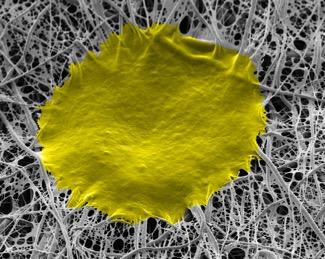
IMAGE

Credit: Kyoto University iCeMS

A new nanofiber-on-microfiber matrix could help produce more and better quality stem cells for disease treatment and regenerative therapies.

A matrix made of gelatin nanofibers on a synthetic polymer microfiber mesh may provide a better way to culture large quantities of healthy human stem cells.

Developed by a team of researchers led by Ken-ichiro Kamei of Kyoto University's Institute for Integrated Cell-Material Sciences (iCeMS), the 'fiber-on-fiber' (FF) matrix improves on currently available stem cell culturing techniques.

Researchers have been developing 3D culturing systems to allow human pluripotent stem cells (hPSCs) to grow and interact with their surroundings in all three dimensions, as they would inside the human body, rather than in two dimensions, like they do in a petri dish.

Pluripotent stem cells have the ability to differentiate into any type of adult cell and have huge potential for tissue regeneration therapies, treating diseases, and for research purposes.

Most currently reported 3D culturing systems have limitations, and result in low quantities and quality of cultured cells.

Kamei and his colleagues fabricated gelatin nanofibers onto a microfiber sheet made of synthetic, biodegradable polyglycolic acid. Human embryonic stem cells were then seeded onto the matrix in a cell culture medium.

The FF matrix allowed easy exchange of growth factors and supplements from the culture medium to the cells. Also, the stem cells adhered well to the matrix, resulting in robust cell growth: after four days of culture, more than 95% of the cells grew and formed colonies.

The team also scaled up the process by designing a gas-permeable cell culture bag in which multiple cell-loaded, folded FF matrices were placed. The system was designed so that minimal changes were needed to the internal environment, reducing the amount of stress placed on the cells. This newly developed system yielded a larger number of cells compared to conventional 2D and 3D culture methods.

"Our method offers an efficient way to expand hPSCs of high quality within a shorter term," write the researchers in their study published in the journal Biomaterials. Also, because the use of the FF matrix is not limited to a specific type of culture container, it allows for scaling up production without loss of cell functions. "Additionally, as nanofiber matrices are advantageous for culturing other adherent cells, including hPSC-derived differentiated cells, FF matrix might be applicable to the large-scale production of differentiated functional cells for various applications," the researchers conclude.

###

Media Contact

Izumi Mindy Takamiya
[email protected]
81-757-539-755
@KyotoU_News

http://www.kyoto-u.ac.jp/en

############

Story Source: Materials provided by Scienmag
Share12Tweet8Share2ShareShareShare2

Related Posts

New Study Connects Age-Related Gut Changes to Higher Disease Risk

May 15, 2026
Single mother must adapt swiftly — the survival of her colony depends on it — Biology

Single mother must adapt swiftly — the survival of her colony depends on it

May 15, 2026

Cancer-Linked Protein Plays Key Role in Tumor DNA Repair

May 15, 2026

Single-Cell Atlas Reveals CD55+ Stem Cells’ Role in Atherosclerosis

May 15, 2026
Please login to join discussion

POPULAR NEWS

  • Research Indicates Potential Connection Between Prenatal Medication Exposure and Elevated Autism Risk

    843 shares
    Share 337 Tweet 211
  • New Study Reveals Plants Can Detect the Sound of Rain

    730 shares
    Share 291 Tweet 182
  • Salmonella Haem Blocks Macrophages, Boosts Infection

    62 shares
    Share 25 Tweet 16
  • Breastmilk Balances E. coli and Beneficial Bacteria in Infant Gut Microbiomes

    58 shares
    Share 23 Tweet 15

About

We bring you the latest biotechnology news from best research centers and universities around the world. Check our website.

Follow us

Recent News

New Study Connects Age-Related Gut Changes to Higher Disease Risk

Single mother must adapt swiftly — the survival of her colony depends on it

Cancer-Linked Protein Plays Key Role in Tumor DNA Repair

Subscribe to Blog via Email

Enter your email address to subscribe to this blog and receive notifications of new posts by email.

Join 82 other subscribers
  • Contact Us

Bioengineer.org © Copyright 2023 All Rights Reserved.

Welcome Back!

Login to your account below

Forgotten Password?

Retrieve your password

Please enter your username or email address to reset your password.

Log In
No Result
View All Result
  • Homepages
    • Home Page 1
    • Home Page 2
  • News
  • National
  • Business
  • Health
  • Lifestyle
  • Science

Bioengineer.org © Copyright 2023 All Rights Reserved.