• HOME
  • NEWS
  • EXPLORE
    • CAREER
      • Companies
      • Jobs
    • EVENTS
    • iGEM
      • News
      • Team
    • PHOTOS
    • VIDEO
    • WIKI
  • BLOG
  • COMMUNITY
    • FACEBOOK
    • INSTAGRAM
    • TWITTER
Thursday, July 30, 2026
BIOENGINEER.ORG
No Result
View All Result
  • Login
  • HOME
  • NEWS
  • EXPLORE
    • CAREER
      • Companies
      • Jobs
        • Lecturer
        • PhD Studentship
        • Postdoc
        • Research Assistant
    • EVENTS
    • iGEM
      • News
      • Team
    • PHOTOS
    • VIDEO
    • WIKI
  • BLOG
  • COMMUNITY
    • FACEBOOK
    • INSTAGRAM
    • TWITTER
  • HOME
  • NEWS
  • EXPLORE
    • CAREER
      • Companies
      • Jobs
        • Lecturer
        • PhD Studentship
        • Postdoc
        • Research Assistant
    • EVENTS
    • iGEM
      • News
      • Team
    • PHOTOS
    • VIDEO
    • WIKI
  • BLOG
  • COMMUNITY
    • FACEBOOK
    • INSTAGRAM
    • TWITTER
No Result
View All Result
Bioengineer.org
No Result
View All Result
Home NEWS Science News Health

A microscope that can monitor the development of the heart

Bioengineer by Bioengineer
October 30, 2023
in Health
Reading Time: 2 mins read
0
Juhyun Lee
Share on FacebookShare on TwitterShare on LinkedinShare on RedditShare on Telegram

The ability to dynamically track the movement of cells is essential for modeling cellular interactions as they form organs such as the heart. But current microscope technology isn’t up to the task of capturing those movements.
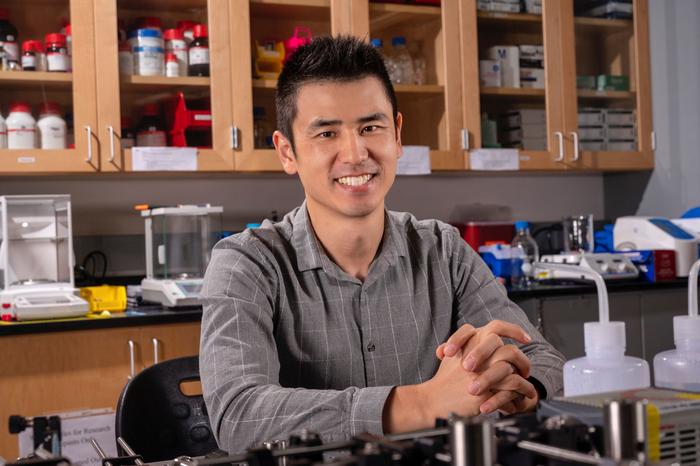
Juhyun Lee

Credit: UT Arlington

The ability to dynamically track the movement of cells is essential for modeling cellular interactions as they form organs such as the heart. But current microscope technology isn’t up to the task of capturing those movements.

Juhyun Lee, associate professor in the Bioengineering Department at The University of Texas at Arlington, recently received a five-year, $1.94 million grant from the National Institutes of Health to develop a 4D high-resolution imaging system to quantify cell tracking.

Traditional microscopes allow users to zoom in to view an individual cell. However, doing so obscures that cell’s relationship to everything around it. Likewise, when the microscope is zoomed out to view the full field, the cell details are no longer visible.

Lee’s system will use microscopy and advanced computational post-processing to provide the next generation of imaging tools for biomedical researchers. His high-resolution microscope will zoom in and sweep left and right to scan an entire field of view. Those images will be stitched together to show a complete view, and an additional scan will create a 3D model.

“We are trying to quantify where each cell will go as the heart develops. The whole idea of this tool is to enable us to see the whole picture in high resolution,” Lee said. “Cells that form organs with dynamic motion, like the heart, are fast-moving. Using methods based on the motion and orientation of a cell, we can predict where it will go.”

Lee’s research has focused on how the heart develops, and he has received multiple previous grants focused on developing a new microscope that can capture 3D motion and add time. With this, he can construct a 4D beating heart using optical imaging techniques with fluorescent nanoparticles in a zebrafish. It is this microscope that will be used in his new grant.

Developmental biologists could eventually use Lee’s system to predict early cell development, making it valuable for detecting possible anomalies.

“The integration of technology and biology is a constant goal in the biomedical engineering field, and Dr. Lee’s work to develop imaging systems that can assist in our knowledge of cell activity and development is at the forefront of that effort,” said Michael Cho, the Alfred R. Potvin and Janet H. Potvin Endowed Chair in Bioengineering.

  • Written by Jeremy Agor, College of Engineering



Share12Tweet8Share2ShareShareShare2

Related Posts

Representations of the intrinsic value of information in mouse orbitofrontal cortex

July 30, 2026

Ferroptotic propagation: from single-cell execution to tissue-scale death programs

July 30, 2026

Residential proximity to major roadways and prevalent diabetes in older adults: a cross-sectional study based on CLHLS

July 30, 2026

Regulation of RNA transcript elongation in metazoans and its relevance to disease

July 30, 2026

POPULAR NEWS

  • Combined phage therapy and faecal microbiota transplantation to treat recurrent urinary tract infection: a case series

    29 shares
    Share 12 Tweet 7
  • Representations of the intrinsic value of information in mouse orbitofrontal cortex

    29 shares
    Share 12 Tweet 7
  • Pilot study to validate endothelium collection from pulmonary artery balloon catheter in children

    29 shares
    Share 12 Tweet 7
  • Ferroptotic propagation: from single-cell execution to tissue-scale death programs

    29 shares
    Share 12 Tweet 7

About

We bring you the latest biotechnology news from best research centers and universities around the world. Check our website.

Follow us

Recent News

Combined phage therapy and faecal microbiota transplantation to treat recurrent urinary tract infection: a case series

Representations of the intrinsic value of information in mouse orbitofrontal cortex

Pilot study to validate endothelium collection from pulmonary artery balloon catheter in children

Subscribe to Blog via Email

Enter your email address to subscribe to this blog and receive notifications of new posts by email.

Join 85 other subscribers
  • Contact Us

Bioengineer.org © Copyright 2023 All Rights Reserved.

Welcome Back!

Login to your account below

Forgotten Password?

Retrieve your password

Please enter your username or email address to reset your password.

Log In
No Result
View All Result
  • Homepages
    • Home Page 1
    • Home Page 2
  • News
  • National
  • Business
  • Health
  • Lifestyle
  • Science

Bioengineer.org © Copyright 2023 All Rights Reserved.