• HOME
  • NEWS
  • EXPLORE
    • CAREER
      • Companies
      • Jobs
    • EVENTS
    • iGEM
      • News
      • Team
    • PHOTOS
    • VIDEO
    • WIKI
  • BLOG
  • COMMUNITY
    • FACEBOOK
    • INSTAGRAM
    • TWITTER
Saturday, February 7, 2026
BIOENGINEER.ORG
No Result
View All Result
  • Login
  • HOME
  • NEWS
  • EXPLORE
    • CAREER
      • Companies
      • Jobs
        • Lecturer
        • PhD Studentship
        • Postdoc
        • Research Assistant
    • EVENTS
    • iGEM
      • News
      • Team
    • PHOTOS
    • VIDEO
    • WIKI
  • BLOG
  • COMMUNITY
    • FACEBOOK
    • INSTAGRAM
    • TWITTER
  • HOME
  • NEWS
  • EXPLORE
    • CAREER
      • Companies
      • Jobs
        • Lecturer
        • PhD Studentship
        • Postdoc
        • Research Assistant
    • EVENTS
    • iGEM
      • News
      • Team
    • PHOTOS
    • VIDEO
    • WIKI
  • BLOG
  • COMMUNITY
    • FACEBOOK
    • INSTAGRAM
    • TWITTER
No Result
View All Result
Bioengineer.org
No Result
View All Result
Home NEWS Science News Health

A lightning-fast flu virus detector

Bioengineer by Bioengineer
May 30, 2017
in Health
Reading Time: 2 mins read
0
Share on FacebookShare on TwitterShare on LinkedinShare on RedditShare on Telegram
IMAGE

Credit: Department of Bioelectronics,Institute of Biomaterials and Bioengineering,TMDU

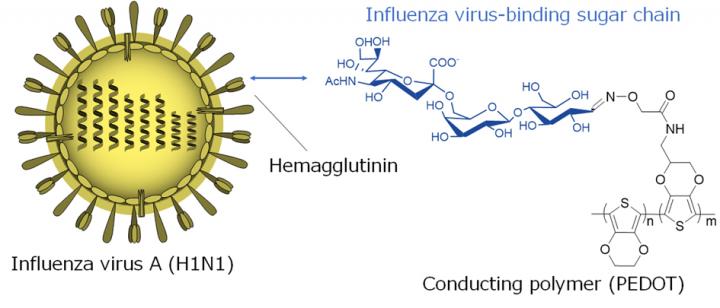
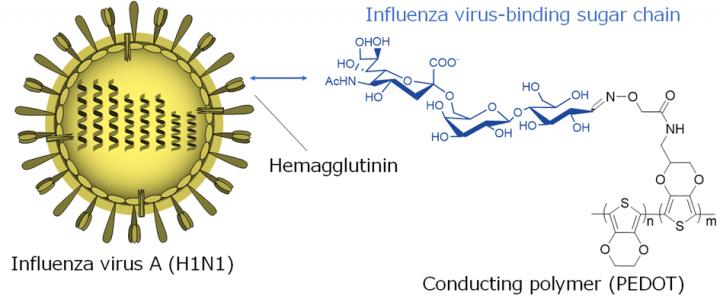
Tokyo, Japan – Researchers have developed a new, rapid biosensor for the early detection of even tiny concentrations of the human influenza A (H1N1) virus. Such early-stage diagnosis is crucial for averting a potential pandemic outbreak, as antiviral medication must be administered in a timely fashion. Conventional tests for detecting the flu virus are often slow and expensive, and can miss early viral infections. In contrast, the new biosensor measures tiny changes in voltage in an electrically conductive polymer to quickly detect virus concentrations almost 100 times smaller than the limit of currently available kits. The work was done at the Tokyo Medical and Dental University (TMDU), in a collaboration between the Institute of Biomaterials and Bioengineering and the Department of Molecular Virology.

Conductive polymers are a class of carbon-based molecules that conduct electricity, but can also be used in biological environments. They are very attractive materials for biosensor applications because researchers can easily attach biomolecules to the polymers, which allow them to bind with specific targets, such as flu viruses. In this study, poly(3,4-ethylenedioxythiophene) (PEDOT) was modified with a functional group that binds with the H1N1 human influenza virus, but not avian flu strains. "Conducting polymers have several advantages over inorganic counterparts," explains corresponding author Yuji Miyahara. "These include the ability to conduct both electrical and ionic carriers, mechanical flexibility, low cytotoxicity, low-cost production by casting or printing, and tunable properties via chemical synthesis or doping."

To construct the biosensor, the polymer film was placed between two electrodes. When a solution containing H1N1, which carries a tiny positive charge on its exterior shell, was added, some of the viruses stuck to the polymer and increased the voltage measured by the electrodes. This electrical method allows the sensor to detect the presence of miniscule amounts of the virus. Viral loads are often measured in hemagglutination units (HAU). The new sensor can detect viral concentrations as small as 0.013 HAU. By comparison, commercially available kits that use immunochromatographic tests only work for concentrations greater than about 1.13 HAU. This represents an almost 100-fold increase in sensitivity. Study coauthor Shoji Yamaoka stressed the clinical applications of the device. "We developed a conducting polymer-based sensor that can recognize a specific virus, which makes it a good candidate for wearable monitoring and point-of-care testing."

The article, "Specific Recognition of Human Influenza Virus with PEDOT Bearing Sialic Acid-Terminated Trisaccharides" was published in ACS Applied Materials & Interfaces at DOI: 10.1021/acsami.7b02523

###

Media Contact

Tatsuro Goda
[email protected]

http://www.tmd.ac.jp/english/

############

Story Source: Materials provided by Scienmag

Share12Tweet8Share2ShareShareShare2

Related Posts

Succinate Receptor 1 Limits Blood Cell Formation, Leukemia

February 7, 2026

Palmitoylation of Tfr1 Drives Platelet Ferroptosis and Exacerbates Liver Damage in Heat Stroke

February 7, 2026

Oxygen-Enhanced Dual-Section Microneedle Patch Improves Drug Delivery and Boosts Photodynamic and Anti-Inflammatory Treatment for Psoriasis

February 7, 2026

Scientists Identify SARS-CoV-2 PLpro and RIPK1 Inhibitors Showing Potent Synergistic Antiviral Effects in Mouse COVID-19 Model

February 7, 2026
Please login to join discussion

POPULAR NEWS

  • Robotic Ureteral Reconstruction: A Novel Approach

    Robotic Ureteral Reconstruction: A Novel Approach

    82 shares
    Share 33 Tweet 21
  • Digital Privacy: Health Data Control in Incarceration

    63 shares
    Share 25 Tweet 16
  • Study Reveals Lipid Accumulation in ME/CFS Cells

    57 shares
    Share 23 Tweet 14
  • Breakthrough in RNA Research Accelerates Medical Innovations Timeline

    53 shares
    Share 21 Tweet 13

About

We bring you the latest biotechnology news from best research centers and universities around the world. Check our website.

Follow us

Recent News

Succinate Receptor 1 Limits Blood Cell Formation, Leukemia

Palmitoylation of Tfr1 Drives Platelet Ferroptosis and Exacerbates Liver Damage in Heat Stroke

Oxygen-Enhanced Dual-Section Microneedle Patch Improves Drug Delivery and Boosts Photodynamic and Anti-Inflammatory Treatment for Psoriasis

Subscribe to Blog via Email

Enter your email address to subscribe to this blog and receive notifications of new posts by email.

Join 73 other subscribers
  • Contact Us

Bioengineer.org © Copyright 2023 All Rights Reserved.

Welcome Back!

Login to your account below

Forgotten Password?

Retrieve your password

Please enter your username or email address to reset your password.

Log In
No Result
View All Result
  • Homepages
    • Home Page 1
    • Home Page 2
  • News
  • National
  • Business
  • Health
  • Lifestyle
  • Science

Bioengineer.org © Copyright 2023 All Rights Reserved.