Researcher in joint research group between Osaka University and Mandom Corporation wins prize at the world’s largest cosmetics cluster for proposing new concepts for next-generation antiperspirants
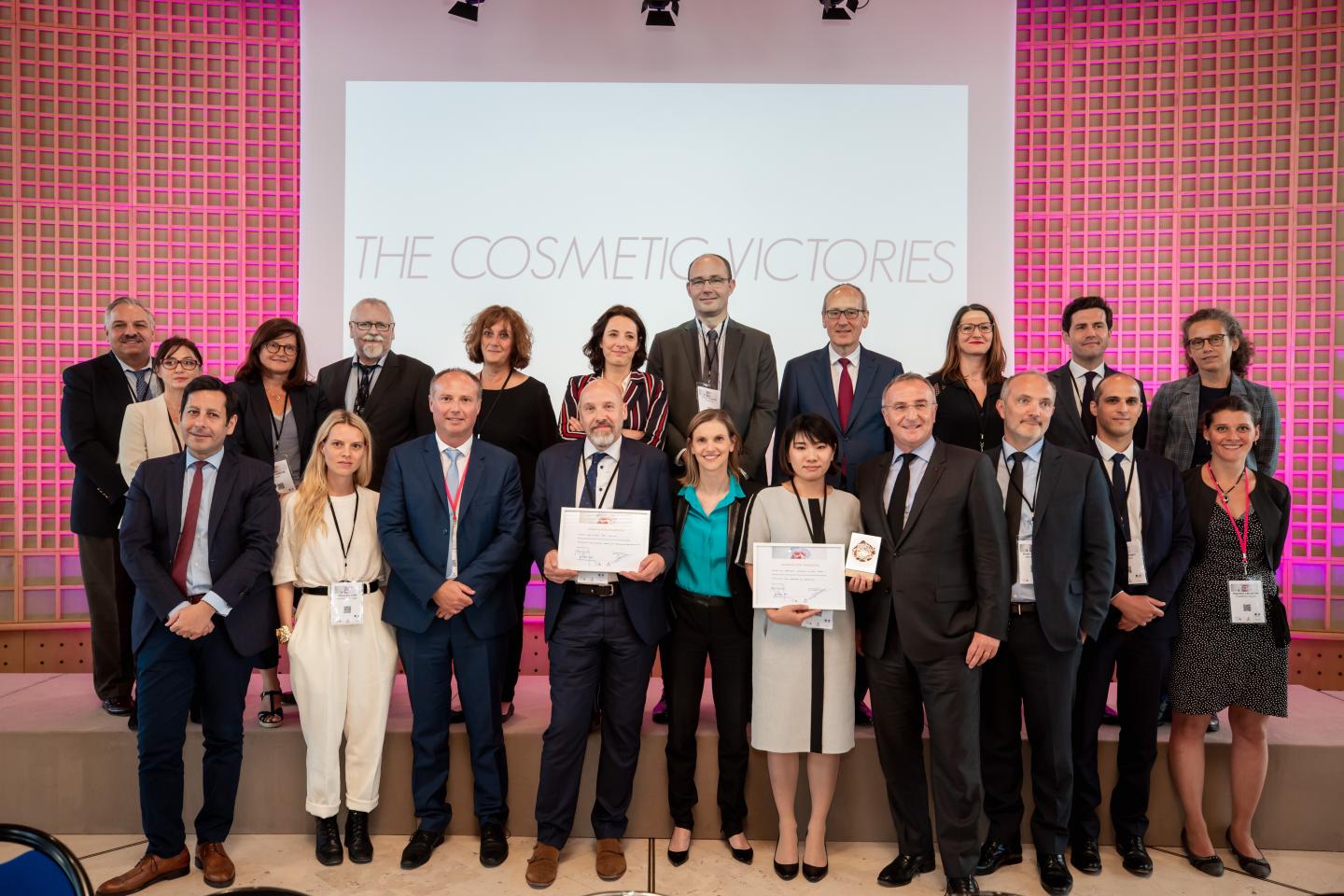
Credit: Cécile Muzard
Osaka, Japan – Kie Nakashima, a Specially Appointed Researcher at the Laboratory of Advanced Cosmetic Science, Graduate School of Pharmaceutical Sciences, Osaka University, has won the Academic Prize at Cosmetics Victories 2019, sponsored by Cosmetic Valley in France*1, the world’s largest cosmetics cluster. In the awarded research, an imaging system of contracting motility of human sweat glands in sweating was established. The system clarified contracting motility of sweat glands in sweating and was applied to evaluate active ingredients that suppress sweating. The imaging system of motility of sweat gland resolves problems caused when the exit of sweat gland is plugged by using a conventional antiperspirant (excessive sweating that cannot be suppressed, skin inflammation, yellowing of the clothes caused by active ingredients, etc.). It is also expected to be applied to next-generation antiperspirants that directly act on the secretory part of sweat glands.
Laboratory of Advanced Cosmetic Science was jointly set up in June 2015 by the Graduate School of Pharmaceutical Sciences at Osaka University and Mandom Corporation. This laboratory is an independent research organization set up within Osaka University and conducts flexible and speedy research activities through discussions between Osaka University and Mandom.
The joint research group*2, led by Fumihiro Okada, Guest Professor at the Laboratory, conducts research for the development of next-generation antiperspirants. This time, the group clarified the temporal change in sweat gland contraction in a three-dimensional (3D) structure using a 3D live imaging system (to observe the motility in 3D). As an application of this imaging system, Dr. Nakashima presented a new concept of new antiperspirants to suppress sweating by making sweat glands inactive, not by plugging the exit of sweat glands as is the case with conventional antiperspirants. The concept was highly praised, winning the Academic Prize at the Cosmetic Victories 2019 contest (held at 17:00, June 6, 2019 local time and 0:00 on June 7, 2019, Japan time) sponsored by Cosmetic Valley of France, the world’s largest cosmetics cluster.
As global warming and Japan’s super-aging society continue to progress, an increase in people suffering hyperhidrosis and heat stroke has become a social issue. To improve failure of sweating function, it is necessary to understand the structure of sweat glands that contract in sweating. A sweat gland is a single tubular exocrine gland consisting of a secretory part and an excretory part. Sweat secreted at the secretory part is excreted to the skin surface through the excretory part. The secretory part at the end of the sweat gland and a part of the excretory part are intricately folded in a coiled structure similar to thread waste entanglement*3. The outermost layer of the secretory part in this coiled area is surrounded by myoepithelial cells and contracts in sweating. However, due to the complex structure of sweat glands, the mechanism of sweat glands had not been clarified with conventional analysis methods. The group has found sweat gland stem cells of humans and successfully reproduced a sweat gland-like structure in vitro, visualizing the three-dimensional structure of sweat glands.
Social impact of these research results
If a next-generation antiperspirant that inhibits sweat gland contraction through use of this award-winning new concept is developed, it is expected to resolve problems that conventional antiperspirants have and greatly contribute to the reduction of hyperhidrosis and sweat odor, both of which are troubling today’s consumers. Mandom Corporation will work to commercialize a next-generation antiperspirant that inhibits sweating using this evaluation method.
###
Remarks
This research project was conducted with Grants-in-Aid for Scientific Research of the Japan Society for the Promotion of Science for 17K16337 and 19K177710.
*1 Cosmetic Valley (France)
The world’s largest cluster in the fragrance and cosmetics industry in France. Since 2015, it has hosted the annual Cosmetic Victories contest as part of its support for research projects on health and beauty. In the contest, the “Academic Prize” is awarded to researchers, while the “Industry Prize” is given to business people. The awardees receive a prize of €10,000.
*2 Joint research group
This research was conducted by a group consisting of Professor Kiyotoshi Sekiguchi at the Division of Matrixome Research and Application, Institute for Protein Research, Osaka University, Professor Hiroyuki Murota at the Department of Dermatology, Graduate School of Biomedical Sciences, Nagasaki University (at the Dermatology Department of Integrated Medicine, Graduate School of Medicine, Osaka University at the time this research was conducted), and the Dermatology Department of Integrated Medicine, Graduate School of Medicine, Osaka University.
*3 Coiled structure of a sweat gland
A sweat gland is a single tubular exocrine gland, and the end part of a sweat gland is intricately folded in a coiled structure similar to thread waste entanglement. The outermost layer of the secretory part in this coiled area is surrounded by myoepithelial cells and contracts in sweating.
Media Contact
Fumihiro Okada
[email protected]