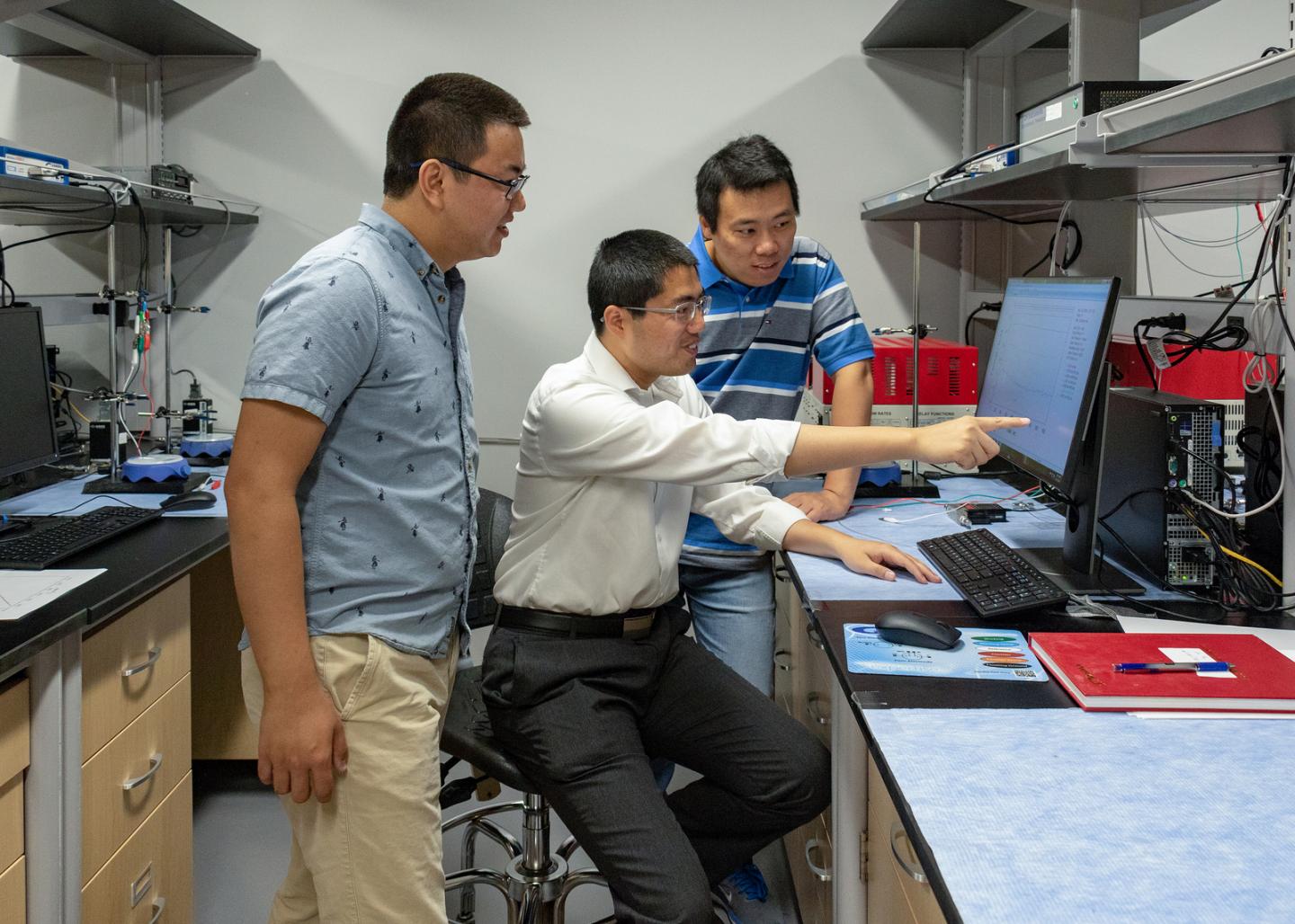
"This new…
Credit: UCF: Karen Norum
A UCF research team with collaborators at Virginia Tech have developed a new "green" approach to making ammonia that may help make feeding the rising world population more sustainable.
"This new approach can facilitate ammonia production using renewable energy, such as electricity generated from solar or wind," said physics Assistant Professor Xiaofeng Feng. "Basically, this new approach can help advance a sustainable development of our human society."
Ammonia, a compound of nitrogen and hydrogen, is essential to all life on the planet and is a vital ingredient in most fertilizers used for food production. Since World War I, the ammonia in fertilizer has been primarily produced using the Haber-Bosch method, which is energy and fossil-fuel intensive. There have been substantial obstacles to improving the process, until now.
The research team's new approach is documented in the Nature Communications Journal published online today.
The biggest obstacle to ammonia synthesis is the high energy barrier to activate nitrogen molecules. In order for the chemical process to hit a high reaction rate, nitrogen and hydrogen molecules must be heated to a temperature of 662 to 1,022 oF under a pressure of 2,200?5,100 pounds per square inch with the presence of iron-based catalysts. Translation: The chemical reaction only happens under very high temperature and pressure conditions.
There are many efforts to pursue ammonia synthesis under milder conditions, and one of them is to use electrical energy. In an electrochemical method at room temperature, active electrons are used to drive the reaction with water as the hydrogen source, but the electrons passing through an electrode cannot be efficiently used and the reaction rate is very low.
"Our research discovered a new mechanism whereby electrons can be more efficiently used via the catalyst of palladium hydride. This new approach may not only provide a new route for ammonia synthesis with minimal electrical energy, but also inspire peer researchers to use the principle to address other challenging reactions for renewable energy conversion, such as turning carbon dioxide into fuels," Feng said.
Co-author Hongliang Xin, an assistant professor at Virginia Tech, said there is so much more to discover in this new area of research.
"This is a very exciting research for converting nitrogen to ammonia at room temperature. Quantum chemical simulations have suggested a unique reaction pathway for the palladium catalyst with a lower energy barrier," Xin said. "However, the detailed mechanism, particularly its competition with electron-stealing hydrogen evolution and effect of operating voltage, is still largely unknown."
###
Other contributors to the research published today include: postdoctoral scholar Jun Wang and graduate student Lin Hu from Feng's research group at UCF, chemistry Assistant Professor Gang Chen from UCF, and postdoctoral scholar Liang Yu from Xin's research group at Virginia Tech.
This team's work was supported by the UCF Startup Fund, the American Chemical Society Petroleum Research Fund and the National Science Foundation CBET Catalysis Program. The team has been granted synchrotron beam time at the Department of Energy's SLAC National Accelerator Laboratory facility in California this summer to further investigate the mechanism.
Feng joined UCF's physics department and the Energy Conversion and Propulsion Cluster in 2016 with joint appointments in the Department of Chemistry and the Department of Materials Science and Engineering. He has a doctorate in materials science and engineering from the University of California at Berkeley and was a postdoctoral scholar at Stanford University.
Media Contact
Zenaida Gonzalez Kotala
[email protected]
407-823-6120
@UCF
http://www.ucf.edu
Related Journal Article
http://dx.doi.org/10.1038/s41467-018-04213-9