• HOME
  • NEWS
  • EXPLORE
    • CAREER
      • Companies
      • Jobs
    • EVENTS
    • iGEM
      • News
      • Team
    • PHOTOS
    • VIDEO
    • WIKI
  • BLOG
  • COMMUNITY
    • FACEBOOK
    • INSTAGRAM
    • TWITTER
Wednesday, April 15, 2026
BIOENGINEER.ORG
No Result
View All Result
  • Login
  • HOME
  • NEWS
  • EXPLORE
    • CAREER
      • Companies
      • Jobs
        • Lecturer
        • PhD Studentship
        • Postdoc
        • Research Assistant
    • EVENTS
    • iGEM
      • News
      • Team
    • PHOTOS
    • VIDEO
    • WIKI
  • BLOG
  • COMMUNITY
    • FACEBOOK
    • INSTAGRAM
    • TWITTER
  • HOME
  • NEWS
  • EXPLORE
    • CAREER
      • Companies
      • Jobs
        • Lecturer
        • PhD Studentship
        • Postdoc
        • Research Assistant
    • EVENTS
    • iGEM
      • News
      • Team
    • PHOTOS
    • VIDEO
    • WIKI
  • BLOG
  • COMMUNITY
    • FACEBOOK
    • INSTAGRAM
    • TWITTER
No Result
View All Result
Bioengineer.org
No Result
View All Result
Home NEWS Science News Chemistry

A glimpse into the very first processes that could have formed life on Earth

Bioengineer by Bioengineer
June 29, 2023
in Chemistry
Reading Time: 2 mins read
0
Figure 1
Share on FacebookShare on TwitterShare on LinkedinShare on RedditShare on Telegram

A new technology has shed further light on the age-old question: what are the origins of life on Earth?
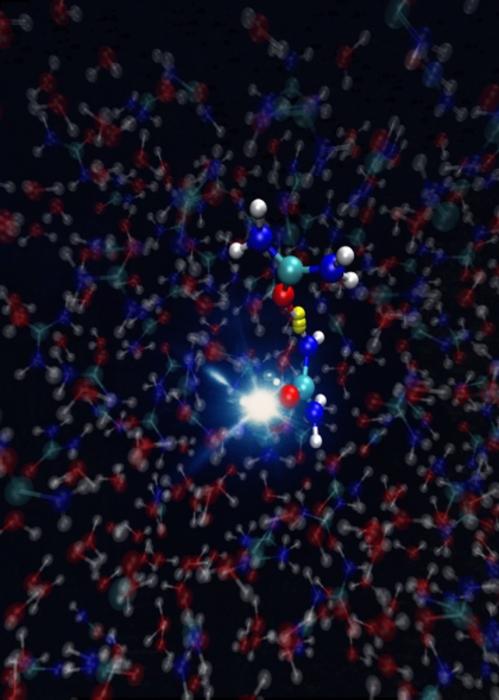
Figure 1

Credit: Ludger Inhester

A new technology has shed further light on the age-old question: what are the origins of life on Earth?

Before life was formed on Earth, what scientists dub the pre-biotic condition, the atmosphere was less dense. This meant that high energy radiation from space was omnipresent and ionized molecules. Some hypothesize that small water puddles containing urea – an organic compound essential for forming nucleo bases – became exposed to this intense radiation, causing the urea to undergo conversion into reaction products. These would serve as the building blocks of life: DNA and RNA.

But to learn more about this process, scientists needed to dive further into the mechanism behind the urea’s ionization and reaction, as well as the reaction pathways and energy dissipation.

An international collaborative group comprising corresponding author Zhong Yin, currently based as an associate professor at Tohoku University’s International Center for Synchrotron Radiation Innovation Smart (SRIS), along with colleagues from the University of Geneva (UNIGE) and ETH Zurich (ETHZ), and the University of Hamburg, have been able to reveal more thanks to an innovative X-ray spectroscopy approach.

The technology, which harnessed a high-harmonic generation light source and a sub-micron liquid flat-jet, enabled researchers to examine chemical reactions occurring in liquids with unparalleled temporal precision. Crucially, the groundbreaking approach allowed the researchers to investigate the intricate changes in urea molecules at the femtosecond level, that is a quadrillionth part of a second.

“We have shown for the first time how urea molecules react after ionization,” says Yin. “Ionisation radiation damages the urea biomolecules. But in dissipating the energy from the radiation, the ureas undergo a dynamical process which occurs at the femtosecond time scale.”

Previous studies that examined molecule reactions were limited to the gas phase. In order to expand this to the aqueous environment, which is the natural environment of bio-chemical processes, the group had to engineer a device that could generate an ultra-thin liquid jet, with a thickness smaller than one millionth of a meter, within a vacuum. A thicker jet would have impeded measurements by absorbing a portion of the X-rays employed.

Yin, who acted as lead experimentalist, believes their breakthrough does more than answer how life on Earth formed. It also opens a new pathway in the novel scientific field of attochemistry. “Shorter light pulses are necessary to understand chemical reactions in real time and push the boundaries in attochemistry. Our approach enables scientists to observe a molecular movie, following each step of the process along the way.”

Details of the group’s findings were reported in the journalĀ NatureĀ on June 28, 2023.


Journal

Nature

DOI

10.1038/s41586-023-06182-6

Article Title

Femtosecond Proton Transfer in Urea Solutions Probed by X-ray Spectroscopy

Article Publication Date

28-Jun-2023

Share12Tweet8Share2ShareShareShare2

Related Posts

Dysprosium, Terbium Complexes Show Contrasting Magnetism

Dysprosium, Terbium Complexes Show Contrasting Magnetism

April 15, 2026
Scientists Discover a Universal Rhythm in Nature

Scientists Discover a Universal Rhythm in Nature

April 14, 2026

Ph.D. Student Achieves Breakthrough Poised to Transform Materials Development

April 14, 2026

Volcanic Eruptions Linked to Global Cooling: New Research Reveals Climate Impact

April 14, 2026

POPULAR NEWS

  • Scientists Investigate Possible Connection Between COVID-19 and Increased Lung Cancer Risk

    60 shares
    Share 24 Tweet 15
  • Boosting Breast Cancer Risk Prediction with Genetics

    47 shares
    Share 19 Tweet 12
  • Popular Anti-Aging Compound Linked to Damage in Corpus Callosum, Study Finds

    45 shares
    Share 18 Tweet 11
  • Revolutionary Theory Transforms Quantum Perspective on the Big Bang

    41 shares
    Share 16 Tweet 10

About

We bring you the latest biotechnology news from best research centers and universities around the world. Check our website.

Follow us

Recent News

PSMF1 Variants Cause Parkinsonism to Perinatal Death

University of Chicago Secures Prestigious Laude Institute Moonshots Seed Grant

Worldwide Approach to Fighting Drug-Resistant Fungi Set for Major Overhaul

Subscribe to Blog via Email

Enter your email address to subscribe to this blog and receive notifications of new posts by email.

Join 79 other subscribers
  • Contact Us

Bioengineer.org Ā© Copyright 2023 All Rights Reserved.

Welcome Back!

Login to your account below

Forgotten Password?

Retrieve your password

Please enter your username or email address to reset your password.

Log In
No Result
View All Result
  • Homepages
    • Home Page 1
    • Home Page 2
  • News
  • National
  • Business
  • Health
  • Lifestyle
  • Science

Bioengineer.org Ā© Copyright 2023 All Rights Reserved.