• HOME
  • NEWS
  • EXPLORE
    • CAREER
      • Companies
      • Jobs
    • EVENTS
    • iGEM
      • News
      • Team
    • PHOTOS
    • VIDEO
    • WIKI
  • BLOG
  • COMMUNITY
    • FACEBOOK
    • INSTAGRAM
    • TWITTER
Saturday, May 9, 2026
BIOENGINEER.ORG
No Result
View All Result
  • Login
  • HOME
  • NEWS
  • EXPLORE
    • CAREER
      • Companies
      • Jobs
        • Lecturer
        • PhD Studentship
        • Postdoc
        • Research Assistant
    • EVENTS
    • iGEM
      • News
      • Team
    • PHOTOS
    • VIDEO
    • WIKI
  • BLOG
  • COMMUNITY
    • FACEBOOK
    • INSTAGRAM
    • TWITTER
  • HOME
  • NEWS
  • EXPLORE
    • CAREER
      • Companies
      • Jobs
        • Lecturer
        • PhD Studentship
        • Postdoc
        • Research Assistant
    • EVENTS
    • iGEM
      • News
      • Team
    • PHOTOS
    • VIDEO
    • WIKI
  • BLOG
  • COMMUNITY
    • FACEBOOK
    • INSTAGRAM
    • TWITTER
No Result
View All Result
Bioengineer.org
No Result
View All Result
Home NEWS Science News

A flip switch for binge-eating?

Bioengineer by Bioengineer
May 25, 2017
in Science News
Reading Time: 2 mins read
0
Share on FacebookShare on TwitterShare on LinkedinShare on RedditShare on Telegram
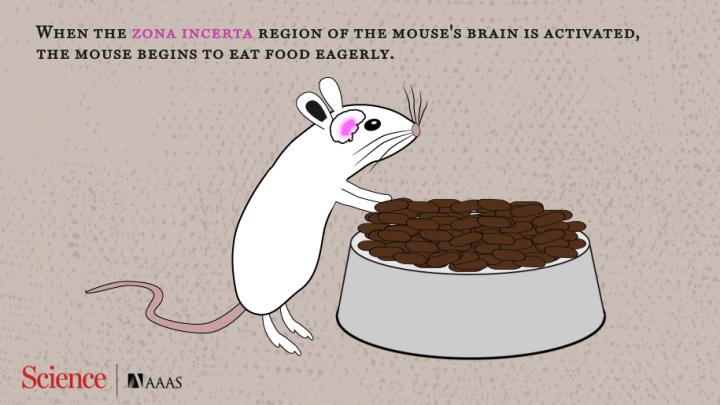
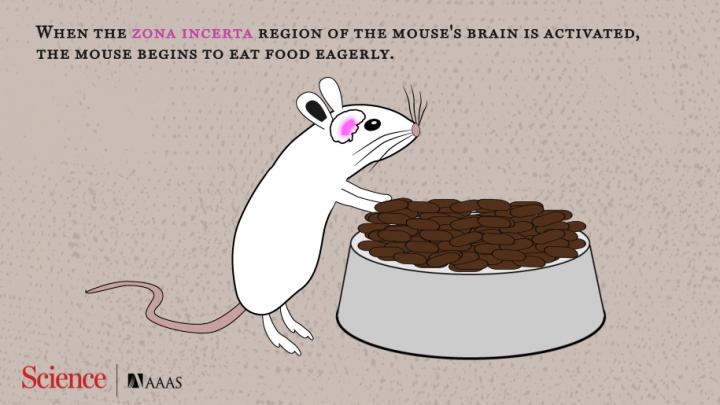
IMAGE

Credit: Carla Schaffer / AAAS

Researchers have identified a subgroup of neurons in the mouse brain that, upon activation, immediately prompt binge-like eating. Furthermore, repeated stimulation of these neurons over time caused the mice to gain weight. The zona incerta (ZI) is a relatively understudied part of the brain. Intriguingly, patients receiving deep brain stimulation of the subthalamus, which includes the ZI, for the treatment of movement disorders can exhibit characteristics of binge eating. To explore this phenomenon in greater detail, Xiaobing Zhang and Anthony N. van den Pol optogenetically labelled GABA neurons in the ZIs of mice. They found that stimulating ZI GABA neurons with axons extending into the paraventricular thalamus (PVT) prompted immediate binge-like eating, just two to three seconds after stimulation. Within ten minutes of continuous ZI GABA stimulation, mice rapidly consumed 35% of their daily high-fat food store, meant to be eaten over a 24-hour period. The researchers also found that ghrelin, a hormone that signals a reduced energy state in the gut, excited ZI GABA neurons. Upon stimulating the subgroup of ZI neurons for five minutes every three hours over a period of two weeks, the mice significantly increased their food intake, and gained weight. Yet, once photostimulation was over, the mice showed a significantly reduced food intake compared with that of controls. Lastly, the authors found that stimulation of excitatory axons from the parasubthalamic nucleus to PVT or direct stimulation of glutamate neurons in the PVT reduced food intake.

###

Media Contact

Science Press Package Team
[email protected]
202-326-6440
@AAAS

http://www.aaas.org

############

Story Source: Materials provided by Scienmag

Share12Tweet8Share2ShareShareShare2

Related Posts

Esomeprazole vs. Fexuprazan: Anti-Inflammatory Effects Compared

May 9, 2026

Medical Care Patterns in Complex-Needs Chinese Elders

May 9, 2026

Epidermal MHC-II Drives NK Cell Attack in Psoriasis

May 9, 2026

Catecholaminergic Neurons Enhance Keloid Fibroblast Bone Growth

May 9, 2026
Please login to join discussion

POPULAR NEWS

  • Research Indicates Potential Connection Between Prenatal Medication Exposure and Elevated Autism Risk

    839 shares
    Share 336 Tweet 210
  • New Study Reveals Plants Can Detect the Sound of Rain

    726 shares
    Share 290 Tweet 181
  • Scientists Investigate Possible Connection Between COVID-19 and Increased Lung Cancer Risk

    68 shares
    Share 27 Tweet 17
  • Salmonella Haem Blocks Macrophages, Boosts Infection

    61 shares
    Share 24 Tweet 15

About

We bring you the latest biotechnology news from best research centers and universities around the world. Check our website.

Follow us

Recent News

Esomeprazole vs. Fexuprazan: Anti-Inflammatory Effects Compared

Medical Care Patterns in Complex-Needs Chinese Elders

Epidermal MHC-II Drives NK Cell Attack in Psoriasis

Subscribe to Blog via Email

Enter your email address to subscribe to this blog and receive notifications of new posts by email.

Join 82 other subscribers
  • Contact Us

Bioengineer.org © Copyright 2023 All Rights Reserved.

Welcome Back!

Login to your account below

Forgotten Password?

Retrieve your password

Please enter your username or email address to reset your password.

Log In
No Result
View All Result
  • Homepages
    • Home Page 1
    • Home Page 2
  • News
  • National
  • Business
  • Health
  • Lifestyle
  • Science

Bioengineer.org © Copyright 2023 All Rights Reserved.