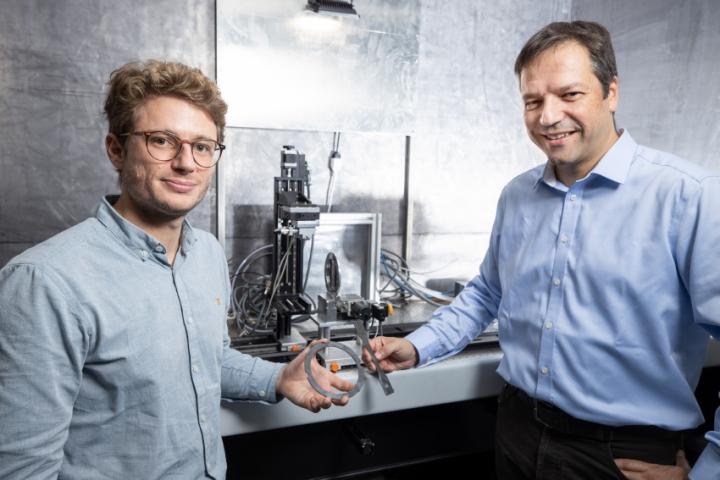
Credit: Paul Scherrer Institute/Mahir Dzambegovic
Researchers at the Paul Scherrer Institute PSI have improved a method for small angle X-ray scattering (SAXS) to such an extent that it can now be used in the development or quality control of novel fibre-reinforced composites. This means that in the future, such materials can be investigated not only with X-rays from especially powerful sources such as the Swiss Light Source SLS, but also with those from conventional X-ray tubes. The researchers have published their results in the journal Nature Communications.
Novel fibre-reinforced composites are becoming increasingly important as stable and lightweight materials. One example of this type of composite is carbon fibre reinforced polymers (CFRP), which are used in aircraft construction or in the construction of Formula 1 racing cars and sports bicycles. The properties of these materials depend to a large extent on how the tiny fibres are aligned and how they are arranged and embedded in the surrounding material, influencing the mechanical, optical, or electromagnetic behaviour of the composites.
To investigate the fibre’s orientation in such composites, researchers must look inside them. One could use small angle X-ray scattering (SAXS), exploiting the fact that X-rays are scattered when they penetrate matter. The resulting scattering pattern can then be used to obtain information about the interior of a sample and potentially the orientation of the fibres. However, the common SAXS methods have the disadvantage of being quite slow: It can take up to several hours to scan centimetre-sized specimens with the required resolution.
Observing the knotting of a carbon fibre ribbon
Researchers at the Paul Scherrer Institute PSI and ETH Zurich, together with colleagues from EPF Lausanne and the Danish spin-off company Xnovo Technology, have now succeeded in further developing the technology for practical applications. “The decisive factor was that we installed an array of X-ray lenses behind the sample. This makes it possible to detect multiple local scattering patterns that reflect the spatial inner structure of a sample with only one X-ray shot, enabling us to take a large number of consecutive images”, says Matias Kagias, the inventor of the method and a postdoctoral researcher in the PSI X-ray tomography group headed by Marco Stampanoni. As a proof of principle, the researchers used the new method to display fibres’ orientation in a carbon fibre ribbon during the knotting process. They acquired time-resolved X-ray projections at a rate of 25 images per second over a period of 11 seconds.
Applications in medicine and security are conceivable
The new method works not only with X-rays from synchrotron facilities such as the Swiss Light Source SLS, but also with beams from conventional X-ray tubes. Therefore, says Prof. Marco Stampanoni, “it is expected that this novel approach will find practical applications in medical devices and non-destructive testing as well as the area of homeland security”.
The researchers have published their results in the journal Nature Communications.
###
About PSI
The Paul Scherrer Institute PSI develops, builds and operates large, complex research facilities and makes them available to the national and international research community. The institute’s own key research priorities are in the fields of matter and materials, energy and environment and human health. PSI is committed to the training of future generations. Therefore about one quarter of our staff are post-docs, post-graduates or apprentices. Altogether PSI employs 2100 people, thus being the largest research institute in Switzerland. The annual budget amounts to approximately CHF 407 million. PSI is part of the ETH Domain, with the other members being the two Swiss Federal Institutes of Technology, ETH Zurich and EPFL Lausanne, as well as Eawag (Swiss Federal Institute of Aquatic Science and Technology), Empa (Swiss Federal Laboratories for Materials Science and Technology) and WSL (Swiss Federal Institute for Forest, Snow and Landscape Research). (Last updated in May 2019)
Contact
Prof. Marco Stampanoni
Head of the X-ray Tomography Group
Paul Scherrer Institute, Forschungsstrasse 111, 5232 Villigen PSI, Switzerland
Telephone: +41 56 310 47 24, e-mail: [email protected] [English]
Dr. Matias Kagias
X-ray Tomography Group
Paul Scherrer Institute, Forschungsstrasse 111, 5232 Villigen PSI, Switzerland
Telephone: +41 56 310 51 20, e-mail: [email protected] [English]
Publication
Diffractive small angle X-ray scattering imaging for anisotropic structures
Matias Kagias, Zhentian Wang, Mie Elholm Birkbak, Erik Lauridsen, Matteo
Abis, Goran Lovric, Konstantins Je_movs, Marco Stampanoni
Nature Communications, 12.11.2019
DOI: 10.1038/s41467-019-12635-2.
Media Contact
Dagmar Baroke
41-563-102-111
Related Journal Article
http://dx.