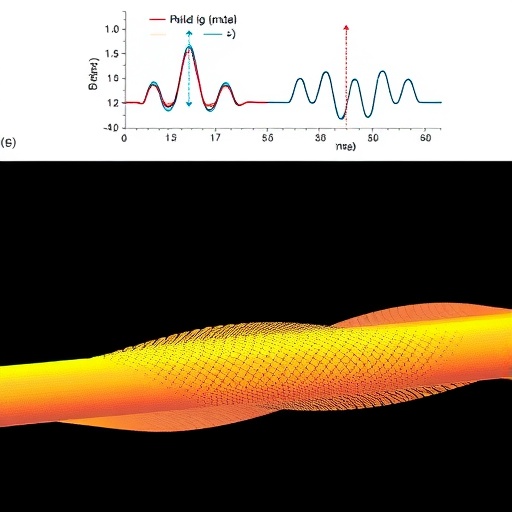
Functionally graded materials have long promised engineers the ability to tailor stiffness, inertia, and thermal resistance within a single structural component, but a new study pushes that promise further than most. Published in the open-access journal Results in Engineering, the research by Nassima Ayoub, Anass Moukhliss, Abdellatif Rahmouni, Ihsan Tikonab, and Rhali Benamar introduces a unified discrete mechanical model capable of predicting the linear and geometrically nonlinear vibrations of multi-stepped two-directional functionally graded beams exposed to combined thermal and moisture environments. The formulation is notable not only for its breadth—simultaneously treating axial and thickness material gradation, abrupt geometric steps, hygrothermal prestress, and cubic nonlinearity—but also for its physical transparency, in which every mathematical coefficient corresponds to a recognizable mechanical element such as a spring or a lumped mass.
The structures at the heart of the study are beams whose elastic modulus, density, thermal expansion, and moisture expansion coefficients vary continuously along both the axial direction and through the thickness. Unlike conventional layered composites, functionally graded materials avoid abrupt internal interfaces, distributing the ceramic and metallic phases smoothly according to power-law volume-fraction functions. The team models the ceramic volume fraction as a separable product of an axial function and a thickness function, controlled by two independent gradation indices, and then blends constituent properties through the classical rule of mixtures. Crucially, the constituent properties themselves are treated as temperature dependent, following the standard nonlinear power-series representation used for ceramic materials such as silicon nitride and stainless steel SUS304, which allows the model to remain valid in severe thermal environments.
On top of this bidirectional material architecture, the beams are stepped: they are divided into several segments of different lengths, thicknesses, and widths, each with constant rectangular cross-section. Step changes of this kind introduce sharp discontinuities in mass per unit length, bending rigidity, and strain energy distribution, which can substantially modify mode shapes, resonance frequencies, and nonlinear modal interactions. The authors treat these discontinuities with physically motivated interface coefficients. At each stepped interface, the rotational spring stiffness is obtained by combining the flexural compliances of the two adjacent half segments in series, while lumped masses at interfaces are averaged from the left and right segment contributions. This allows an arbitrary number of segments to be handled within the same computational framework without deriving a new continuous governing equation for every configuration.
The discrete representation itself is an evolution of an approach first introduced by Rahmouni and colleagues more than a decade ago. The continuous beam is replaced by a chain of rigid bars of equal length, with inertia concentrated in lumped masses at the internal nodes, bending resistance supplied by rotational springs between the bars, and axial stretching captured by longitudinal springs along each bar. The physical division of labor is deliberate: masses represent inertia, rotational springs represent bending stiffness, and longitudinal springs generate the cubic nonlinear restoring forces that arise when large transverse deflections stretch the beam’s axis. When the beam deflects, the distance between consecutive nodes increases, elongating the longitudinal springs and producing axial forces that interact with transverse motion. This mechanism supplies the fourth-order nonlinear stiffness tensor that governs the large-amplitude response.
Environmental effects enter the model through a separate but equally physical channel. Temperature increments and moisture concentrations, assumed to vary through the thickness, induce free expansion strains in the graded cross-section. When axial expansion is restrained, these strains generate thermal and moisture-induced axial resultants, obtained by integrating hygrothermal stresses through each segment’s thickness. These resultants act on each rigid bar as initial axial loads, contributing additional quadratic terms to the potential energy and thus a hygrothermal geometric stiffness matrix. Depending on the sign convention, this contribution can either stiffen or soften the apparent transverse response. The team considers uniform, linear, and nonlinear sinusoidal distributions of temperature and moisture through the thickness, and demonstrates how the resulting axial resultants shift the resonance behavior in ways that depend on both the environmental profile and the stepped geometry.
Once the discrete mass, bending, hygrothermal, and nonlinear stiffness tensors are assembled, the equations are projected onto a modal basis and reduced through Hamilton’s principle combined with first-harmonic balance. The resulting nonlinear algebraic system is solved with a multimode procedure adapted from earlier semi-analytical work by El Kadiri, Benamar, and White, in which the first modal coordinate is treated as the dominant resonant amplitude while higher modes are retained as correction terms obtained from a reduced linear system. A preliminary fourteen-mode truncation study showed that modes two through nine account for roughly 97.8 to 98.7 percent of the total higher-mode correction across the amplitude range investigated, allowing the team to work efficiently with nine modes while still reconstructing accurate nonlinear mode shapes and curvature fields. Importantly, the physical discretization retains 300 internal coordinates for computing the linear eigenmodes and stiffness tensors, so the modal truncation affects only the nonlinear solution stage.
Validation of the formulation is extensive and draws on several independent benchmarks. For a three-section bidirectional FGM cantilever beam previously analyzed by Viet, Zaki, and Wang, the discrete model reproduced Euler-Bernoulli reference frequencies with a maximum relative error below 0.56 percent. A thermal benchmark based on El Hantati and coworkers’ multistepped FGM beam, using temperature-dependent silicon nitride and stainless steel properties, yielded a mean difference of about 0.582 percent against the published results, and a direct comparison with an independently assembled Euler-Bernoulli finite element model remained below 0.866 percent across all examined temperatures and gradation exponents. A five-segment stepped configuration under both uniform and nonlinear through-thickness temperature distributions showed DMM-versus-FEM differences ranging only from roughly 0.24 to 0.89 percent, with a mean of 0.544 percent over forty frequency values.
The nonlinear side of the formulation was tested against Shen and Wang’s shear-deformation analysis of a simply supported zirconia–titanium alloy FGM beam in thermal environments. Across thirty nonlinear comparison points spanning normalized amplitudes up to three, the mean absolute relative difference in the nonlinear frequency ratio was approximately 0.52 percent, with the homogeneous case remaining below about 0.23 percent and the strongly graded case below 0.68 percent for both thermal fields considered. Forced-vibration validation against the classical clamped-clamped beam solutions of El Kadiri and colleagues reproduced the characteristic hardening and the folded, multivalued resonance branches for both concentrated and uniformly distributed harmonic loads, confirming that the longitudinal-spring mechanism faithfully captures geometric nonlinearity under excitation.
The parametric investigation that follows reveals several findings of practical interest. All free and forced nonlinear responses exhibit hardening behavior, with resonance branches bending toward higher frequencies and, in the forced case, developing multivalued regions where jump phenomena can occur. Raising temperature and moisture increases the absolute linear and nonlinear frequencies under the adopted stiffness convention—at a zero moisture increment, the linear dimensionless frequency climbs roughly 33 percent as the temperature increment rises from 40 to 700 kelvin—yet the normalized nonlinear correction actually shrinks, because the linear frequency grows proportionally faster than the additional nonlinear contribution. At a fixed temperature, adding moisture compresses the normalized backbone curves further, meaning that the environmental state alters the relative importance of geometric nonlinearity rather than merely rescaling frequencies. The curvature field proved far more sensitive than normalized displacement shapes: abrupt curvature changes concentrate at the stepped interfaces, and hygrothermal variations redistribute local bending demand even when the global mode shape appears nearly unchanged.
Perhaps the most striking demonstration concerns the role of load distribution. Holding the nominal force amplitude constant, the team compared concentrated, uniformly distributed, linearly distributed, and sinusoidally distributed harmonic loads. The concentrated force produced the strongest multimode activation, with only about 18 percent of the generalized excitation directed into the first mode, while a sinusoidal distribution was highly selective, delivering roughly 75 percent to the fundamental mode. Uniform and linear distributions fell in between at approximately 45 and 28 percent, respectively. Because the spatial distribution of a load controls its projection onto the mode shapes, two excitations with identical amplitudes can generate substantially different response levels, nonlinear frequency shifts, and extents of the multivalued resonance region—a result with direct implications for vibration testing and structural design of graded components.
The authors position the discrete mechanical model not as a replacement for finite-element, spectral, or analytical methods but as a complementary, mechanically transparent framework well suited to repeated parametric studies and the generation of benchmark data. Because every coefficient arises from a physical element, changes in step ratios, gradation indices, environmental fields, boundary conditions, or loading distributions are introduced through direct local updates of masses, springs, hygrothermal resultants, and generalized forces rather than through a new continuous formulation. Limitations remain: the current formulation uses Euler-Bernoulli kinematics, first-harmonic balance, and an undamped steady-state assumption. The team identifies future extensions including shear deformation and rotary inertia, damping, transient and multi-harmonic excitation, stability classification of response branches, imperfect or damaged interfaces, and elastic foundations, directions that would broaden an already unusually versatile modeling architecture.
Subject of Research: Linear and geometrically nonlinear free and forced vibration of multi-stepped two-directional functionally graded beams under combined thermal and moisture effects, modeled with a discrete mechanical multimode formulation
Subject of Research: Technology and Engineering
Article Title: Discrete multimode formulation for nonlinear free and forced vibrations of stepped two directional functionally graded beams under thermal and moisture effects
Article References: Ayoub, N., Moukhliss, A., Rahmouni, A., Tikonab, I., & Benamar, R. (2026). Discrete multimode formulation for nonlinear free and forced vibrations of stepped two directional functionally graded beams under thermal and moisture effects. Results in Engineering, 32, Article 112741. https://doi.org/10.1016/j.rineng.2026.112741
Image Credits: AI Generated
DOI: 10.1016/j.rineng.2026.112741
Keywords: functionally graded materials, two-directional FGM beams, stepped beams, nonlinear vibration, hygrothermal effects, discrete mechanical model, multimode formulation, geometric nonlinearity, temperature-dependent properties, geometric stiffness, forced vibration, resonance hardening
Cite Scienmag News
APA MLA Chicago
Denise Maddox. (September 10, 2026). A Discrete Multimode Model for Nonlinear Vibrations of Functionally Graded Stepped Beams. Scienmag. https://scienmag.com/a-discrete-multimode-model-for-nonlinear-vibrations-of-functionally-graded-stepped-beams/
Denise Maddox. “A Discrete Multimode Model for Nonlinear Vibrations of Functionally Graded Stepped Beams.” Scienmag, 10 September 2026, https://scienmag.com/a-discrete-multimode-model-for-nonlinear-vibrations-of-functionally-graded-stepped-beams/. Accessed 10 September 2026.
Denise Maddox. “A Discrete Multimode Model for Nonlinear Vibrations of Functionally Graded Stepped Beams.” Scienmag. September 10, 2026. https://scienmag.com/a-discrete-multimode-model-for-nonlinear-vibrations-of-functionally-graded-stepped-beams/
Copy citation Download RIS
Tags: analytical modeling of functionally graded beam stiffness andaxial and thickness material property gradationaxial and thickness material property variationdiscrete multimode mechanical modelsdiscrete multimode modeling of stepped beamsFunctionally graded beam vibration modelingfunctionally graded beamsfunctionally graded materials in structural mechanicsgeometric nonlinear analysis of functionally graded beamsgeometrically nonlinear vibration predictionhybrid thermal-moisture effects on beam dynamicsinfluence of thermal and moisture environments on beam vibrationsmechanical element-based mathematical modelingmulti-step functionally graded beam analysisnonlinear dynamic response of functionally graded beamsnonlinear finite element modeling of graded structuresnonlinear vibration analysis of graded beamsnonlinear vibrations of functionally graded materialspower-law distribution of ceramic and metallic phasespower-law volume fraction functions in FGMsstepped beam structural analysisthermally and moisture-induced beam deformationsthermo-hygro-mechanical coupling in graded structuresunified mechanical modeling of graded structures