Aneurysmal subarachnoid hemorrhage-related hydrocephalus (aSAH-H) is a clinical syndrome that leads to excessive accumulation of cerebrospinal fluid (CSF) and ventricle enlargement in the brain. aSAH-H is a complex pathophysiological syndrome and can often lead to cognitive impairment and neurological damage. Acute hydrocephalus (less than 3 days of aSAH) can result in a fatal cerebral hernia, whereas chronic hydrocephalus (more than 3 days of aSAH) can adversely affect a patient’s quality of life.
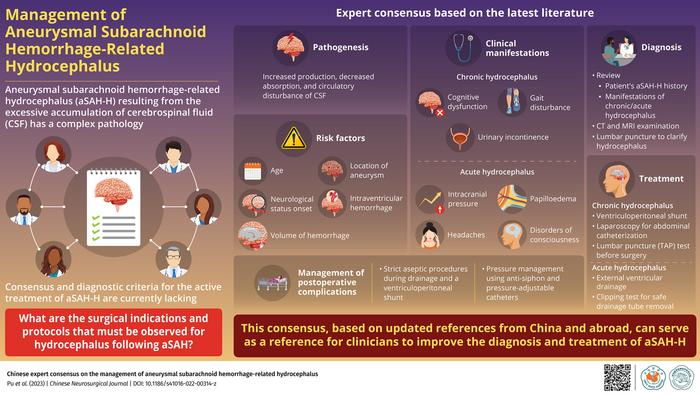
Credit: Hua Lu of Jiangsu Province Hospital and Shuo Wang of Capital Medical University
Aneurysmal subarachnoid hemorrhage-related hydrocephalus (aSAH-H) is a clinical syndrome that leads to excessive accumulation of cerebrospinal fluid (CSF) and ventricle enlargement in the brain. aSAH-H is a complex pathophysiological syndrome and can often lead to cognitive impairment and neurological damage. Acute hydrocephalus (less than 3 days of aSAH) can result in a fatal cerebral hernia, whereas chronic hydrocephalus (more than 3 days of aSAH) can adversely affect a patient’s quality of life.
Despite the complexity associated with this condition, there is a lack of diagnostic criteria and treatment protocol for aSAH-H, not only in China, but also elsewhere. Moreover, the lack of consensus among clinicians on the preferred treatment for aSAH-H calls for an urgent need for clarity and consistent standards.
Prof. Shuo Wang from the Department of Neurosurgery at Beijing Tiantan Hospital, Capital Medical University, recently led an expert group from China to review and compose a consensus on the management of aSAH-H. The study was published in the form of a consensus guideline in volume 9 of the Chinese Neurosurgical Journal on March 20, 2023. Dr. Hua Lu from the Department of Interventional Neuroradiology at Jiangsu Province Hospital along with Prof. Wang are the corresponding authors of this study.
“Hydrocephalus is a common complication following aSAH and currently, the diagnosis and treatment of aSAH-H is clouded by a lack of clarity and inconsistency of standards. We wanted to make definite progress toward removing the ambiguity tied to its treatment,” explains Prof. Wang. The panel of experts reviewed latest literature on aSAH-H from China and other countries to build a consensus.
In terms of occurrence, the experts identified that aSAH-H is determined by the location of the aneurysm, intraventricular hemorrhage, and volume of the subarachnoid hemorrhage. Disturbances in CSF circulation drive the pathogenesis of aSAH-H, enlarge the ventricular system, and damage the brain’s white matter. In terms of factors contributing to the risk of aSAH-H, the experts concluded that age, volume of subarachnoid hemorrhage, the location and size of aneurysms are related to the occurrence.
The consensus states that the standard-of-care approach to diagnosis should include reviewing a patient’s history of aSAH-H, identifying its clinical manifestations, and a head computed tomography (CT) scan to detect abnormal enlargement of the ventricles.
Moreover, the consensus states that the main objective of aSAH-H treatment should be to release excessive intracranial pressure or address pathological changes to brain tissue to prevent further damage and loss of neurological function. This can include medications inhibiting CSF secretion or surgical interventions, such as CSF drainage, CSF shunt surgery, and CSF intracranial diversion.
Furthermore, the consensus guideline recommends external ventricular drainage and ensuring the safe removal of the CSF drainage tube in the case of acute hydrocephalus. A ventriculoperitoneal shunt is recommended for cases of chronic hydrocephalus. The effectiveness of a shunt procedure can be confirmed with a positive lumbar puncture preceding surgery.
Lastly, the consensus suggests measures to minimize postoperative complications. It recommends strict aseptic surgical procedures, anti-siphon and pressure-adjustable shunt catheters, monitoring of clinical manifestations, and use of imaging and laboratory examinations for management.
Evincing hope about this development, Prof. Wang says, “This expert consensus applies to adults, but it’s a good reference point for clinical diagnosis and treatment. Further research will certainly refine the process of aSAH-H diagnosis and treatment.”
***
Reference
DOI
https://doi.org/10.1186/s41016-022-00314-z
Authors:
Jun Pu1, Yuan‐li Zhao2, Yu‐xiang Gu3, Chun‐hua Hang4, Yong‐ping You5, Mao‐de Wang6, Yan Qu7, Hua Lu5, Shuo Wang2, and Chinese Neurosurgical Society
Affiliations
1Department of Neurosurgery, The Second Affiliated Hospital of Kunming Medical University, Kunming, China
2Department of Neurosurgery, Beijing Tiantan Hospital, Capital Medical University, Beijing, China
3Huashan Hospital, Affiliated to Fudan University, Shanghai, China
4Nanjing Drum Tower Hospital, Nanjing University Medical College, Nanjing, China
5Department of Interventional Neuroradiology, Jiangsu Province Hospital, Nanjing, China
6First Affiliated Hospital of Xi’an Jiaotong University, Xi’an, China
7Tangdu Hospital, Air Force Military Medical University, Xi’an, China
About Dr Hua Lu
Dr. Hua Lu is affiliated with the Department of Interventional Neuroradiology at the Jiangsu Province Hospital, China.
About Professor Shuo Wang
Professor Shuo Wang is a Professor and Director of the Cerebrovascular Neurosurgery Department at Beijing Tiantan Hospital, Capital Medical University. He focuses on the surgical treatment of cerebrovascular diseases and intracranial tissues. He has published over 60 peer-reviewed articles since 2003 and is the recipient of the National Science and Technology Progress Award, the Beijing Science and Technology Progress Award, and the Chinese Medical Association Science and Technology Award.
Journal
Chinese Neurosurgical Journal
DOI
10.1186/s41016-022-00314-z
Method of Research
Literature review
Subject of Research
People
Article Title
Chinese expert consensus on the management of aneurysmal subarachnoid hemorrhage-related hydrocephalus
Article Publication Date
20-Mar-2023
COI Statement
The authors declare that they have no competing interests.