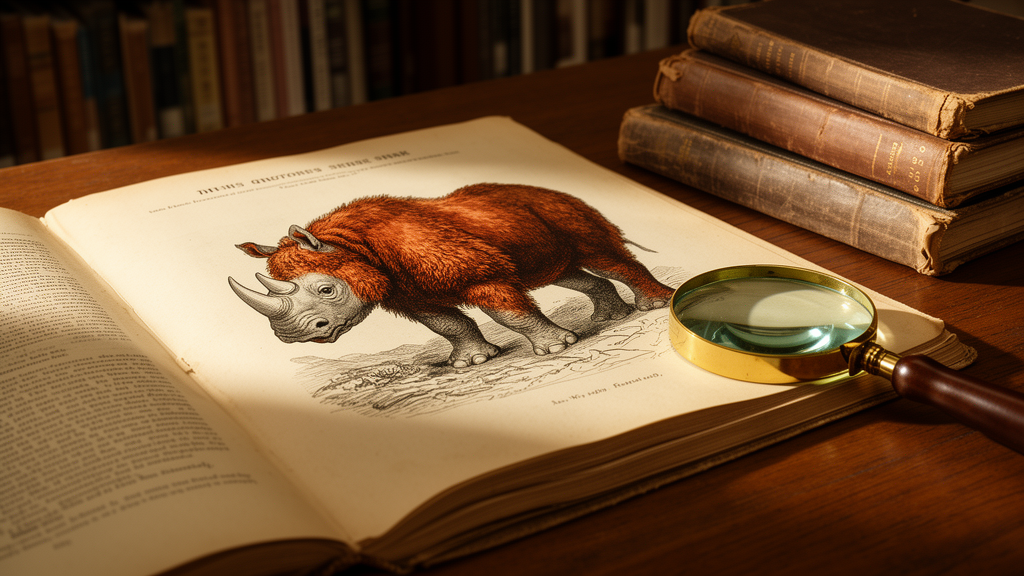
One of the most endangered mammals on Earth, the Sumatran rhinoceros carries a scientific name that has been in continuous use for more than two centuries. New archival research published in the journal Evolutionary Systematics reveals that this familiar name, Dicerorhinus sumatrensis, may not have been the first label ever attached to the species. A forgotten name printed in a German children’s picture magazine in 1808 predates the accepted name by six years, and an even earlier candidate appeared in 1805 in a companion volume aimed at young readers. The discovery reshapes our understanding of how early nineteenth-century naturalists grappled with one of the most distinctive animals in Asia.
The story begins in 1792 on the west coast of Sumatra, where a young British naturalist named William Bell had traveled to serve as a medical doctor at Fort Marlborough. Bell had trained as a zoological assistant and draughtsman under the celebrated surgeon and collector John Hunter in London. Shortly after arriving in early 1792, he had the opportunity to examine a male rhinoceros shot roughly sixteen kilometers from the fort, and later a young female. Bell died of putrid fever on 3 July 1792, but before his death he sent a detailed morphological description of the male animal to London, along with drawings showing a side view of the animal, its skull, and its jaws.
The specimen was remarkable. It bore two horns on the nose, measured 256 centimeters long and 132 centimeters high, and showed six cheek teeth together with two front teeth, or incisors. The shipment reached London in September 1792 and was received by Joseph Banks, President of the Royal Society. Banks read the paper at the Society’s meeting on 3 January 1793, and the description appeared in print soon afterward in the Philosophical Transactions of the Royal Society of London, accompanied by three carefully executed plates engraved by James Basire. Neither Bell nor the editors claimed that the animal was a hitherto unknown species, and no formal scientific name was attached to it.
Yet the description did not go unnoticed. Over the following two decades, at least seventeen authors commented on Bell’s rhinoceros in print, and most of them concluded that it probably represented something distinct. Étienne Geoffroy Saint-Hilaire and Georges Cuvier suggested in 1795 that the presence of incisors pointed to a new species. Jonas Dryander called it a nova species in 1796. Johann Reinhold Forster and later Matthäus Bechstein speculated that it might be a third species of rhinoceros. George Shaw in 1800 went further, declaring that there was little doubt there were three different species and calling Bell’s animal the Sumatran double-horned Rhinoceros. Even Cuvier, in an 1806 paper, concluded that Bell’s rhino seemed to be a third species, though he still refrained from giving it a formal binomial name.
The puzzle is why it took twenty-one years, until 1814, for anyone to actually coin a scientific name. The answer, according to the new research, lies in the state of zoological nomenclature at the time. The Linnaean system of binomial naming had not yet achieved the dominance it holds today. Many workers, particularly in France where the tradition of Buffon remained strong, were content to use vernacular names. It was only when Cuvier embraced the binomial system in his Règne Animal, published in 1816, that the practice became firmly established. Gotthelf Fischer finally proposed the name Rhinoceros sumatrensis in 1814, and Cuvier independently used the same name two years later. For over a century, the name was credited to Cuvier while Fischer’s book lay forgotten.
But the new study has uncovered something remarkable. In 1805, the German writer and publisher Friedrich Justin Bertuch used the name Rhinoceros bicornis Sumatricus in the caption to a reproduction of Bell’s plate in his Bilderbuch für Kinder, a serial magazine aimed at educating and entertaining young people. Published in Weimar, the Bilderbuch ran from 1790 to 1830 and eventually comprised 237 parts with 1,187 copper engravings, covering animals, flowers, fruits, gods, landscapes, and buildings. Bertuch’s text described the Sumatran animal as the third species of rhinoceros, noting its two horns, its rough brownish ash-colored skin, and its hog-like shape, and stating that it had only been met with on the island of Sumatra.
Bertuch’s usage presents a taxonomic complication. The combination Rhinoceros bicornis Sumatricus is a trinomen, a genus name followed by two specific names, a format that would later become standard for indicating subspecies but was rare at the start of the nineteenth century. Under the International Code of Zoological Nomenclature, a name must be published in a work that is consistently binominal to be considered available. Given the enormous bibliographic complexity of Bertuch’s publications, which appeared in multiple formats, languages, and editions across several cities, it is currently impossible to confirm that his work met this criterion. The researcher therefore concludes that Bertuch’s 1805 name should be regarded as unavailable for nomenclatural purposes.
The situation is different for Gottlieb Tobias Wilhelm, a preacher and popular writer based in Augsburg. In the second revised edition of his Unterhaltungen aus der Naturgeschichte, available in 1808, Wilhelm listed three species of rhinoceros: the Asian Rhinoceros unicornis, the African Rhinoceros Africanus, and the Sumatran Rhinoceros Sumatricus. His description of the Sumatran species was properly structured as a binomen, drawing directly on Bell’s observations of the horns, the skin folds, and the coloration. Wilhelm noted that the animal had not yet been sufficiently observed to permit a complete description, but his naming was straightforward and correct by the standards of the Code. Rhinoceros sumatricus Wilhelm, 1808 is therefore an available name and a senior objective synonym of Rhinoceros sumatrensis G. Fischer, 1814.
Fortunately for the stability of rhinoceros taxonomy, the Code provides a mechanism for exactly this kind of situation. Any name proposed between 1758 and 1899 that has not been used since 1899 can be declared a nomen oblitum, or forgotten name. Wilhelm’s Rhinoceros sumatricus has never been used in the literature outside the books by Bertuch and Wilhelm, and it was unknown to Charles Davies Sherborn when he compiled his masterful Index Animalium. It therefore qualifies as a nomen oblitum and should not displace the junior name in current use, Dicerorhinus sumatrensis.
The discovery of forgotten names in obscure old books is sometimes viewed with frustration by working taxonomists, who see them as unnecessary additions to synonym lists. But the researcher argues that such names are part of our collective history and deserve to be documented in studies of how our current understanding of animal classification came to be. The International Code of Zoological Nomenclature provides sufficient tools to handle these discoveries without disrupting established usage or judging the authors who proposed them. The Sumatran rhinoceros keeps its familiar name, but the story of how a children’s magazine in Weimar nearly claimed it first adds a remarkable chapter to the history of natural science.
Subject of Research: The nomenclatural history and naming of the Sumatran rhinoceros
Article Title: The discovery and naming of the Sumatran Rhinoceros ( Dicerorhinus sumatrensis ) after 1793, with details of the Rhinoceros Sumatricus of Bertuch (1805) and Wilhelm (1808)
Article References: Rookmaaker, K. (2024). The discovery and naming of the Sumatran Rhinoceros (Dicerorhinus sumatrensis) after 1793, with details of the Rhinoceros Sumatricus of Bertuch (1805) and Wilhelm (1808). Evolutionary Systematics, 8(2), 155-165. https://doi.org/10.3897/evolsyst.8.127773
Image Credits: AI Generated
DOI: 10.3897/evolsyst.8.127773
Keywords: Sumatran rhinoceros, Dicerorhinus sumatrensis, zoological nomenclature, William Bell, Friedrich Justin Bertuch, Gottlieb Tobias Wilhelm, nomen oblitum, taxonomy, history of science, Evolutionary Systematics, Rhinoceros sumatricus, Bilderbuch für Kinder
News Source: Gavin Prescott. (October 19, 2026). A Children’s Magazine Beat the World to Naming the Sumatran Rhinoceros. Scienmag.