• HOME
  • NEWS
  • EXPLORE
    • CAREER
      • Companies
      • Jobs
    • EVENTS
    • iGEM
      • News
      • Team
    • PHOTOS
    • VIDEO
    • WIKI
  • BLOG
  • COMMUNITY
    • FACEBOOK
    • INSTAGRAM
    • TWITTER
Monday, October 5, 2026
BIOENGINEER.ORG
No Result
View All Result
  • Login
  • HOME
  • NEWS
  • EXPLORE
    • CAREER
      • Companies
      • Jobs
        • Lecturer
        • PhD Studentship
        • Postdoc
        • Research Assistant
    • EVENTS
    • iGEM
      • News
      • Team
    • PHOTOS
    • VIDEO
    • WIKI
  • BLOG
  • COMMUNITY
    • FACEBOOK
    • INSTAGRAM
    • TWITTER
  • HOME
  • NEWS
  • EXPLORE
    • CAREER
      • Companies
      • Jobs
        • Lecturer
        • PhD Studentship
        • Postdoc
        • Research Assistant
    • EVENTS
    • iGEM
      • News
      • Team
    • PHOTOS
    • VIDEO
    • WIKI
  • BLOG
  • COMMUNITY
    • FACEBOOK
    • INSTAGRAM
    • TWITTER
No Result
View All Result
Bioengineer.org
No Result
View All Result
Home NEWS Science News Chemistry

A chemist from RUDN University synthesized analogs of natural toxins

Bioengineer by Bioengineer
November 23, 2020
in Chemistry
Reading Time: 2 mins read
0
IMAGE
Share on FacebookShare on TwitterShare on LinkedinShare on RedditShare on Telegram

IMAGE

Credit: RUDN University

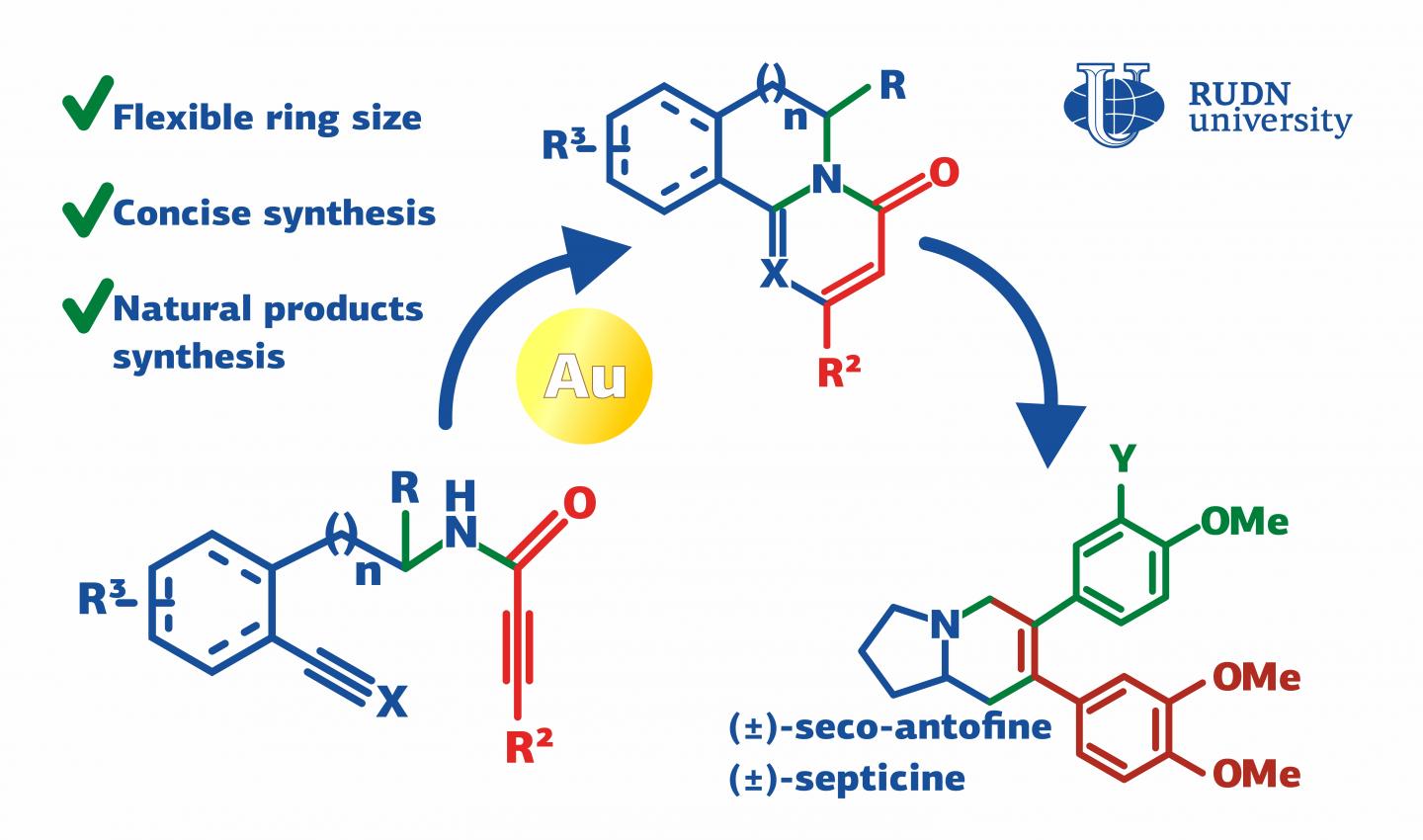
A chemist from RUDN University suggested a simple and accurate method for the synthesis of analogs of two natural toxins, antofine and septicine. This universal approach can also be used to obtain other biologically active substances for medicinal chemistry. The research was published in the Organic Letters journal.

Antofine and septicine have antibacterial and antitumor properties and therefore can be used in the pharmaceutical industry. However, it is difficult to obtain them directly from natural plant sources: they are hydrophobe and can sometimes be unexpectedly toxic. A chemist from RUDN University developed a universal method to produce 2-pyridone derivatives on which antofine and septicine are based.

2-pyridone and 4-pyrimidone are cyclic molecules with one oxygen atom attached to the cycle. The cycle of the former compound contains one nitrogen atom, and of the latter–two. Both substances are used as molecular frameworks for medicinal drugs. By attaching additional cycles and atoms to them, one can obtain compounds with antitumor, antiviral, anti-inflammatory, and antimalarial properties. The new method of 2-pyridone and 4-pyrimidone production consists of just 2 steps.

The first step is the so-called four-component Ugi reaction. Using it, one can obtain peptide fragments (analogs of proteins) from four simple substances. In his experiment, the chemist from RUDN University used different substances at room temperature and the Ugi reaction went on for 12 hours. As a result, around 60 different compounds were obtained, and in all of them, a hydrocarbon ring was attached to other groups of atoms with peptide bonds.

In the next step, several new cycles had to be created in the peptide fragment, and at least one of them had to contain nitrogen atoms. To achieve this, the chemist suggested using gold-based catalysts. Out of five tested catalysts, one produced the best 2-pyridone yield (75%). This result was achieved in the reaction with the first of the synthesized peptide fragments. Further studies showed that the use of other first-stage products can lead up to 93% yield of the products with the required molecular frameworks. The same approach was used for the synthesis of 4-pyrimidone derivatives.

“The main advantage of our method is the ability to develop organic substances based on heterocycles with different functional groups. This advantage appears at the stage of the four-component Ugi reaction, as many simple and affordable reagents can be used in it. The cyclization reaction suggested by us can involve reagents with different functional groups. The simplicity of this approach and a wide range of potential results make it favorable for medicinal chemistry,” said Erik Van der Eycken, the head of the Joint Institute for Chemical Research at RUDN University.

###

Media Contact
Valeriya Antonova
[email protected]

Related Journal Article

http://dx.doi.org/10.1021/acs.orglett.0c03062

Tags: Chemistry/Physics/Materials Sciences
Share12Tweet8Share2ShareShareShare2

Related Posts

One-Pot Tetrazole Chemistry Yields New Antibacterial Candidates Against MRSA

One-Pot Tetrazole Chemistry Yields New Antibacterial Candidates Against MRSA

October 5, 2026
Non-Alcoholic Beer Can Hide as Much Purine as Regular Beer, Study Finds

Non-Alcoholic Beer Can Hide as Much Purine as Regular Beer, Study Finds

October 5, 2026

Sugarcane Waste Gets a Second Life: Silane-Treated Fibers Supercharge Tough Polymer Networks

October 5, 2026

Four-in-One Nanocomposite Turns Sunlight and Air into a Greener Route to Benzaldehyde

October 5, 2026
Please login to join discussion

POPULAR NEWS

  • Alloys That Shrink Their Own Grains: New PIX Mechanism Refines Metals With Heat Alone

    Alloys That Shrink Their Own Grains: New PIX Mechanism Refines Metals With Heat Alone

    29 shares
    Share 12 Tweet 7
  • Endurance Exercise Reshapes the Liver in Males and Females Through Distinct Molecular Routes

    29 shares
    Share 12 Tweet 7
  • Single Transcription Factor PU.1 Rapidly Converts Fibroblasts into Macrophage-Lineage Cells

    29 shares
    Share 12 Tweet 7
  • New Scale Measures How Ready Nurse Educators Really Are for the AI Era

    29 shares
    Share 12 Tweet 7

About

We bring you the latest biotechnology news from best research centers and universities around the world. Check our website.

Follow us

Recent News

Alloys That Shrink Their Own Grains: New PIX Mechanism Refines Metals With Heat Alone

Endurance Exercise Reshapes the Liver in Males and Females Through Distinct Molecular Routes

Single Transcription Factor PU.1 Rapidly Converts Fibroblasts into Macrophage-Lineage Cells

Subscribe to Blog via Email

Success! An email was just sent to confirm your subscription. Please find the email now and click 'Confirm' to start subscribing.

Join 85 other subscribers
  • Contact Us

Bioengineer.org © Copyright 2023 All Rights Reserved.

Welcome Back!

Login to your account below

Forgotten Password?

Retrieve your password

Please enter your username or email address to reset your password.

Log In
No Result
View All Result
  • Homepages
    • Home Page 1
    • Home Page 2
  • News
  • National
  • Business
  • Health
  • Lifestyle
  • Science

Bioengineer.org © Copyright 2023 All Rights Reserved.