• HOME
  • NEWS
  • EXPLORE
    • CAREER
      • Companies
      • Jobs
    • EVENTS
    • iGEM
      • News
      • Team
    • PHOTOS
    • VIDEO
    • WIKI
  • BLOG
  • COMMUNITY
    • FACEBOOK
    • INSTAGRAM
    • TWITTER
Saturday, February 7, 2026
BIOENGINEER.ORG
No Result
View All Result
  • Login
  • HOME
  • NEWS
  • EXPLORE
    • CAREER
      • Companies
      • Jobs
        • Lecturer
        • PhD Studentship
        • Postdoc
        • Research Assistant
    • EVENTS
    • iGEM
      • News
      • Team
    • PHOTOS
    • VIDEO
    • WIKI
  • BLOG
  • COMMUNITY
    • FACEBOOK
    • INSTAGRAM
    • TWITTER
  • HOME
  • NEWS
  • EXPLORE
    • CAREER
      • Companies
      • Jobs
        • Lecturer
        • PhD Studentship
        • Postdoc
        • Research Assistant
    • EVENTS
    • iGEM
      • News
      • Team
    • PHOTOS
    • VIDEO
    • WIKI
  • BLOG
  • COMMUNITY
    • FACEBOOK
    • INSTAGRAM
    • TWITTER
No Result
View All Result
Bioengineer.org
No Result
View All Result
Home NEWS Science News

A big nano boost for solar cells

Bioengineer by Bioengineer
January 18, 2017
in Science News
Reading Time: 2 mins read
0
Share on FacebookShare on TwitterShare on LinkedinShare on RedditShare on Telegram
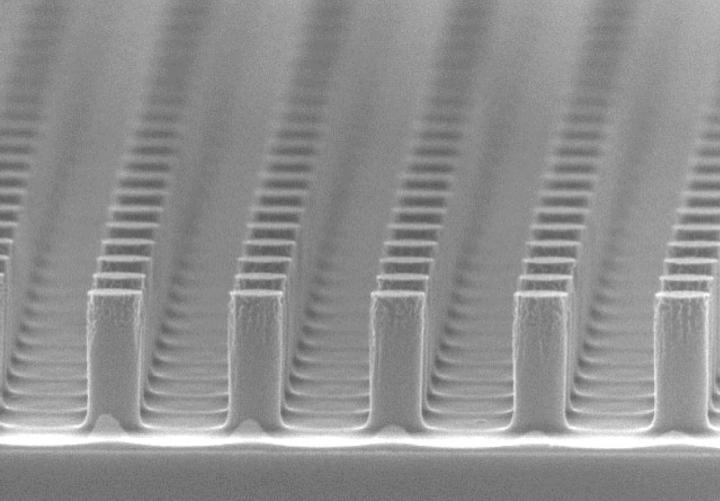
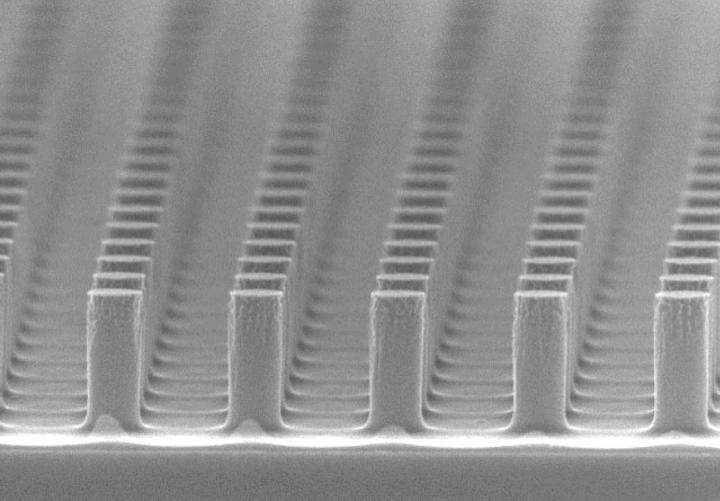
IMAGE

Credit: Kyoto University/Noda Lab

Japan — Solar cells convert light into electricity. While the sun is one source of light, the burning of natural resources like oil and natural gas can also be harnessed.

However, solar cells do not convert all light to power equally, which has inspired a joint industry-academia effort to develop a potentially game-changing solution.

"Current solar cells are not good at converting visible light to electrical power. The best efficiency is only around 20%," explains Kyoto University's Takashi Asano, who uses optical technologies to improve energy production.

Higher temperatures emit light at shorter wavelengths, which is why the flame of a gas burner will shift from red to blue as the heat increases. The higher heat offers more energy, making short wavelengths an important target in the design of solar cells.

"The problem," continues Asano, "is that heat dissipates light of all wavelengths, but a solar cell will only work in a narrow range.

"To solve this, we built a new nano-sized semiconductor that narrows the wavelength bandwidth to concentrate the energy."

Previously, Asano and colleagues of the Susumu Noda lab had taken a different approach. "Our first device worked at high wavelengths, but to narrow output for visible light required a new strategy, which is why we shifted to intrinsic silicon in this current collaboration with Osaka Gas," says Asano.

To emit visible wavelengths, a temperature of 1000C was needed, but conveniently silicon has a melting temperature of over 1400C. The scientists etched silicon plates to have a large number of identical and equidistantly-spaced rods, the height, radii, and spacing of which was optimized for the target bandwidth.

According to Asano, "the cylinders determined the emissivity," describing the wavelengths emitted by the heated device.

Using this material, the team has shown in Science Advances that their nanoscale semiconductor raises the energy conversion rate of solar cells to at least 40%.

"Our technology has two important benefits," adds lab head Noda. "First is energy efficiency: we can convert heat into electricity much more efficiently than before. Secondly is design. We can now create much smaller and more robust transducers, which will be beneficial in a wide range of applications."

###

The paper "Near-infrared-to-visible highly selective thermal emitters based on an intrinsic semiconductor" appeared 23 December 2016 in Science Advances, with doi: 10.1126/sciadv.1600499

Kyoto University is one of Japan and Asia's premier research institutions, founded in 1897 and responsible for producing numerous Nobel laureates and winners of other prestigious international prizes. A broad curriculum across the arts and sciences at both undergraduate and graduate levels is complemented by numerous research centers, as well as facilities and offices around Japan and the world. For more information please see: http://www.kyoto-u.ac.jp/en

Media Contact

David Kornhauser
[email protected]
81-757-535-727
@KyotoU_News

http://www.kyoto-u.ac.jp/en

############

Story Source: Materials provided by Scienmag

Share12Tweet8Share2ShareShareShare2

Related Posts

Succinate Receptor 1 Limits Blood Cell Formation, Leukemia

February 7, 2026

Palmitoylation of Tfr1 Drives Platelet Ferroptosis and Exacerbates Liver Damage in Heat Stroke

February 7, 2026

Oxygen-Enhanced Dual-Section Microneedle Patch Improves Drug Delivery and Boosts Photodynamic and Anti-Inflammatory Treatment for Psoriasis

February 7, 2026

Scientists Identify SARS-CoV-2 PLpro and RIPK1 Inhibitors Showing Potent Synergistic Antiviral Effects in Mouse COVID-19 Model

February 7, 2026
Please login to join discussion

POPULAR NEWS

  • Robotic Ureteral Reconstruction: A Novel Approach

    Robotic Ureteral Reconstruction: A Novel Approach

    82 shares
    Share 33 Tweet 21
  • Digital Privacy: Health Data Control in Incarceration

    63 shares
    Share 25 Tweet 16
  • Study Reveals Lipid Accumulation in ME/CFS Cells

    57 shares
    Share 23 Tweet 14
  • Breakthrough in RNA Research Accelerates Medical Innovations Timeline

    53 shares
    Share 21 Tweet 13

About

We bring you the latest biotechnology news from best research centers and universities around the world. Check our website.

Follow us

Recent News

Succinate Receptor 1 Limits Blood Cell Formation, Leukemia

Palmitoylation of Tfr1 Drives Platelet Ferroptosis and Exacerbates Liver Damage in Heat Stroke

Oxygen-Enhanced Dual-Section Microneedle Patch Improves Drug Delivery and Boosts Photodynamic and Anti-Inflammatory Treatment for Psoriasis

Subscribe to Blog via Email

Enter your email address to subscribe to this blog and receive notifications of new posts by email.

Join 73 other subscribers
  • Contact Us

Bioengineer.org © Copyright 2023 All Rights Reserved.

Welcome Back!

Login to your account below

Forgotten Password?

Retrieve your password

Please enter your username or email address to reset your password.

Log In
No Result
View All Result
  • Homepages
    • Home Page 1
    • Home Page 2
  • News
  • National
  • Business
  • Health
  • Lifestyle
  • Science

Bioengineer.org © Copyright 2023 All Rights Reserved.