Nutrient, sediment runoff impacted differently over time
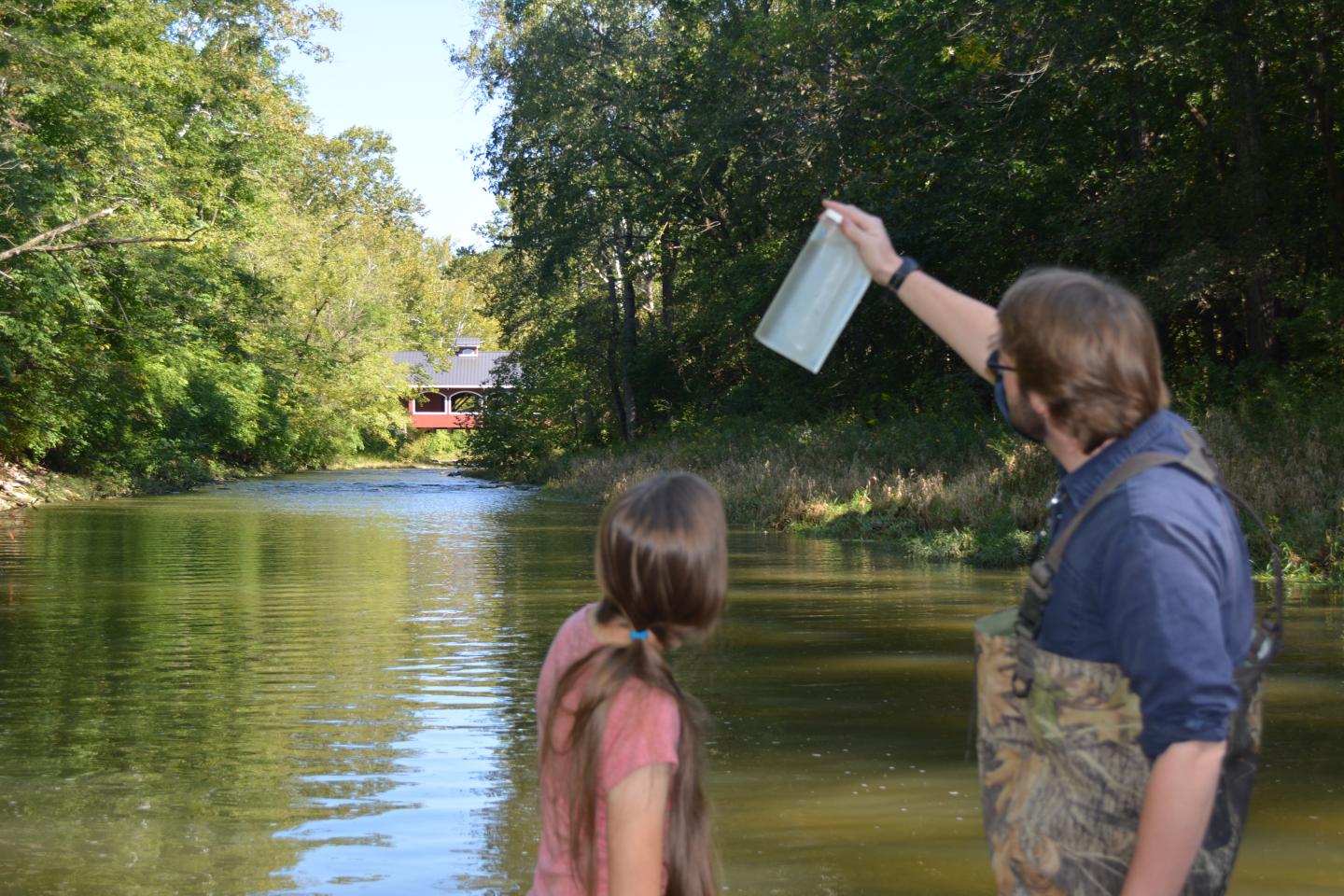
Credit: Carrie Ann Sharitt
In the early 1990s, Acton Lake in southwestern Ohio had a muddy problem. Large amounts of sediment from nearby farms were entering the lake’s watershed. These sediments traveled through streams draining the landscape and were filling up the lake.
So, the USDA gave local farmers incentives to change some of their farming practices. One of these practices was conservation tillage, in which the soil is plowed less often. That can reduce sediment runoff.
A new study examines how the switch to conservation tillage has impacted Acton Lake over the past decades. From 1994 to 2014, the researchers measured concentrations of suspended sediment, nitrogen, and phosphorus in streams draining into Acton Lake.
“We find that short-term trends in water quality may not reflect long-term changes,” says study co-author Michael Vanni.
Tracking changes in water quality over the long term is vital, says Vanni, a biologist at Miami University, Ohio. “We don’t have a lot of long-term information on how water quality in a stream or lake responds to agricultural change,” he says.
That might be surprising since many ecologists study agricultural watersheds. But according to Vanni, studies on a given ecosystem are usually short term. “Long-term studies, like ours, can reveal important shifts in water quality,” says Vanni. “Many of the changes we observed can only be seen after studying the streams for 20 plus years.”
Vanni and his colleagues found that water quality responses were different during the first decade of the study (1994-2003) compared to the next (2004-2014). They also discovered that concentrations of suspended sediment, nitrogen, and phosphorus each reacted differently.
Levels of suspended sediment declined throughout the entire study period. However, the decline was much sharper in the first ten years.
Phosphorus and nitrogen levels had contrasting outcomes. “The concentration of dissolved phosphorus in the streams declined sharply during the first ten years,” says Vanni. “But then, phosphorus levels increased over the next ten years.”
In contrast, nitrogen levels didn’t change much in the first ten years. After that, they fell sharply.
The study focused on the watershed of the Upper Four Mile Creek, which drains into Acton Lake. Most of the surrounding area is made up of corn and soybean farms. The researchers have monitored farming practices in the area since 1989 and water quality since 1994.
The long-term changes seen in this study indicate that there might be tradeoffs in managing different aspects of water quality. “The main reason to encourage conservation tillage was to reduce soil erosion and sedimentation in Acton Lake,” says Vanni. “That has clearly been successful. Sediment inputs to the lake have declined.”
Nitrogen levels are also declining. “That’s great for local freshwater ecosystems,” says Vanni. “It’s also beneficial to the Gulf of Mexico, where some of our runoff eventually travels.”
On the other hand, rising phosphorus levels are a cause for concern. “They could promote algal blooms downstream,” says Vanni. “We might need to consider the tradeoffs involved in managing for sediments, nitrogen, or phosphorus.”
It’s not completely clear how the study findings would apply to other areas. However, the changes in water quality observed in this study are similar to those seen in some of the rivers that drain into Lake Erie.
High phosphorus levels are a problem in those watersheds as well. In fact, “high levels of phosphorus are implicated in causing increased blooms of harmful algae in Lake Erie,” says Vanni.
Vanni and colleagues hope to continue measuring changes in suspended sediments, nitrogen, and phosphorus in the Acton Lake watershed.
“We are also looking at the response of the Acton Lake ecosystem to these changes,” says Vanni. “It will be really interesting to observe these changes over the next ten years, both from a scientific perspective as well as for water quality management.”
###
Read more about this research in Journal of Environmental Quality. This research was funded with several grants from the National Science Foundation, including the Long-term Research in Environmental Biology (LTREB) program.
Media Contact
Susan Fisk
[email protected]
608-273-8091
Related Journal Article
http://dx.