• HOME
  • NEWS
  • EXPLORE
    • CAREER
      • Companies
      • Jobs
    • EVENTS
    • iGEM
      • News
      • Team
    • PHOTOS
    • VIDEO
    • WIKI
  • BLOG
  • COMMUNITY
    • FACEBOOK
    • INSTAGRAM
    • TWITTER
Wednesday, July 8, 2026
BIOENGINEER.ORG
No Result
View All Result
  • Login
  • HOME
  • NEWS
  • EXPLORE
    • CAREER
      • Companies
      • Jobs
        • Lecturer
        • PhD Studentship
        • Postdoc
        • Research Assistant
    • EVENTS
    • iGEM
      • News
      • Team
    • PHOTOS
    • VIDEO
    • WIKI
  • BLOG
  • COMMUNITY
    • FACEBOOK
    • INSTAGRAM
    • TWITTER
  • HOME
  • NEWS
  • EXPLORE
    • CAREER
      • Companies
      • Jobs
        • Lecturer
        • PhD Studentship
        • Postdoc
        • Research Assistant
    • EVENTS
    • iGEM
      • News
      • Team
    • PHOTOS
    • VIDEO
    • WIKI
  • BLOG
  • COMMUNITY
    • FACEBOOK
    • INSTAGRAM
    • TWITTER
No Result
View All Result
Bioengineer.org
No Result
View All Result
Home NEWS Science News Biology

Marine debris study counts trash from Texas to Florida

Bioengineer by Bioengineer
December 28, 2018
in Biology
Reading Time: 2 mins read
0
IMAGE
Share on FacebookShare on TwitterShare on LinkedinShare on RedditShare on Telegram

IMAGE

Credit: Caitlin Wessel

Trash, particularly plastic, in the ocean and along the shoreline is an economic, environmental, human health, and aesthetic problem causing serious challenges to coastal communities around the world, including the Gulf of Mexico.

Researchers from the Dauphin Island Sea Lab and the Mission-Aransas National Estuarine Research Reserve teamed up for a two-year study to document the problem along the Gulf of Mexico shorelines. Their findings are documented in the publication, Accumulation and distribution of marine debris on barrier islands across the northern Gulf of Mexico, in ScienceDirect’s Marine Pollution Bulletin.

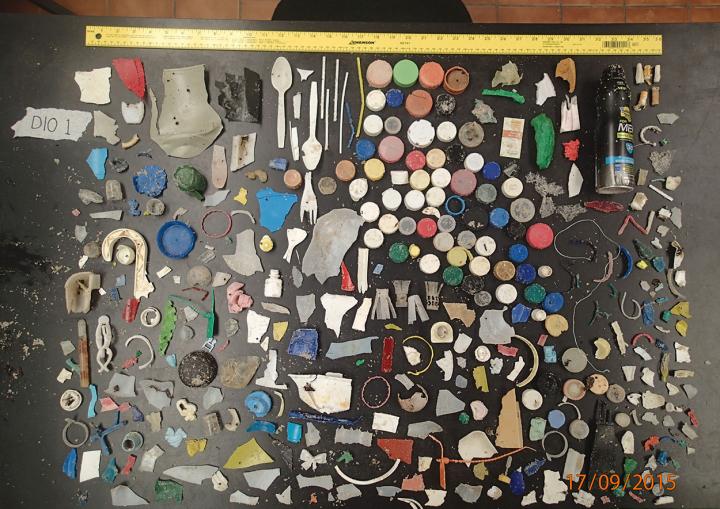
From February 2015 to August of 2017, the researchers kept tabs on marine debris that washed up on the shoreline every month at 12 different sites on nine barrier islands from North Padre Island, Texas to Santa Rosa, Florida. The trash was sorted by type, frequency, and location.

The most shocking discovery was that ten times more trash washes up on the coast of Texas than any of the other Gulf states throughout the year.

Most of the trash, 69 to 95 percent, was plastic. The plastic items included bottles and bottle caps, straws, and broken pieces of plastic. Researchers also cited that more trash washed ashore during the spring and summer. This could be because more people are outside and on the water during this time.

###

For more information or to get a pdf copy of the manuscript, please contact Caitlin Wessel at [email protected].

Reference:
Wessel, C., K. Swanson, T. Weatherall, and J. Cebrian. 2019. Accumulation and distribution of marine debris on barrier islands across the northern Gulf of Mexico. Marine Pollution Bulletin 139 (14-22) https://doi.org/10.1016/j.marpolbul.2018.12.023

Media Contact
Angela Levins
[email protected]
251-591-1865

Original Source

https://www.disl.org/about/news/marine-debris-study-counts-trash-from-texas-to-florida

Related Journal Article

http://dx.doi.org/10.1016/j.marpolbul.2018.12.023

Tags: Earth SciencePollution/Remediation
Share12Tweet8Share2ShareShareShare2

Related Posts

Here are a few rewritten headlines for a science magazine post, each with a slightly different tone: Intriguing & poetic: How do organs sculpt themselves? Sea stars hold the secret Direct & research-focused: Sea stars reveal the hidden rules of organ formation Metaphorical & inviting: Tiny architects beneath the waves: What sea stars teach us about building organs Short & punchy: Star-shaped clues to how our organs take shape Question-led: Could a sea star show us how organs form? Elegant & feature-style: The body’s blueprint, glimpsed in a sea star’s arm

July 6, 2026
Bacteria evolve faster with unconventional gene copies — Biology

Bacteria evolve faster with unconventional gene copies

July 6, 2026

Neighbours rewire soil feedback via root microbiome shifts

July 6, 2026

Evolution-Inspired Biosensors Revolutionize Lipid Tracking in Real Time

July 2, 2026
Please login to join discussion

POPULAR NEWS

  • Detection of EDCs in Breast Milk and Infant Urine Up to Six Months Highlights Early Exposure Risks

    77 shares
    Share 31 Tweet 19
  • New Drug Candidate Developed at McMaster Shows Potential for Treating Brain Cancer

    58 shares
    Share 23 Tweet 15
  • Saying Goodbye to PGY-6: Pediatric Fellowship Realities

    103 shares
    Share 41 Tweet 26
  • KTU Researchers Explore Ultrasound’s Role in Enhancing Blood Flow Beyond Diagnostics

    53 shares
    Share 21 Tweet 13

About

We bring you the latest biotechnology news from best research centers and universities around the world. Check our website.

Follow us

Recent News

Flame retardant BDE-209 targets molecularly linked to ulcerative colitis

Ultra-high frequency particle impacts mimic rockbursts to shatter hard rock

Kidney transplant outcomes in older adults studied by German researchers

Subscribe to Blog via Email

Success! An email was just sent to confirm your subscription. Please find the email now and click 'Confirm' to start subscribing.

Join 83 other subscribers
  • Contact Us

Bioengineer.org © Copyright 2023 All Rights Reserved.

Welcome Back!

Login to your account below

Forgotten Password?

Retrieve your password

Please enter your username or email address to reset your password.

Log In
No Result
View All Result
  • Homepages
    • Home Page 1
    • Home Page 2
  • News
  • National
  • Business
  • Health
  • Lifestyle
  • Science

Bioengineer.org © Copyright 2023 All Rights Reserved.