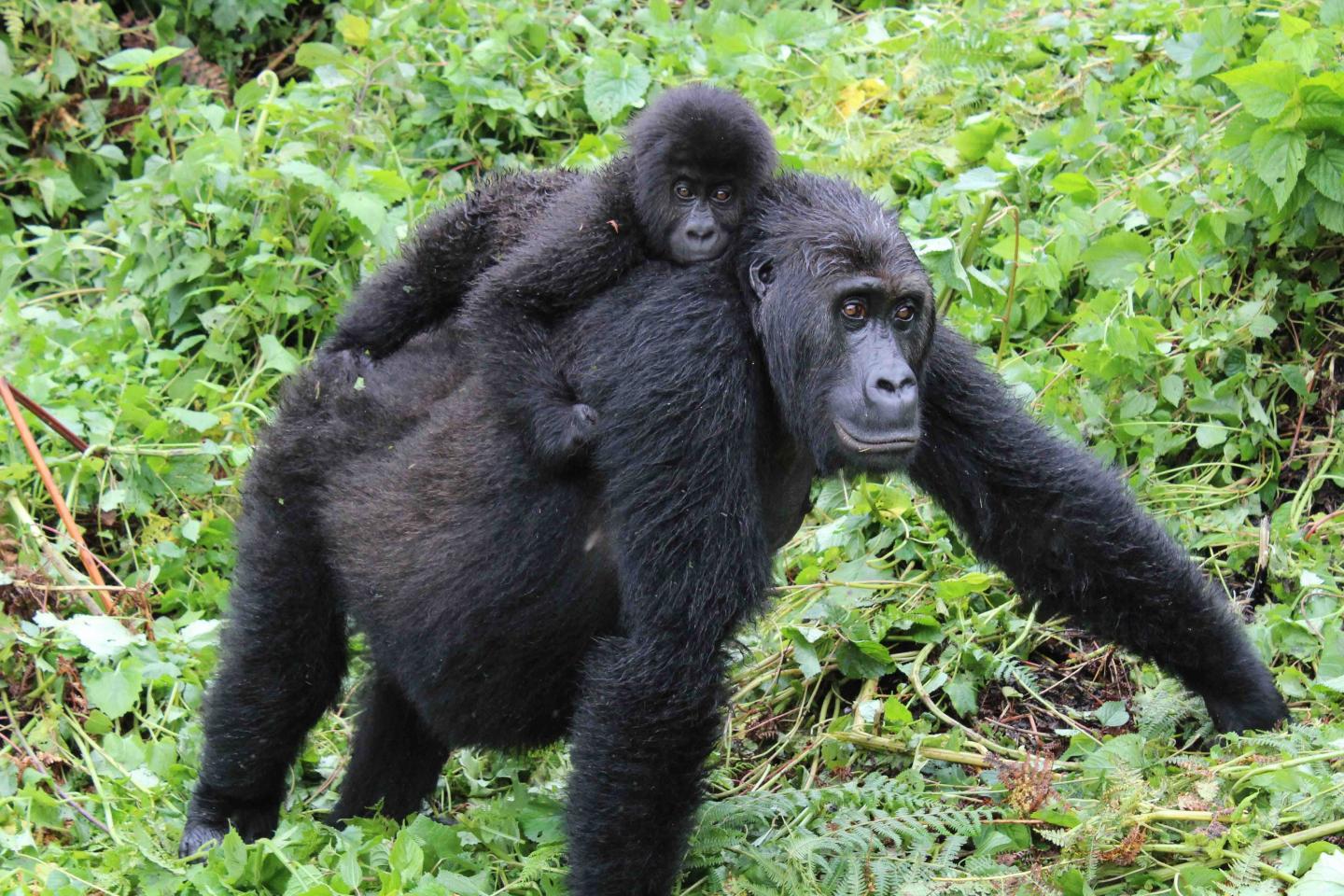
Credit: Amy Porter, Dian Fossey Gorilla Fund International
The critically endangered Grauer’s gorilla has recently lost genetic diversity and has experienced an increase in harmful mutations. These conclusions were reached by an international team of researchers who sequenced eleven genomes from eastern gorilla specimens collected up to 100 years ago, and compared these with genomes from present-day individuals. The results are now published in Current Biology.
Many wild animals have declined in numbers over the past century, and scientists have long worried that these declines have resulted in losses of genetic diversity, increased inbreeding and an accumulation of harmful mutations. Although this could lead to an even higher risk of extinction in threatened species, investigating recent changes in genetic viability has been difficult. In a new study, a team led by scientists from Uppsala University and the Swedish Museum of Natural History has used specimens stored in museum collections to analyse changes in eastern gorilla genomes over the past 100 years.
“We found that the genetic diversity in Grauer’s gorilla has declined significantly in just a few generations,” says Tom van der Valk, a PhD student at Uppsala University in Sweden.
Grauer’s gorillas are found in the Democratic Republic of the Congo and have declined by 80 per cent in recent decades due to poaching and habitat destruction. The results from the comparison of historical and modern genomes show that this decline has led to increased inbreeding and a loss of genetic variation. This in turn means that Grauer’s gorillas have likely become less able to adapt to future disease outbreaks and changes in their environment. In addition, the scientists identified several mutations that are probably harmful and that have increased in frequency over the past 4-5 generations as a consequence of the decline in population size. In the closely related mountain gorilla, however, the scientists did not discover any significant genetic changes, suggesting that its genetic viability has remained stable over the past 100 years.
“This recent increase in harmful mutations really emphasises the need to reverse the ongoing population decline in Grauer’s gorillas,” says Love Dalén at the Swedish Museum of Natural History.
Some of the potentially harmful mutations that have increased in frequency were found in genes that affect disease resistance and male fertility. In addition, the researchers identified mutations leading to loss of function in genes associated with finger and toe development, which likely explains why present-day gorillas sometimes have fused digits.
“Our study highlights that historical museum specimens constitute a unique resource for monitoring recent changes in the genetic status of endangered species,” says Katerina Guschanski at Uppsala University.
Interestingly, the reason why Grauer’s gorillas have been more severely affected than mountain gorillas may lie in their deeper history. While Grauer’s gorillas went through a major increase in numbers between 5,000 and 10,000 years ago, mountain gorillas have been rare for several thousands of years. This long-term small population size may have enabled natural selection to remove harmful mutations before mountain gorilla numbers started to decline in the 20th century.
###
Media Contact
Dr. Katerina Guschanski
[email protected]
46-738-922-197
Related Journal Article
http://dx.