• HOME
  • NEWS
  • EXPLORE
    • CAREER
      • Companies
      • Jobs
    • EVENTS
    • iGEM
      • News
      • Team
    • PHOTOS
    • VIDEO
    • WIKI
  • BLOG
  • COMMUNITY
    • FACEBOOK
    • INSTAGRAM
    • TWITTER
Wednesday, June 24, 2026
BIOENGINEER.ORG
No Result
View All Result
  • Login
  • HOME
  • NEWS
  • EXPLORE
    • CAREER
      • Companies
      • Jobs
        • Lecturer
        • PhD Studentship
        • Postdoc
        • Research Assistant
    • EVENTS
    • iGEM
      • News
      • Team
    • PHOTOS
    • VIDEO
    • WIKI
  • BLOG
  • COMMUNITY
    • FACEBOOK
    • INSTAGRAM
    • TWITTER
  • HOME
  • NEWS
  • EXPLORE
    • CAREER
      • Companies
      • Jobs
        • Lecturer
        • PhD Studentship
        • Postdoc
        • Research Assistant
    • EVENTS
    • iGEM
      • News
      • Team
    • PHOTOS
    • VIDEO
    • WIKI
  • BLOG
  • COMMUNITY
    • FACEBOOK
    • INSTAGRAM
    • TWITTER
No Result
View All Result
Bioengineer.org
No Result
View All Result
Home NEWS Science News Health

Endothelial regenerative capacity and aging: Influence of diet, exercise and obesity

Bioengineer by Bioengineer
December 27, 2018
in Health
Reading Time: 2 mins read
0
IMAGE
Share on FacebookShare on TwitterShare on LinkedinShare on RedditShare on Telegram

This article by Dr. Mark D. Ross is published in Current Cardiology Reviews, Volume 14, Issue 4, 2018
IMAGE

Credit: Dr. Mark D. Ross, Bentham Science Publishers


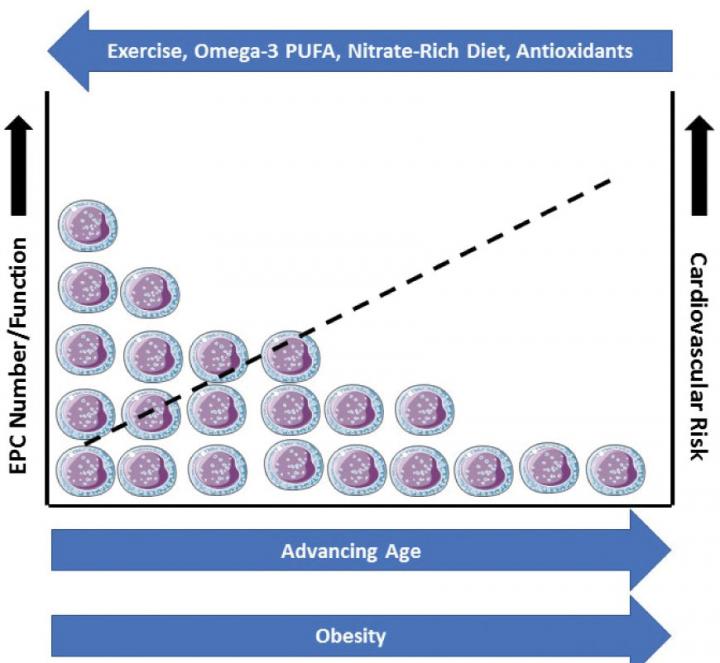
The endothelium plays an important role in cardiovascular regulation, from blood flow to platelet aggregation, immune cell infiltration and demargination. Endothelium dysfunction inevitably leads to the onset and progression of cardiovascular disease (CVD). The aging endothelium displays significant changes in function, such as reduced vasomotor functions and reduced angiogenic capabilities. This may be partially due to increased levels of oxidative stress and reduced endothelial cell turnover.

Endothelial Progenitor Cells (EPCs) are circulating angiogenic cells which play an important role in maintaining endothelial health and function. EPCs maintain endothelial health and function by supporting cell proliferation or by incorporation into vasculature and differentiation into mature endothelial cells. However, EPCs are reduced in number with age, and this reduction may also contribute to elevated CVD risk in aging populations. Lifestyle factors such as exercise, physical activity obesity, and dietary intake of omega-3 polyunsaturated fatty acids, nitrates, and antioxidants, greatly influences the number and function of these circulating angiogenic cells.

This review presents information about the effects of advancing age on endothelial health and vascular regenerative capacity. It also covers the factors that can influence EPC functions which include the influence of diet, exercise, and obesity on these cells, the mechanistic links and the subsequent impact on the cardiovascular health. This is a useful guide for researchers studying the endothelial regenerative capacity and its relation with aging.

###

The article is Open Access till 31st December, 2018. To obtain the article, please visit: http://www.eurekaselect.com/164045

Media Contact
Faizan ul Haq
[email protected]

Related Journal Article

http://dx.doi.org/10.2174/1573403X14666180726112303

Tags: CardiologyCell BiologyCritical Care/Emergency MedicineHematologyImmunology/Allergies/AsthmaMedicine/HealthPharmaceutical SciencesPublic HealthStroke
Share12Tweet8Share2ShareShareShare2

Related Posts

Unfinished Care, Burnout, and Managerial Support in Nursing Homes

June 24, 2026

Yeast Enables Precise Megabase Human DNA Transfer

June 24, 2026

Antler Stem Cells Relieve Cerebral Ischemic Injury

June 24, 2026

Increase in Adolescent Suicidality Following State-Level Total Abortion Bans

June 24, 2026
Please login to join discussion

POPULAR NEWS

  • Saying Goodbye to PGY-6: Pediatric Fellowship Realities

    103 shares
    Share 41 Tweet 26
  • Multi-Hospital Study Reveals Long Covid Burden Is Twice as High as Current Estimates

    92 shares
    Share 36 Tweet 23
  • Detection of EDCs in Breast Milk and Infant Urine Up to Six Months Highlights Early Exposure Risks

    77 shares
    Share 31 Tweet 19
  • New Drug Candidate Developed at McMaster Shows Potential for Treating Brain Cancer

    58 shares
    Share 23 Tweet 15

About

We bring you the latest biotechnology news from best research centers and universities around the world. Check our website.

Follow us

Recent News

Silencing of TRAIL-R2 Associated with Increased Aggressiveness in Breast Cancer

Light-Based Imaging Advances Promise Enhanced Thyroid Cancer Diagnosis and Fewer Surgeries

Water-Activated PVA Film Transforms from Bioplastic to High-Performance Wood Adhesive

Subscribe to Blog via Email

Enter your email address to subscribe to this blog and receive notifications of new posts by email.

Join 82 other subscribers
  • Contact Us

Bioengineer.org © Copyright 2023 All Rights Reserved.

Welcome Back!

Login to your account below

Forgotten Password?

Retrieve your password

Please enter your username or email address to reset your password.

Log In
No Result
View All Result
  • Homepages
    • Home Page 1
    • Home Page 2
  • News
  • National
  • Business
  • Health
  • Lifestyle
  • Science

Bioengineer.org © Copyright 2023 All Rights Reserved.