• HOME
  • NEWS
  • EXPLORE
    • CAREER
      • Companies
      • Jobs
    • EVENTS
    • iGEM
      • News
      • Team
    • PHOTOS
    • VIDEO
    • WIKI
  • BLOG
  • COMMUNITY
    • FACEBOOK
    • INSTAGRAM
    • TWITTER
Wednesday, August 12, 2026
BIOENGINEER.ORG
No Result
View All Result
  • Login
  • HOME
  • NEWS
  • EXPLORE
    • CAREER
      • Companies
      • Jobs
        • Lecturer
        • PhD Studentship
        • Postdoc
        • Research Assistant
    • EVENTS
    • iGEM
      • News
      • Team
    • PHOTOS
    • VIDEO
    • WIKI
  • BLOG
  • COMMUNITY
    • FACEBOOK
    • INSTAGRAM
    • TWITTER
  • HOME
  • NEWS
  • EXPLORE
    • CAREER
      • Companies
      • Jobs
        • Lecturer
        • PhD Studentship
        • Postdoc
        • Research Assistant
    • EVENTS
    • iGEM
      • News
      • Team
    • PHOTOS
    • VIDEO
    • WIKI
  • BLOG
  • COMMUNITY
    • FACEBOOK
    • INSTAGRAM
    • TWITTER
No Result
View All Result
Bioengineer.org
No Result
View All Result
Home NEWS Science News Biology

Central role of transforming growth factor type beta 1 in skeletal muscle dysfunctions

Bioengineer by Bioengineer
December 20, 2018
in Biology
Reading Time: 1 min read
0
IMAGE
Share on FacebookShare on TwitterShare on LinkedinShare on RedditShare on Telegram

This article by Dr. Claudio Cabello-Verrugio et al. is published in Current Protein & Peptide Science, Volume 19, Issue 12, 2018
IMAGE

Credit: Bentham Science Publisher, Claudio Cabello-Verrugio


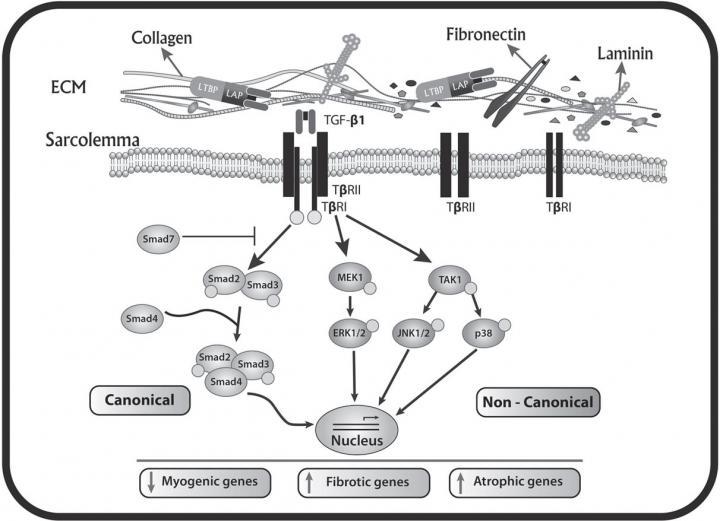
The innate immune system comprises of various soluble factors that provide the first line of defense against pathogens. Transforming Growth Factor type Beta 1 (TGF-β1) is one such soluble factor that also regulates skeletal muscle function, and it one of the most studied factors. TGF-Beta 1 is a potent modulator of immune and glial cell functions. It is known to have a play in to cardiac fibrosis and muscle atrophy. It also regulates the activity and function of satellite cells that inhibits myo-genesis.

In this review, researchers present different types of mechanisms and cellular targets which are involved with the effects of TGF-Beta 1 muscles, such as pothological the processes like fibrosis, atrophy and inhibition of regeneration. Furthermore, the reviewers also present an update on the development of new strategies with therapeutic potential to inhibit the deleterious actions of TGF-β in skeletal muscle.

###

This article is Open Access. To obtain the article please visit http://www.eurekaselect.com/157258

Media Contact
Faizan ul Haq
[email protected]

Related Journal Article

http://dx.doi.org/10.2174/1389203718666171117101916

Tags: BiochemistryHealth Care Systems/ServicesImmunology/Allergies/AsthmaMedicine/HealthNeurochemistryPharmaceutical SciencesPharmaceutical/Combinatorial Chemistry
Share12Tweet8Share2ShareShareShare2

Related Posts

Entropy theory offers new view of critical illness beyond organ dysfunction

Entropy theory offers new view of critical illness beyond organ dysfunction

August 12, 2026
NUS researchers engineer color-sensing yeast in scientific breakthrough

NUS researchers engineer color-sensing yeast in scientific breakthrough

August 12, 2026

Immune Cell Differences Predict Skin Cancer Treatment Outcomes

August 12, 2026

H6PD Identified as Parkinson’s Causal Gene Linking ER-Mitochondria Disruption to Neurodegeneration

August 12, 2026
Please login to join discussion

POPULAR NEWS

  • AI Forecasts the Ocean Amid the Climate Crisis

    29 shares
    Share 12 Tweet 7
  • Social disadvantage sharply raises mortality risk among women experiencing early menopause

    29 shares
    Share 12 Tweet 7
  • Bone loss alone doesn’t explain fractures in older type 2 diabetics

    29 shares
    Share 12 Tweet 7
  • New computational framework uncovers novel pathway linked to asthma

    29 shares
    Share 12 Tweet 7

About

We bring you the latest biotechnology news from best research centers and universities around the world. Check our website.

Follow us

Recent News

AI Forecasts the Ocean Amid the Climate Crisis

Social disadvantage sharply raises mortality risk among women experiencing early menopause

Bone loss alone doesn’t explain fractures in older type 2 diabetics

Subscribe to Blog via Email

Enter your email address to subscribe to this blog and receive notifications of new posts by email.

Join 86 other subscribers
  • Contact Us

Bioengineer.org © Copyright 2023 All Rights Reserved.

Welcome Back!

Login to your account below

Forgotten Password?

Retrieve your password

Please enter your username or email address to reset your password.

Log In
No Result
View All Result
  • Homepages
    • Home Page 1
    • Home Page 2
  • News
  • National
  • Business
  • Health
  • Lifestyle
  • Science

Bioengineer.org © Copyright 2023 All Rights Reserved.