• HOME
  • NEWS
  • EXPLORE
    • CAREER
      • Companies
      • Jobs
    • EVENTS
    • iGEM
      • News
      • Team
    • PHOTOS
    • VIDEO
    • WIKI
  • BLOG
  • COMMUNITY
    • FACEBOOK
    • INSTAGRAM
    • TWITTER
Saturday, February 7, 2026
BIOENGINEER.ORG
No Result
View All Result
  • Login
  • HOME
  • NEWS
  • EXPLORE
    • CAREER
      • Companies
      • Jobs
        • Lecturer
        • PhD Studentship
        • Postdoc
        • Research Assistant
    • EVENTS
    • iGEM
      • News
      • Team
    • PHOTOS
    • VIDEO
    • WIKI
  • BLOG
  • COMMUNITY
    • FACEBOOK
    • INSTAGRAM
    • TWITTER
  • HOME
  • NEWS
  • EXPLORE
    • CAREER
      • Companies
      • Jobs
        • Lecturer
        • PhD Studentship
        • Postdoc
        • Research Assistant
    • EVENTS
    • iGEM
      • News
      • Team
    • PHOTOS
    • VIDEO
    • WIKI
  • BLOG
  • COMMUNITY
    • FACEBOOK
    • INSTAGRAM
    • TWITTER
No Result
View All Result
Bioengineer.org
No Result
View All Result
Home NEWS Science News Biology

New composite advances lignin as a renewable 3D printing material

Bioengineer by Bioengineer
December 19, 2018
in Biology
Reading Time: 3 mins read
0
IMAGE
Share on FacebookShare on TwitterShare on LinkedinShare on RedditShare on Telegram

IMAGE

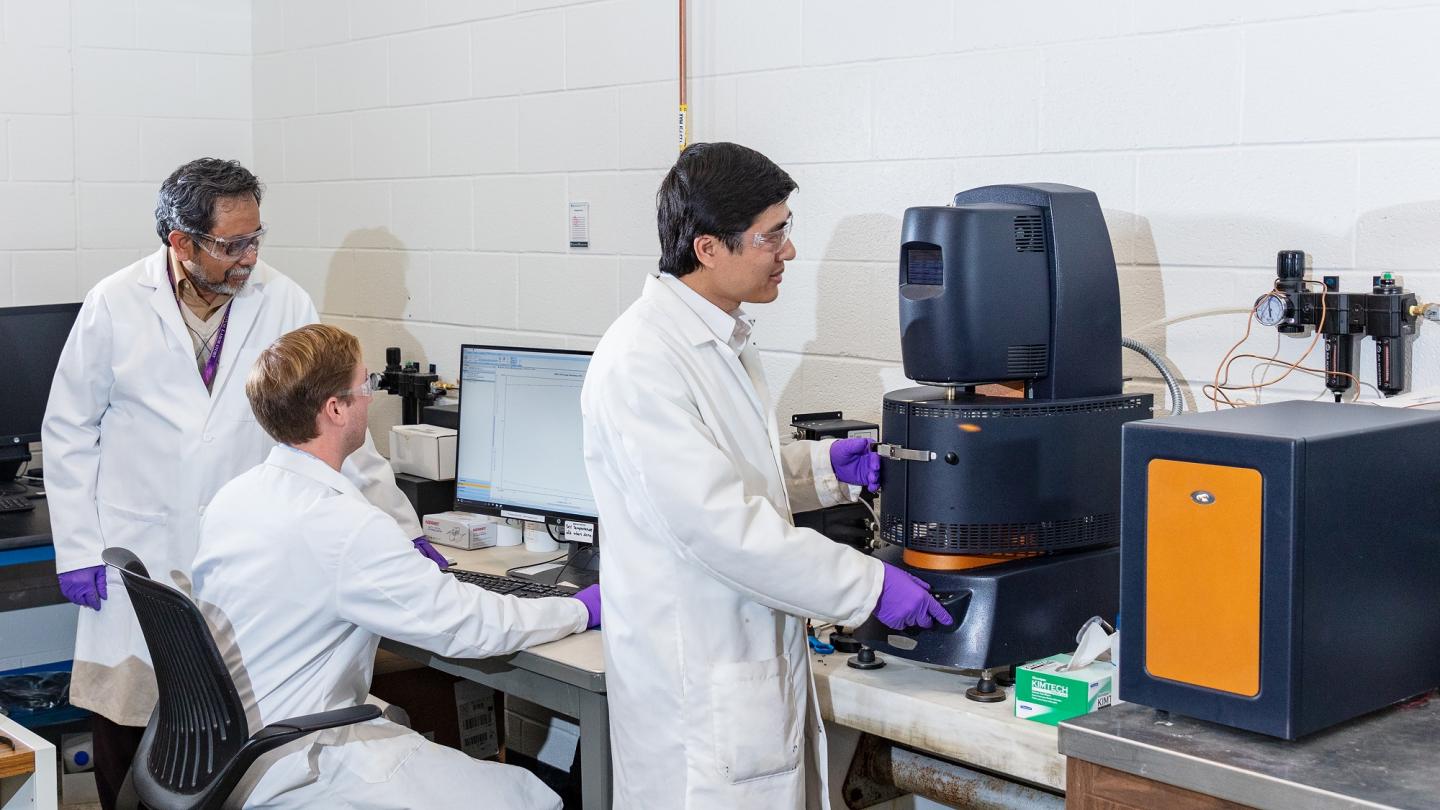
Credit: Oak Ridge National Laboratory.


Scientists at the Department of Energy’s Oak Ridge National Laboratory have created a recipe for a renewable 3D printing feedstock that could spur a profitable new use for an intractable biorefinery byproduct: lignin.

The discovery, detailed in Science Advances, expands ORNL’s achievements in lowering the cost of bioproducts by creating novel uses for lignin–the material left over from the processing of biomass. Lignin gives plants rigidity and also makes biomass resistant to being broken down into useful products.

“Finding new uses for lignin can improve the economics of the entire biorefining process,” said ORNL project lead Amit Naskar.

Researchers combined a melt-stable hardwood lignin with conventional plastic, a low-melting nylon, and carbon fiber to create a composite with just the right characteristics for extrusion and weld strength between layers during the printing process, as well as excellent mechanical properties.

The work is tricky. Lignin chars easily; unlike workhorse composites like acrylonitrile-butadiene-styrene (ABS) that are made of petroleum-based thermoplastics, lignin can only be heated to a certain temperature for softening and extrusion from a 3D-printing nozzle. Prolonged exposure to heat dramatically increases its viscosity–it becomes too thick to be extruded easily.

But when researchers combined lignin with nylon, they found a surprising result: the composite’s room temperature stiffness increased while its melt viscosity decreased. The lignin-nylon material had tensile strength similar to nylon alone and lower viscosity, in fact, than conventional ABS or high impact polystyrene.

The scientists conducted neutron scattering at the High Flux Isotope Reactor and used advanced microscopy at the Center for Nanophase Materials Science–both DOE Office of Science User Facilities at ORNL–to explore the composite’s molecular structure. They found that the combination of lignin and nylon “appeared to have almost a lubrication or plasticizing effect on the composite,” noted Naskar.

“Structural characteristics of lignin are critical to enhance 3D printability of the materials,” said ORNL’s Ngoc Nguyen who collaborated on the project.

Scientists were also able to mix in a higher percentage of lignin–40 to 50 percent by weight–a new achievement in the quest for a lignin-based printing material. ORNL scientists then added 4 to 16 percent carbon fiber into the mix. The new composite heats up more easily, flows faster for speedier printing, and results in a stronger product.

“ORNL’s world-class capabilities in materials characterization and synthesis are essential to the challenge of transforming byproducts like lignin into coproducts, generating potential new revenue streams for industry and creating novel renewable composites for advanced manufacturing,” said Moe Khaleel, associate laboratory director for Energy and Environmental Sciences.

###

The lignin-nylon composite is patent-pending and work is ongoing to refine the material and find other ways to process it. The ORNL research team also included Sietske Barnes, Christopher Bowland, Kelly Meek, Kenneth Littrell and Jong Keum. The research was funded by DOE’s Office of Energy Efficiency and Renewable Energy’s Bioenergy Technologies Office.

ORNL is managed by UT-Battelle for the Department of Energy’s Office of Science, the single largest supporter of basic research in the physical sciences in the United States. DOE’s Office of Science is working to address some of the most pressing challenges of our time. For more information, please visit https://science.energy.gov.

Media Contact
Kim Askey
[email protected]
865-576-2841

Original Source

http://www.ornl.gov/news/new-composite-advances-lignin-renewable-3d-printing-material

Related Journal Article

http://dx.doi.org/10.1126/sciadv.aat4967

Tags: AgricultureBiomedical/Environmental/Chemical EngineeringChemistry/Physics/Materials SciencesMaterialsPlant SciencesPolymer ChemistryResearch/DevelopmentTechnology/Engineering/Computer Science
Share12Tweet8Share2ShareShareShare2

Related Posts

New Study Uncovers Mechanism Behind Burn Pit Particulate Matter–Induced Lung Inflammation

New Study Uncovers Mechanism Behind Burn Pit Particulate Matter–Induced Lung Inflammation

February 6, 2026

DeepBlastoid: Advancing Automated and Efficient Evaluation of Human Blastoids with Deep Learning

February 6, 2026

Navigating the Gut: The Role of Formic Acid in the Microbiome

February 6, 2026

AI-Enhanced Optical Coherence Photoacoustic Microscopy Revolutionizes 3D Cancer Model Imaging

February 6, 2026
Please login to join discussion

POPULAR NEWS

  • Robotic Ureteral Reconstruction: A Novel Approach

    Robotic Ureteral Reconstruction: A Novel Approach

    82 shares
    Share 33 Tweet 21
  • Digital Privacy: Health Data Control in Incarceration

    63 shares
    Share 25 Tweet 16
  • Study Reveals Lipid Accumulation in ME/CFS Cells

    57 shares
    Share 23 Tweet 14
  • Breakthrough in RNA Research Accelerates Medical Innovations Timeline

    53 shares
    Share 21 Tweet 13

About

We bring you the latest biotechnology news from best research centers and universities around the world. Check our website.

Follow us

Recent News

Palmitoylation of Tfr1 Drives Platelet Ferroptosis and Exacerbates Liver Damage in Heat Stroke

Oxygen-Enhanced Dual-Section Microneedle Patch Improves Drug Delivery and Boosts Photodynamic and Anti-Inflammatory Treatment for Psoriasis

Scientists Identify SARS-CoV-2 PLpro and RIPK1 Inhibitors Showing Potent Synergistic Antiviral Effects in Mouse COVID-19 Model

Subscribe to Blog via Email

Enter your email address to subscribe to this blog and receive notifications of new posts by email.

Join 73 other subscribers
  • Contact Us

Bioengineer.org © Copyright 2023 All Rights Reserved.

Welcome Back!

Login to your account below

Forgotten Password?

Retrieve your password

Please enter your username or email address to reset your password.

Log In
No Result
View All Result
  • Homepages
    • Home Page 1
    • Home Page 2
  • News
  • National
  • Business
  • Health
  • Lifestyle
  • Science

Bioengineer.org © Copyright 2023 All Rights Reserved.