• HOME
  • NEWS
  • EXPLORE
    • CAREER
      • Companies
      • Jobs
    • EVENTS
    • iGEM
      • News
      • Team
    • PHOTOS
    • VIDEO
    • WIKI
  • BLOG
  • COMMUNITY
    • FACEBOOK
    • INSTAGRAM
    • TWITTER
Saturday, February 7, 2026
BIOENGINEER.ORG
No Result
View All Result
  • Login
  • HOME
  • NEWS
  • EXPLORE
    • CAREER
      • Companies
      • Jobs
        • Lecturer
        • PhD Studentship
        • Postdoc
        • Research Assistant
    • EVENTS
    • iGEM
      • News
      • Team
    • PHOTOS
    • VIDEO
    • WIKI
  • BLOG
  • COMMUNITY
    • FACEBOOK
    • INSTAGRAM
    • TWITTER
  • HOME
  • NEWS
  • EXPLORE
    • CAREER
      • Companies
      • Jobs
        • Lecturer
        • PhD Studentship
        • Postdoc
        • Research Assistant
    • EVENTS
    • iGEM
      • News
      • Team
    • PHOTOS
    • VIDEO
    • WIKI
  • BLOG
  • COMMUNITY
    • FACEBOOK
    • INSTAGRAM
    • TWITTER
No Result
View All Result
Bioengineer.org
No Result
View All Result
Home NEWS Science News Biology

Parrot genome analysis reveals mutations favoring longevity and cognition

Bioengineer by Bioengineer
December 6, 2018
in Biology
Reading Time: 3 mins read
0
IMAGE
Share on FacebookShare on TwitterShare on LinkedinShare on RedditShare on Telegram

IMAGE

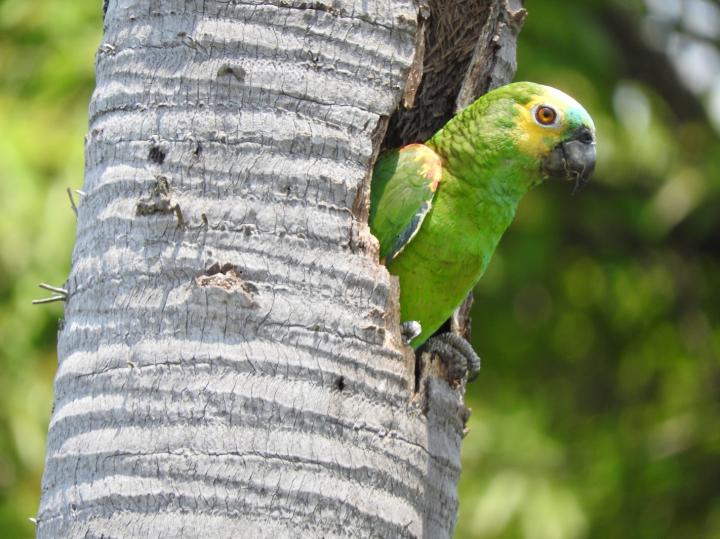
Credit: Glaucia Seixas, https://bluefrontedamazonproject.wordpress.com

A genome analysis of traits in parrots and 26 other bird species revealed that parrots and other long-lived birds share high rates of conserved mutations in genes responsible for supporting an abnormally long lifespan for a small animal. For example, the expected lifespan for a bird of a similar size as a parrot would be in the range of 15-20 years, whereas the blue-fronted Amazon parrot (Amazona aestiva) can live up to 66 years.

“Many of these genes support telomerase activity; DNA damage repair; control of cell proliferation, cancer, and immunity; and anti-oxidative mechanisms and were previously shown to affect lifespan in worms and flies,” says co-senior author Claudio Mello, a behavioral neuroscientist at Oregon Health & Science University. “We also found a few hundred genes that have not been implicated in lifespan before, which are good candidates to study further.”

The work, appearing December 6 in the journal Current Biology, also identified several dozen parrot specific genes that may be important for their defining traits, such as their ability to imitate sounds. “We saw that regulatory elements of genes related to brain development and function had similar modifications in humans and parrots,” says Mello. “That means that some cognitive abilities may have evolved convergently in both humans and parrots.”

Parrots tend to live in large groups, which Mello speculates may have driven the evolution of traits such as the ability to imitate sounds, complex social behaviors, and other cognitive abilities; their calls are thought to reflect these social structures. Complex social structures are thought to have been a driving force in the evolution of human language as well.

“Learning to imitate sounds is the basis of speech in birds and in humans as well,” says Mello. “It’s actually a very complex process, and we don’t fully understand how it happens. We know that species incapable of vocal learning will still make sounds if you deafen or isolate them from birth, because their sounds are innate. But isolate or deafen a young parrot, as has been shown in budgerigars, and it will not learn to vocalize properly.”

###

The analysis, co-led by Francisco Prosdocimi at the Federal University of Rio de Janeiro and Morgan Wirthlin (@morganneuro) at Oregon Health & Science University and now at Carnegie Mellon University, involved a collaborative network with several institutions in Brazil and the United States.

This research was funded through the Avian Genome Consortium grant by the Brazilian National Council for Scientific and Technological Development (CNPq/MCT), The Amazon Foundation for Research Support (FAPESPA), the Foundation for Research Support of the State of Rio de Janeiro (FAPERJ) , the Howard Hughes Medical Institute, and the The National Institute on Deafness and Other Communication Disorders/National Institutes of Health.

Current Biology, Wirthlin et al.: “Parrot Genomes and the Evolution of Heightened Longevity and Cognition” https://www.cell.com/current-biology/fulltext/S0960-9822(18)31417-9

Current Biology (@CurrentBiology), published by Cell Press, is a bimonthly journal that features papers across all areas of biology. Current Biology strives to foster communication across fields of biology, both by publishing important findings of general interest and through highly accessible front matter for non-specialists. Visit: http://www.cell.com/current-biology. To receive Cell Press media alerts, contact [email protected].

Media Contact
Erin Kohnke
[email protected]
617-417-7053

Related Journal Article

http://dx.doi.org/10.1016/j.cub.2018.10.050

Tags: BiologyEvolutionGenesGeneticsZoology/Veterinary Science
Share12Tweet8Share2ShareShareShare2

Related Posts

Florida Cane Toad: Complex Spread and Selective Evolution

Florida Cane Toad: Complex Spread and Selective Evolution

February 7, 2026
New Study Uncovers Mechanism Behind Burn Pit Particulate Matter–Induced Lung Inflammation

New Study Uncovers Mechanism Behind Burn Pit Particulate Matter–Induced Lung Inflammation

February 6, 2026

DeepBlastoid: Advancing Automated and Efficient Evaluation of Human Blastoids with Deep Learning

February 6, 2026

Navigating the Gut: The Role of Formic Acid in the Microbiome

February 6, 2026
Please login to join discussion

POPULAR NEWS

  • Robotic Ureteral Reconstruction: A Novel Approach

    Robotic Ureteral Reconstruction: A Novel Approach

    82 shares
    Share 33 Tweet 21
  • Digital Privacy: Health Data Control in Incarceration

    63 shares
    Share 25 Tweet 16
  • Study Reveals Lipid Accumulation in ME/CFS Cells

    57 shares
    Share 23 Tweet 14
  • Breakthrough in RNA Research Accelerates Medical Innovations Timeline

    53 shares
    Share 21 Tweet 13

About

We bring you the latest biotechnology news from best research centers and universities around the world. Check our website.

Follow us

Recent News

Inflammasome Protein ASC Drives Pancreatic Cancer Metabolism

Phage-Antibiotic Combo Beats Resistant Peritoneal Infection

Boosting Remote Healthcare: Stepped-Wedge Trial Insights

Subscribe to Blog via Email

Enter your email address to subscribe to this blog and receive notifications of new posts by email.

Join 73 other subscribers
  • Contact Us

Bioengineer.org © Copyright 2023 All Rights Reserved.

Welcome Back!

Login to your account below

Forgotten Password?

Retrieve your password

Please enter your username or email address to reset your password.

Log In
No Result
View All Result
  • Homepages
    • Home Page 1
    • Home Page 2
  • News
  • National
  • Business
  • Health
  • Lifestyle
  • Science

Bioengineer.org © Copyright 2023 All Rights Reserved.