• HOME
  • NEWS
  • EXPLORE
    • CAREER
      • Companies
      • Jobs
    • EVENTS
    • iGEM
      • News
      • Team
    • PHOTOS
    • VIDEO
    • WIKI
  • BLOG
  • COMMUNITY
    • FACEBOOK
    • INSTAGRAM
    • TWITTER
Friday, November 27, 2026
BIOENGINEER.ORG
No Result
View All Result
  • Login
  • HOME
  • NEWS
  • EXPLORE
    • CAREER
      • Companies
      • Jobs
        • Lecturer
        • PhD Studentship
        • Postdoc
        • Research Assistant
    • EVENTS
    • iGEM
      • News
      • Team
    • PHOTOS
    • VIDEO
    • WIKI
  • BLOG
  • COMMUNITY
    • FACEBOOK
    • INSTAGRAM
    • TWITTER
No Result
View All Result
Bioengineer.org
No Result
View All Result
Home NEWS Science News Cancer

How brain tumors spread, become resistant to therapy

Bioengineer by Bioengineer
September 29, 2016
in Cancer
Reading Time: 2 mins read
1
Share on FacebookShare on TwitterShare on LinkedinShare on RedditShare on Telegram

Research teams from Karolinska Institutet and Uppsala University have jointly discovered that the usually protective enzyme FBW7 is commonly mutated and inactivated in childhood brain cancers causing tumors to spread and become more difficult to treat. The study, recently published in the scientific journal EMBO Journal, contribute to improving knowledge that is relevant to the development of more effective cancer treatments and future individualized treatment strategies.
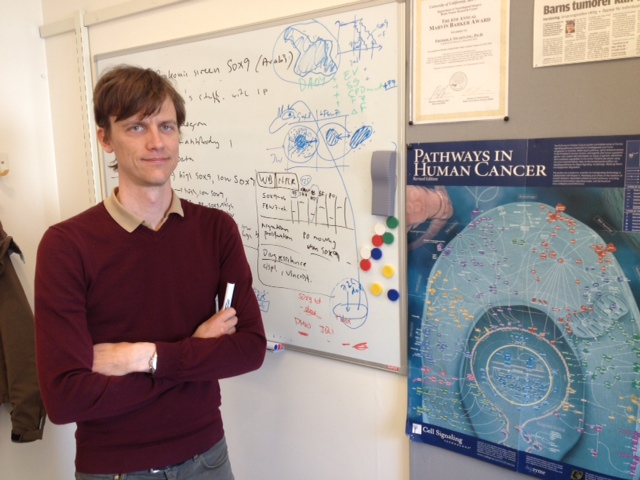
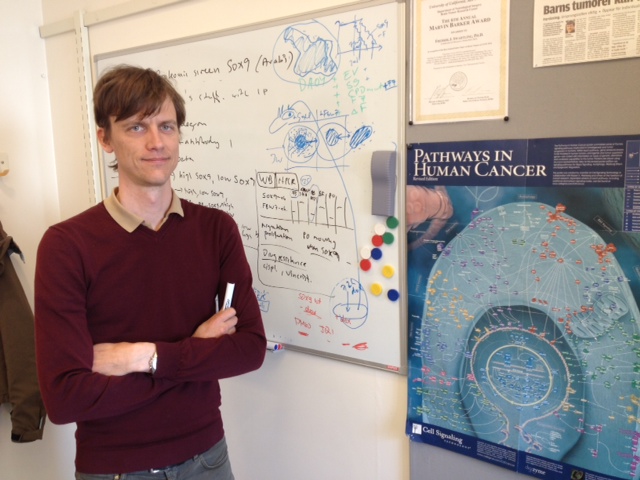
Fredrik Swartling, research group leader at Uppsala University

“We have shown that when FBW7 is functionally inactivated this leads to a block of degradation of the stem cell protein SOX9 which becomes more stable in the brain cancer cells,” said first author Aldwin Suryo Rahmanto at the department of Cell and Molecular Biology. These findings are not unique to childhood brain tumours.

“We believe this is a central mechanism for different types of cancer since an independent research team at the Rutgers Cancer Institute of New Jersey, USA, recently published similar results as ours, but instead in colon, skin and lung tumors,” says Fredrik Swartling, research group leader at Uppsala University and one of the principal investigators of the Swedish study.

The researchers examined the protein levels of SOX9 in malignant childhood brain tumours from more than 140 patients together with scientists in Germany. They found that tumours with increased levels of SOX9 more easily metastasise. In laboratory experiments the researchers mimicked the way SOX9 is stabilised in brain tumour cells and showed that SOX9 turned on 40 to 50 genes in the tumour to make it more resistant to standard treatment with cytotoxic drugs and more prone to spread.

“We also identified a way to de-stabilize the SOX9 protein by treating the brain cancer cells with small molecular drugs, which made them less resistant to chemotherapy again,” says Olle Sangfelt, the other principal investigator of the study and research group leader at Karolinska Institutet.

At the molecular level, tumours from different patients are often quite diverge, even though they belong to the same type of cancer. Certain childhood brain tumours have for instance high levels of SOX9 whereas others have relatively low levels. If it would be possible to identify tumours that have an aberrantly stabilised SOX9 protein, the drugs tested in this study could be used to prevent tumour spread in these patients and improve their response to standard chemotherapy.

Web Source: Karolinska Institutet.

Journal Reference:

Aldwin Suryo Rahmanto, Vasil Savov, Andrä Brunner, Sara Bolin, Holger Weishaupt, Alena Malyukova, Gabriela Rosén, Matko Čančer, Sonja Hutter, Anders Sundström, Daisuke Kawauchi, David TW Jones, Charles Spruck, Michael D Taylor, Yoon‐Jae Cho, Stefan M Pfister, Marcel Kool, Andrey Korshunov, Fredrik J Swartling, Olle Sangfelt. FBW7 suppression leads to SOX9 stabilization and increased malignancy in medulloblastoma. The EMBO Journal, 2016; e201693889 DOI: 10.15252/embj.201693889

The post How brain tumors spread, become resistant to therapy appeared first on Scienmag.
Share12Tweet8Share2ShareShareShare2

Related Posts

Lactylation Mechanism Promotes Gastric Cancer Spread Through Organelle Calcium Signaling

Lactylation Mechanism Promotes Gastric Cancer Spread Through Organelle Calcium Signaling

November 27, 2026
Ultrasound Habitat Modeling Predicts Lymphovascular Invasion in Invasive Breast Cancer

Ultrasound Habitat Modeling Predicts Lymphovascular Invasion in Invasive Breast Cancer

November 27, 2026

Clinical Features Explain Biomarker Testing Differences in Non-Small Cell Lung Cancer

November 27, 2026

Disrupting BRCA1–BARD1 Complex Restores Drug Sensitivity in Resistant Ovarian Cancer Models

November 27, 2026
Please login to join discussion

POPULAR NEWS

  • Global Hepatitis B Fibrosis Research Reaches 3,684 Studies With Shift Toward Precision Medicine

    Global Hepatitis B Fibrosis Research Reaches 3,684 Studies With Shift Toward Precision Medicine

    29 shares
    Share 12 Tweet 7
  • High Drug-Loading Amorphous Nanoparticles Balance Physical Stability and Passive Membrane Permeability

    29 shares
    Share 12 Tweet 7
  • Spectroscopic Model Predicts Wine Tannin Polymerization and Links Fractions to Dynamic Astringency

    29 shares
    Share 12 Tweet 7
  • Attention-Based Model Reduces Highway Trajectory Prediction Error by Six Percent

    29 shares
    Share 12 Tweet 7

About

We bring you the latest biotechnology news from best research centers and universities around the world. Check our website.

Follow us

Recent News

Computational Framework Maps Complex Biological Tissues Using Curved Coordinate Systems

Biobank Gene Network Analysis Identifies MRPL Family Associations in Psoriasis

Early Flue-Curing Triggers Broad Transcriptional Reprogramming but Selective Methylome Changes in Tobacco

Subscribe to Blog via Email

Enter your email address to subscribe to this blog and receive notifications of new posts by email.

Join 89 other subscribers
  • Contact Us

Bioengineer.org © Copyright 2023 All Rights Reserved.

Welcome Back!

Login to your account below

Forgotten Password?

Retrieve your password

Please enter your username or email address to reset your password.

Log In
No Result
View All Result
  • Homepages
    • Home Page 1
    • Home Page 2
  • News
  • National
  • Business
  • Health
  • Lifestyle
  • Science

Bioengineer.org © Copyright 2023 All Rights Reserved.