


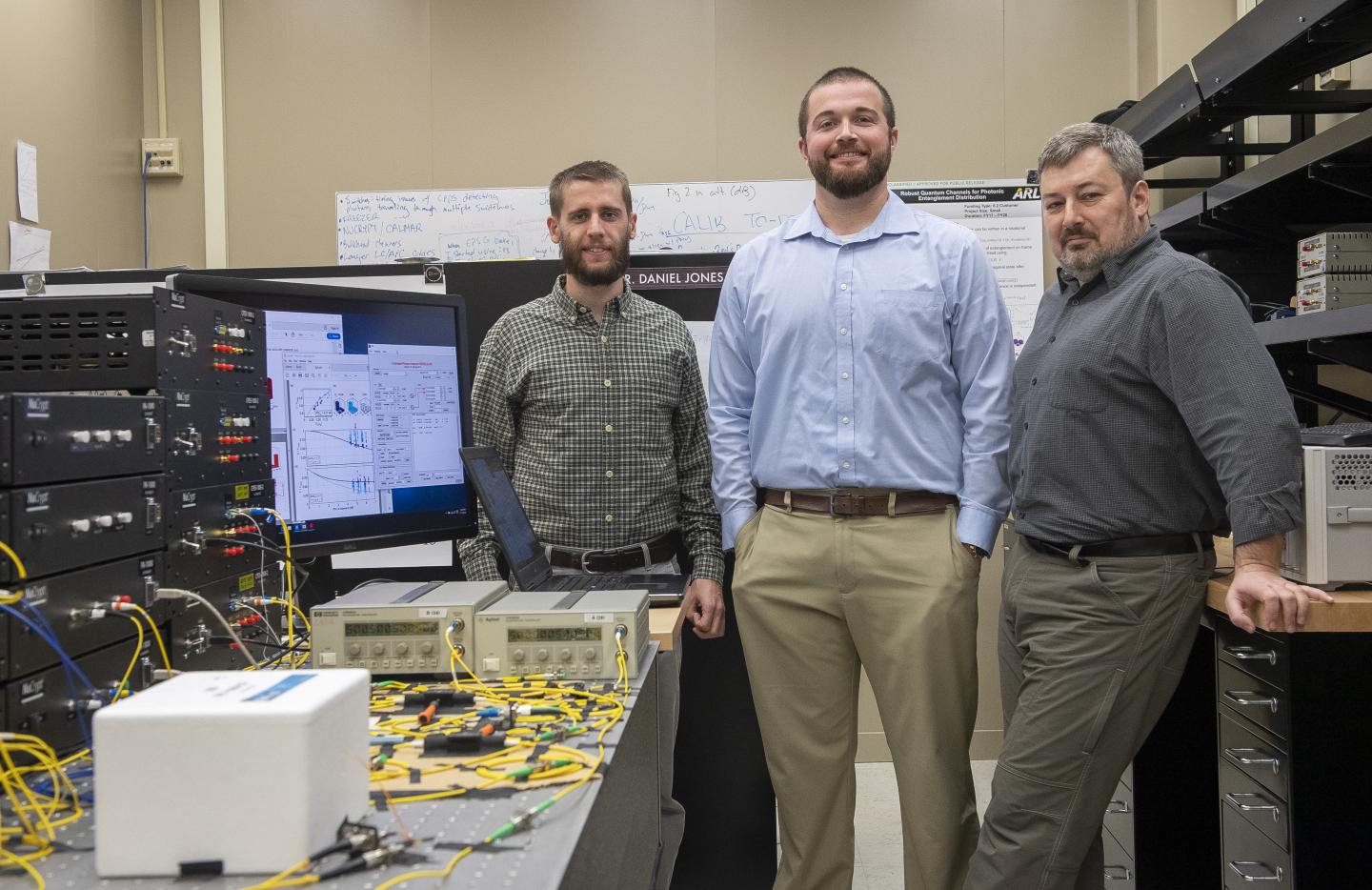
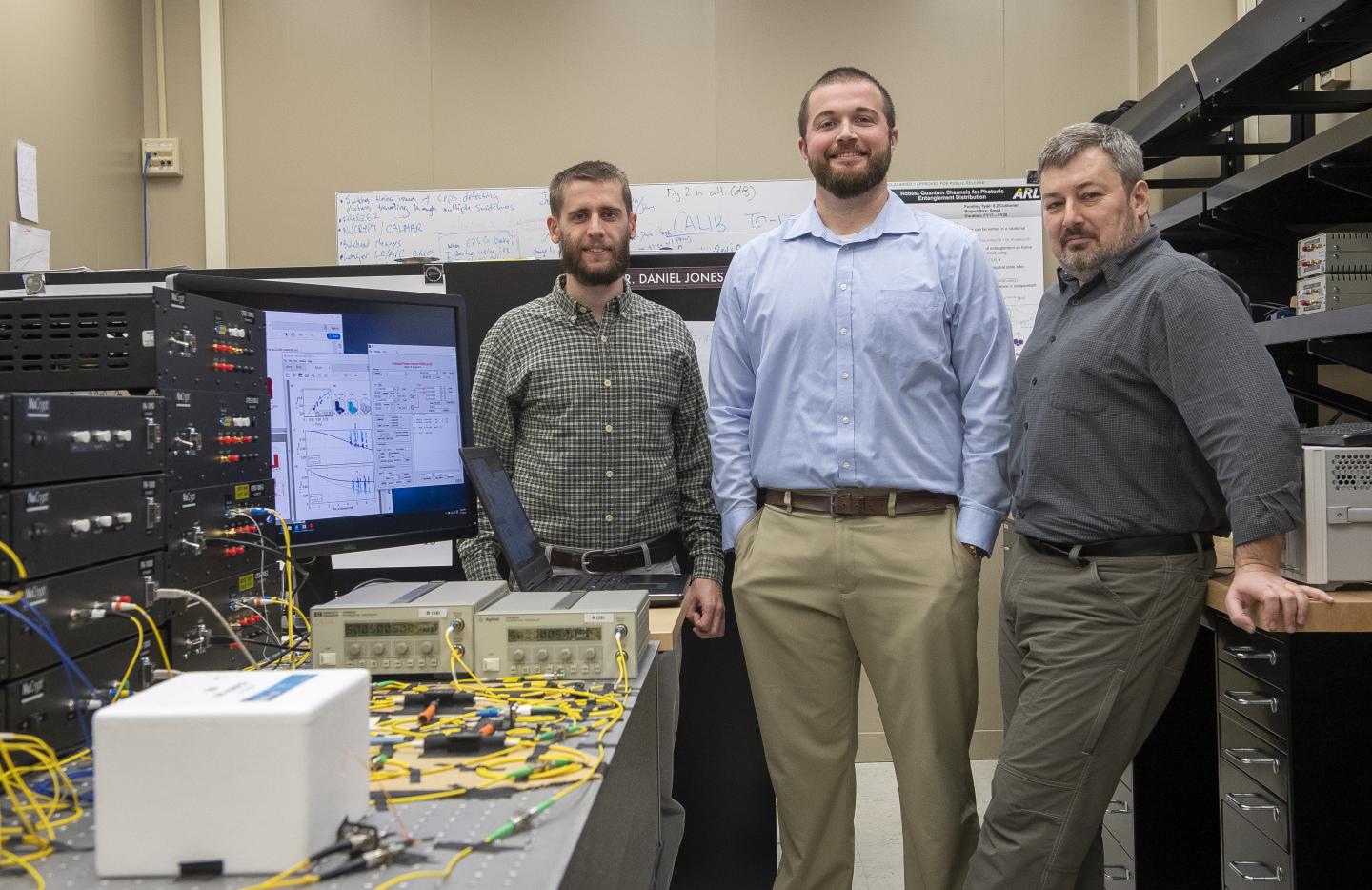
Credit: (US Army Photo by Jhi Scott)
Scientists at the RDECOM Research Laboratory, the Army's corporate research laboratory (ARL) have found a novel way to safeguard quantum information during transmission, opening the door for more secure and reliable communication for warfighters on the battlefield.
Recent advancements of cutting-edge technologies in lasers and nanophysics, quantum optics and photonics have given researchers the necessary tools to control and manipulate miniature quantum systems, such as individual atoms or photons – the smallest particles of light.
These developments have given rise to a new area of science – Quantum Information Science, or QIS, that studies information encoded in quantum systems and encompasses quantum computing, quantum communication and quantum sensing among other subfields.
Quantum Information Science is believed to have the potential to shape the way information is processed in the future.
The Army's corporate research laboratory invests in QIS research to guarantee continuous technological superiority in this rapidly developing field, which in turn will bring about multiple new technologies in computation, encryption, secure communication and precise measurements.
However, to utilize quantum information, scientists need to figure out robust ways to process and transmit it – a task being tackled by Drs. Daniel Jones, Brian Kirby, and Michael Brodsky from the laboratory's Computational and Information Sciences Directorate.
"In our classical world, information is often corrupted during manipulation and transmission – everyone is familiar with noisy cell phone connections in poor reception areas," Brodsky said. "Thus, communication engineers have been working on a variety of techniques to filter out the noise."
In classical communications, the filtering is rather straightforward as it is done locally, that is in the very place the information is received, such as directly in your phone or internet router.
In the quantum world, things become much more intricate.
The lab's research team has been looking into ways of filtering noise from little bits of quantum information – quantum bits or qubits sent across fiber-optic telecom links.
They discovered that the filtering does not necessarily need to be done by the receiving party.
"The nature of the quantum states in which the information is encoded is such that the filtering could be more easily done at a different location in the network," Kirby said.
That's right, to fix a qubit sent over a certain route, one could actually apply a filter to other qubits that traverse a different route.
Over the last year, the researchers have been looking into the problem of transmission of entangled pairs of photons over optical fibers.
"We started with developing an understanding of how physical properties of real telecom fibers, such as inherent residual birefringence and polarization dependent loss, or PDL, affect the quality of quantum communications," Jones said. "We exploited a novel mathematical approach, which has led to the development of a simple and elegant geometrical model of the PDL effects on polarization entanglement," Kirby added.
The developed model predicts both the quality of transmitted quantum states as well as the rate at which quantum information could be transmitted.
Furthermore, the lab's team invented a new technique that helps reduce the deleterious effects of the noise.
The developed models were experimentally validated using the recently built Quantum Networking Testbed at the lab, which simulates the practical telecom fiber infrastructure.
"We believe that this research has a potential to revolutionize cybersecurity and to enable secure secret sharing and authentication for the warfighter of the future," Brodsky said. "In addition, it will have an impact on developing better sensors for position navigation and timing as well as quantum computers that might result in the synthesis of novel special materials with on demand properties."
According to the researchers, in order to make quantum technology a reality, a large-scale field-deployed testbed must be built, thus guiding the development of both quantum hardware and software.
A journal paper documenting the research titled "Tuning quantum channels to maximize polarization entanglement for telecom photon pairs" is featured in the prestigious Nature Partner Journal Quantum Information.
###
Media Contact
Jenna Brady
[email protected]
301-394-1819
@ArmyResearchLab
http://www.arl.army.mil
Original Source
https://www.arl.army.mil/www/default.cfm?article=3342

