Credit: Wellcome Images CC-BY-NC-ND http://www.cellimagelibrary.org/images/38960
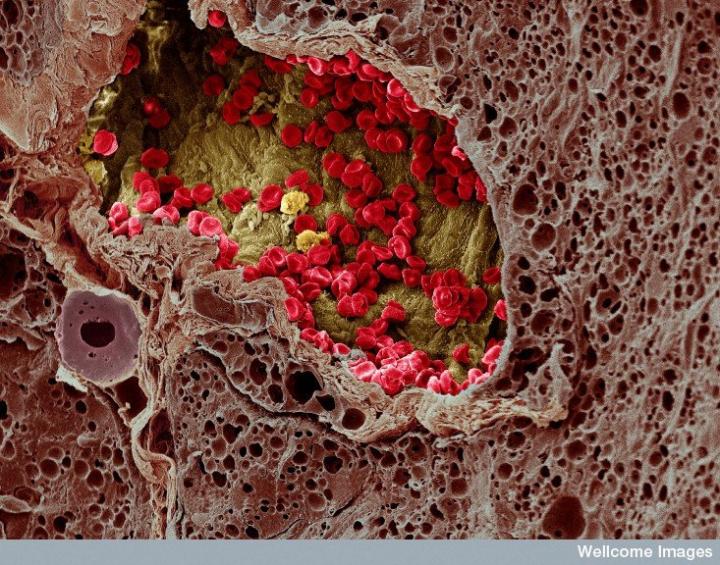
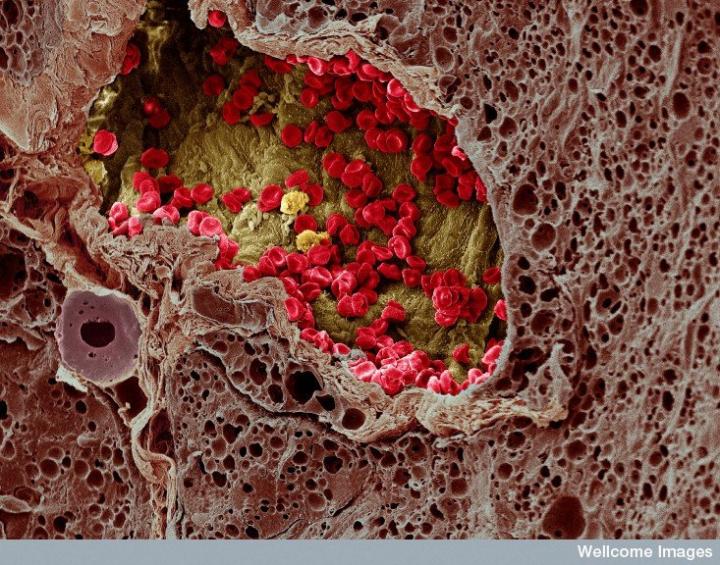
Melanoma skin cancer tumors grow larger and are more likely to metastasize due to interactions between a pair of molecules, according to experiments in mice and human cells. The results may restore the potential for a type of cancer therapy previously abandoned in clinical trials. The results also implicate one molecule already connected to obesity and dementia as a potential cause of metastasis, or spread of cancer cells to other areas of the body.
Melanoma accounts for about 1 percent of skin cancers, but causes a large majority of skin cancer deaths, according to the American Cancer Society. Few treatments exist to prevent melanoma from metastasizing.
A research team led by Associate Professor Beate Heissig at the University of Tokyo Institute of Medical Science has studied tissue type plasminogen activator (tPA) for over a decade. tPA is a protease, a small molecule that can cut proteins. tPA bonds to a larger protein that sits within the membrane barrier of animal cells, called low-density lipoprotein receptor-related protein 1 (LRP1).
Heissig's research team proposes blocking the metastasis-promoting action of tPA by preventing it from connecting to LRP1. Mice without LRP1 had smaller tumors, even when researchers provided extra tPA.
Other studies have linked LRP1 to chronic diseases including diabetes, obesity, and Alzheimer's disease.
"It's surprising that LRP1 is also regulating cancer growth and spread. It's normally a receptor for fat molecules," said Heissig.
Controlling cancer's spread
In 2016, Heissig's research group discovered that mice given extra tPA had greater numbers of a specific type of cell. This same cell type usually increases within the melanoma tumors and can enhance tumor growth. Based on that potential connection, the current project was designed to investigate what role tPA might play in skin cancer.
When cancer cells metastasize, they use proteases to cut through the matrix of protein chains that holds healthy cells in place. When cancer cells arrive in a new part of the body and begin to form new tumors, they corrupt nearby cells to build a niche, or supportive home for themselves.
Clinical researchers have attempted to prevent metastasis by stopping proteases. However, completely blocking all proteases causes unintended side effects. No protease-based cancer therapy has succeeded in clinical trials.
"Our vision is a cancer therapy that specifically prevents the interaction of LRP1 and tPA so that only the metastasis effect of the protease is stopped. Better understanding of the specific interactions of LRP1 and tPA will hopefully lead to protease cancer treatments that maintain the normal, healthy protease actions of tPA," said Yousef Salama, first author of the research paper and postdoctoral researcher in Heissig's lab.
Salama also suggests that tPA may be linked to cancer immunotherapy, the life-saving treatment awarded the 2018 Nobel Prize in Physiology or Medicine.
"The scientific community knows that tPA can interfere with the cell signals being studied for cancer immunotherapy. Blocking tPA could enhance the immune system's action and potentially boost the effectiveness of cancer immunotherapy treatments," said Salama.
###
About the Research
Collaborators at the Juntendo University School of Medicine also contributed to the research.
This research is an experimental study using live mice as well as mouse and human cells published in Federation of American Societies for Experimental Biology Journal.
Background Information
For more information about melanoma skin cancer, please visit the American Cancer Society website: https://www.cancer.org/cancer/melanoma-skin-cancer/about/key-statistics.html
Previous research on tPA and mesenchymal stromal cells was published by Heissig and colleagues in August 2016 in the journal Blood. Please see the citation information below.
Douaa Dhahri, Kaori Sato-Kusubata, Makiko Ohki-Koizumi, Chiemi Nishida, Yoshihiko Tashiro, Shinya Munakata, Hiroshi Shimazu, Yousef Salama, Salita Eiamboonsert, Hiromitsu Nakauchi, Koichi Hattori and Beate Heissig. Fibrinolytic crosstalk with endothelial cells expands murine mesenchymal stromal cells. Blood 25 August 2016 128:1063-1075. DOI: 10.1182/blood-2015-10-673103.
Journal Article
Salama Y, Lin SY, Dhahri D, Hattori K, Heissig B. The fibrinolytic factor tPA drives LRP1-mediated melanoma growth and metastasis. 20 November 2018. FASEB Journal. DOI: 10.1096/fj.201801339RRR
Related Links
Institute of Medical Science: http://www.ims.u-tokyo.ac.jp/imsut/en/
Center for Stem Cell Biology and Regenerative Medicine: http://stemcell-u-tokyo.org/en/
Heissig lab website: http://stemcell-u-tokyo.org/en/scd/
Research Contact
Beate Heissig, M.D., Ph.D.
Center for Stem Cell Biology and Regenerative Medicine, Division of Stem Cell Dynamics, The Institute of Medical Science, The University of Tokyo
4-6-1, Shirokanedai, Minato-ku, Tokyo 108-8639, JAPAN
Phone: +81-3-6409-2108
E-mail: [email protected]
Press Contact
Ms. Caitlin Devor
Division for Strategic Public Relations, The University of Tokyo, 7-3-1 Hongo, Bunkyo-ku, Tokyo 113-8654, JAPAN
Tel: +81-3-5841-0876
Email: [email protected]
About the University of Tokyo
The University of Tokyo is Japan's leading university and one of the world's top research universities. The vast research output of some 6,000 researchers is published in the world's top journals across the arts and sciences. Our vibrant student body of around 15,000 undergraduate and 15,000 graduate students includes over 2,000 international students. Find out more at http://www.u-tokyo.ac.jp/en/ or follow us on Twitter at @UTokyo_News_en.
Media Contact
Beate Heissig, M.D., Ph.D.
[email protected]
81-036-409-2108
@UTokyo_News_en
http://www.u-tokyo.ac.jp
Related Journal Article
http://dx.doi.org/10.1096/fj.201801339RRR